Aegean Boat Report launches urgent fundraising campaign to keep its life-saving human rights work alive
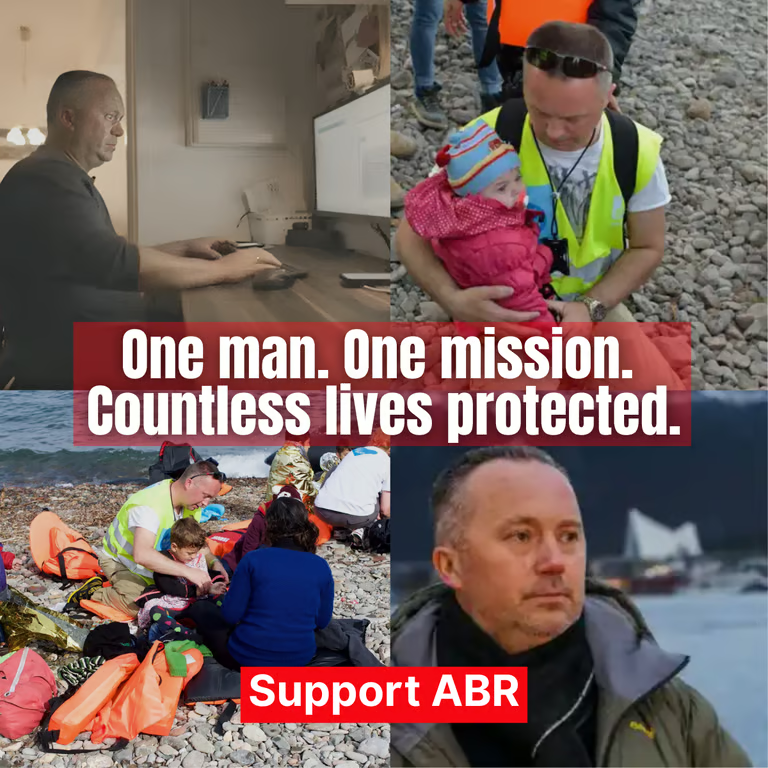
Tromsø, Norway — 17.11.2025 — After eight years of documenting human-rights violations and saving lives at sea, Aegean Boat Report (ABR), Europe’s only independent watchdog monitoring refugee movements across the Aegean Sea, has launched an emergency fundraising campaign to secure its future.
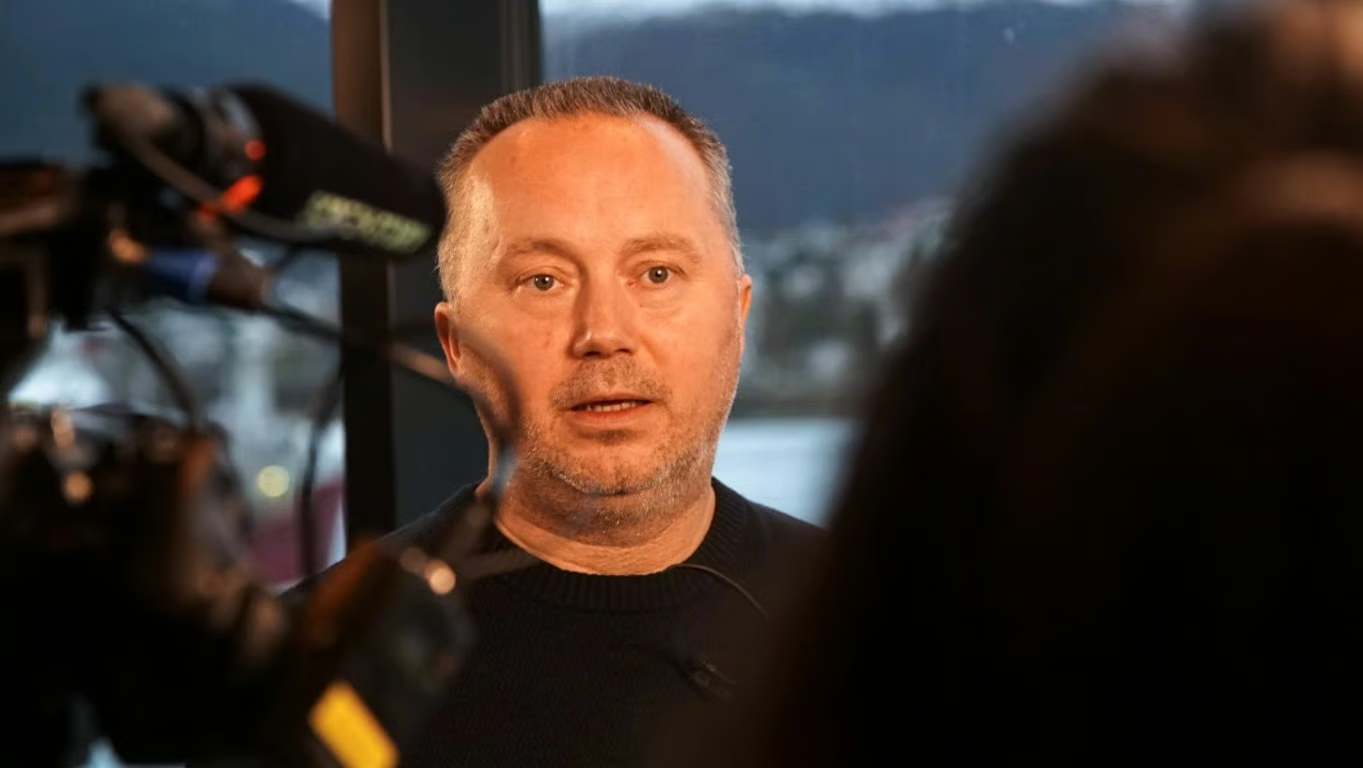
Founded in 2017 by Tommy Olsen, a volunteer from northern Norway who first arrived in Lesvos during the height of the refugee crisis, Aegean Boat Report was created to bring transparency and accountability to one of the world’s most dangerous migration routes.
Every day, ABR monitors the Aegean Sea in real time, answering distress calls from people in danger, documenting illegal pushbacks, and providing verified data to journalists, lawyers, UN agencies, and humanitarian organisations. Its reports have been cited by Amnesty International, Human Rights Watch, and major international media outlets.
But now, this vital work is at risk. Without sustainable funding, the organisation will be forced to scale down or close by 2026, leaving no one to monitor Europe’s most militarised maritime border.
“If we disappear, the truth disappears beneath the waves and so do the people,” says Tommy Olsen, founder of Aegean Boat Report. “Our hotline has saved lives, our data has exposed abuse, and our independence has made us a trusted source, but we are running out of resources. We need support to keep watch.”
Aegean Boat Report operates independently and receives no government funding. To maintain its current level of operation for one year, the organisation requires €100,000, with an additional €20,000–30,000 needed to expand its 24/7 hotline and another €20,000–30,000 to strengthen research, data verification, and social media outreach.
This is not charity, it is human rights work. Every contribution helps Aegean Boat Report stay operational, continue documenting violations, and ensure that every person who crosses the Aegean Sea is seen, counted, and remembered.
About Aegean Boat Report
Founded in 2017 and based in Tromsø, Norway, Aegean Boat Report (ABR) is an independent, non-profit organisation that monitors migration across the Aegean Sea. ABR provides verified information on refugee movements, pushbacks, and human-rights violations, serving as a trusted source for journalists, lawyers, and humanitarian agencies worldwide.
Every week, people in distress contact Aegean Boat Report — families lost at sea, or newly arrived on land, terrified and desperate for help.
When this happens, we do what we have done for years: we call the authorities — the Coast Guard, the police — to pass on information so that lives can be saved.
But too often, we are met with hesitation, denial, or even hostility. Calls are ignored, arguments start, and sometimes, the phone is simply hung up — while people are in immediate danger.
We are tired of having to argue when lives are at risk.
This is not how a democracy, bound by international law and human rights principles, should act when people are in distress.
We should not have to debate humanity each time someone asks for help.
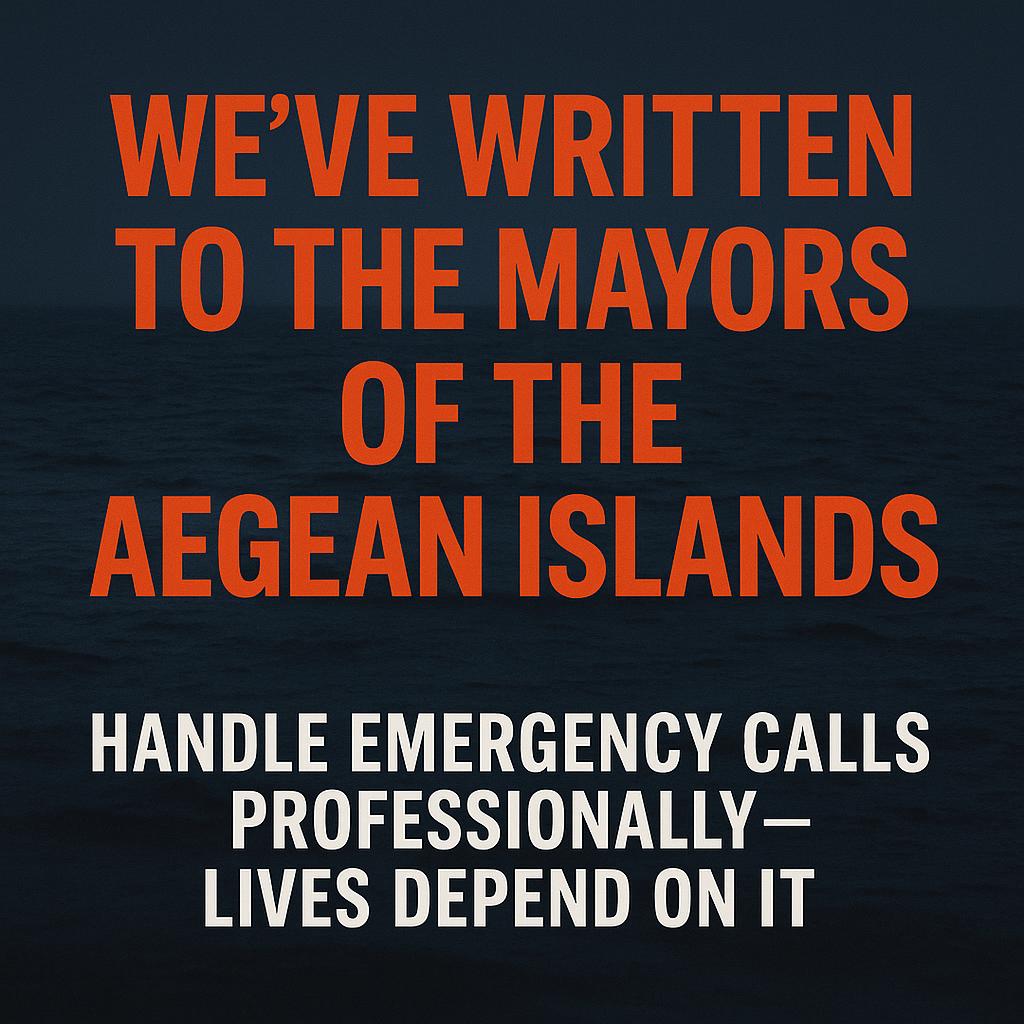
That is why we have appealed to the mayors — asking them, on humanitarian grounds, to remind local police and Coast Guard officers to act in accordance with international law and render assistance without delay.
When people are not rescued in time, it is often local residents who find the bodies — children discovering the dead on beaches, or fishermen pulling them from the sea together with their fish. These scenes are deeply traumatic and leave lasting scars on island communities that have already carried this burden for years.
Preventing such tragedies through professional, lawful, and humane response is not only a moral duty — it is a matter of respect for life and for the people who live on these islands.
If there are mayors that, for some reason, haven’t received their email, they can download it here 👉🌐 www.aegeanboatreport.com
In the early hours of October 25, a boat carrying 34 people, including 11 small children, departed from Karaburun, Turkey. Their destination was the small Greek island of Pasas, northeast of Chios.
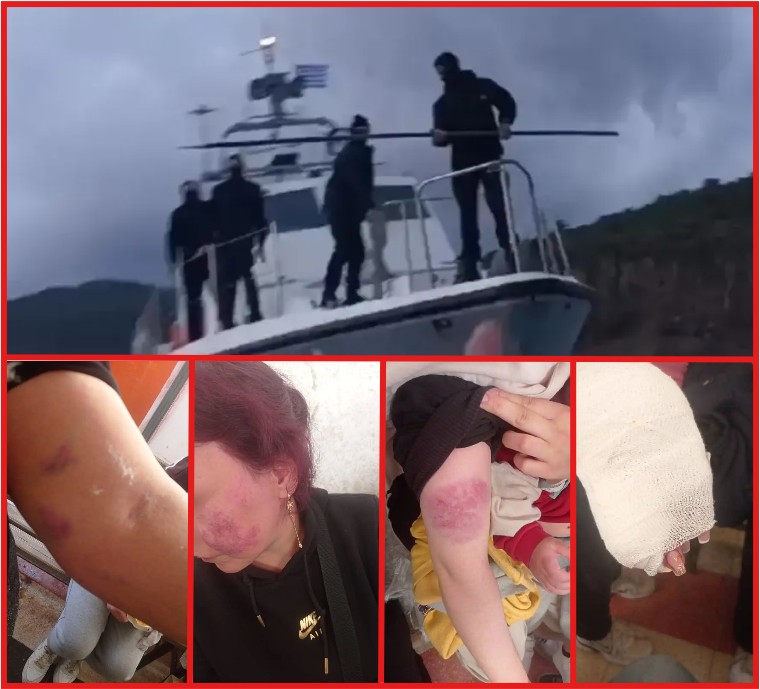
Deep inside Greek territorial waters, their boat was spotted and intercepted by a vessel from the Greek Coast Guard. Masked men in a RIB launched from the Coast Guard vessel threatened them at gunpoint, ordering everyone to hand over their belongings, bags, papers — and especially their phones. Those who didn’t obey immediately or protested were brutally beaten, regardless of gender.
The engine was removed and thrown into the sea. A rope was attached to the bow, and they were towed back into Turkish waters.
One brave girl in the group had managed to hide her phone. At 02:36, she called for help — she called Aegean Boat Report. We immediately alerted the Turkish Coast Guard.
People were screaming hysterically over the phone, making it impossible to understand what was being said. We did our best to calm them down. Panic onboard a fragile, overloaded boat in the dark, filled with people who cannot swim, is an extremely dangerous situation.
After a few minutes, we managed to restore some calm and establish a normal conversation. We gathered vital information and received videos from the boat, which we immediately shared with the Turkish Coast Guard — unfortunately, they were nearly an hour away.
While waiting for rescue, we continued documenting the situation to ensure it could later be verified. Videos from the boat clearly showed signs of violence: a man bleeding from a head wound, a woman bleeding from her hand.
It is almost incomprehensible that this could have been done by a European Coast Guard, officers sworn to protect life at sea — beating unarmed civilians seeking protection.
We stayed in contact until the Turkish Coast Guard arrived at 03:35.
The young girl contacted us again the following morning, describing in more detail what had happened and sharing photographs showing the brutality inflicted by the Greek Coast Guard.
For more than five years, Greek authorities have systematically kidnapped, beaten, tortured, and killed men, women, and children at Europe’s border — in the name of “border protection” — with complete disregard for human dignity, life, and international law.
Such actions directly violate: • The 1951 Refugee Convention (Article 33, non-refoulement principle) • The European Convention on Human Rights (Articles 2, 3 & 5 – right to life, prohibition of torture, liberty and security) • The UN Convention Against Torture • And the International Convention on Maritime Search and Rescue, which obliges all vessels to rescue those in distress at sea.
These are not allegations — they are documented crimes, confirmed through independent investigations, including by Frontex’s Fundamental Rights Office and the EU’s Anti-Fraud Agency (OLAF), both of which verified the existence of systematic pushbacks, cover-ups, and EU complicity.
Europe cannot claim to defend human rights while funding, enabling, and politically protecting those who violate them.
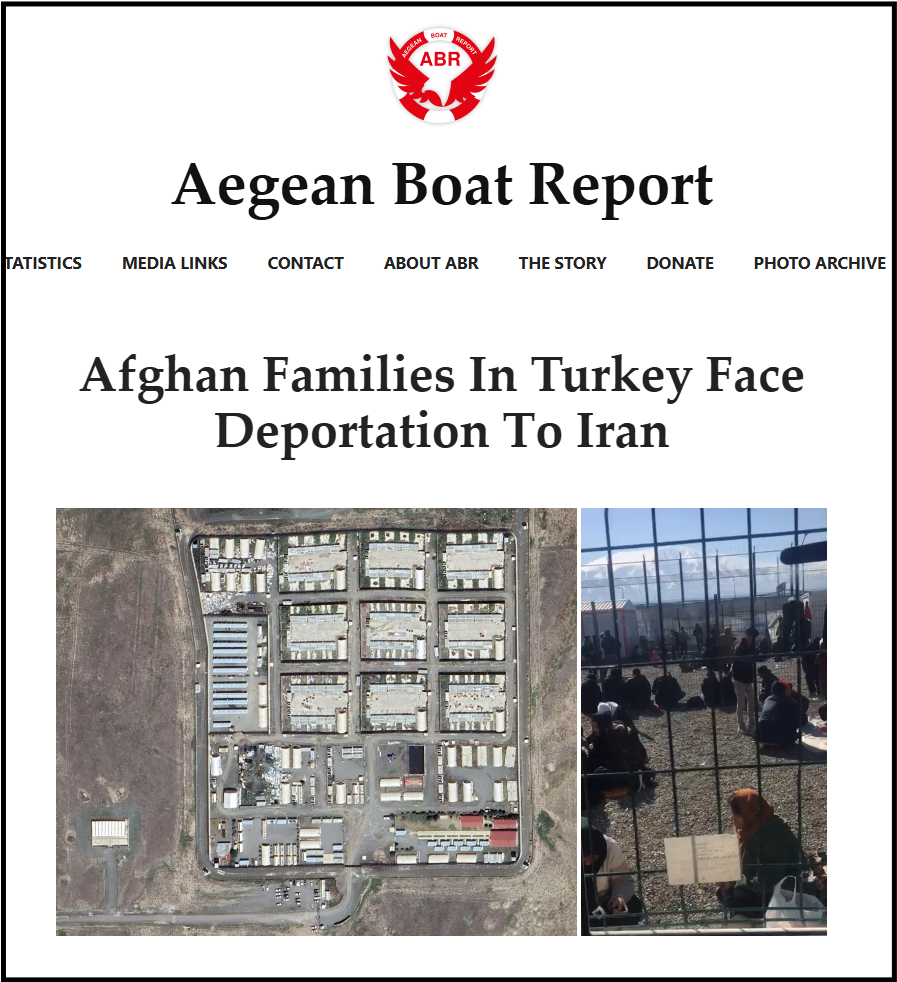
All 34 people in this group were Afghans from the Hazara minority, one of the most persecuted ethnic groups in Afghanistan. After being intercepted at sea, such groups are routinely arrested by Turkish authorities and taken to EU-financed Removal Centres. From there, they are transferred to camps near the Iranian border and eventually deported to Afghanistan through Iran.
For Hazara deportees, this is not repatriation — it is a return to a country where their very identity puts them in mortal danger. The Taliban has for decades targeted the Hazara population through mass killings, disappearances, forced displacement, and religious persecution, documented by the United Nations, Amnesty International, and Human Rights Watch. Since the Taliban’s takeover in 2021, attacks against Hazara civilians — including bombings of schools and mosques — have intensified, prompting UN experts to warn of possible crimes against humanity and genocide.
When Hazara refugees are forcibly returned from Turkey, they face:
Arbitrary detention or execution by the Taliban.
Systematic discrimination and exclusion from education, work, and healthcare.
Religious persecution as Shia Muslims in a Sunni extremist regime.
For women and girls, a complete denial of basic human rights and increased risk of gender-based violence.
Returning them to Afghanistan under these conditions constitutes a clear violation of international law, including: • Article 33 of the 1951 Refugee Convention (non-refoulement) • Articles 2 & 3 of the European Convention on Human Rights (right to life, prohibition of torture) • The UN Convention Against Torture • EU Charter Of Fundamental Rights, Artical 18 & 19
Aegean Boat Report documents these violations every day — independently, without government funding. Our work continues only because people believe the truth still matters.
In the morning of Tuesday, September 30, a boat in distress south of Lesvos—reportedly carrying 27 people, including 14 small children—contacted Aegean Boat Report for assistance.
“Aegean Boat Report has been contacted by people onboard a drifting boat inside Greek waters, 7 nautical miles south of Lesvos. According to passengers, the boat is carrying 27 people—including 14 small children. The Greek Coast Guard has been informed. We hope they will immediately initiate a rescue operation in line with international and maritime law.”
No rescue followed. No one was brought to the camp on Lesvos that day. The Greek Coast Guard later claimed there were no rescue operations in the area and that they had not been alerted to a boat in distress. This is false. We alerted them directly and can document that we did so.
What we documented
The boat was drifting inside Greek waters, south of Lesvos, with a failed engine. We informed the Greek Coast Guard and provided the location.
A short time later, the same boat was found drifting off Karaburun, Turkey—around 10 km away—still with a failed engine.
People onboard reported that masked men from a Lambro 57 coastal patrol vessel threatened them at gunpoint and seized their belongings, especially their phones. After that, we lost contact with the group.
On the morning of September 30, the Turkish Coast Guard located 31 people—including 12 small children—inside Turkish waters off Karaburun, removed them from the boat, and transported them back to Turkey. As is routine in such cases, Turkish authorities were notified by email after the pushback.
This sequence does not require speculation. There is no plausible way a powerless boat drifted against the tide and wind from Greek waters to Karaburun without external intervention. We therefore maintain that the Greek Coast Guard intercepted the boat inside Greek waters and pushed the people back into Turkish waters—an illegal practice under international and maritime law.
Legal obligations
Under international maritime law, every vessel and coastal state has a duty to render assistance to any person in distress at sea (Article 98 of the UN Convention on the Law of the Sea, and the International Convention on Maritime Search and Rescue).
At the same time, human rights law—including the European Convention on Human Rights (Article 3 and Article 4 of Protocol 4) and the 1951 Refugee Convention (Article 33 on non-refoulement)—strictly prohibits returning people to a place where they risk persecution, torture, or inhuman treatment.
Pushbacks at sea violate all these obligations. When the Greek Coast Guard forcibly returns people to Turkish waters without assessing protection needs, they breach both maritime and human rights law. These are not political opinions—they are legal facts.
Pattern—and consequences
The Greek Coast Guard publicly denies such actions, insisting it would never endanger lives. Yet the pattern is consistent and well documented.
Yesterday, a separate boat bound for Lesvos—with at least 18 people—sank after encountering the Greek Coast Guard before reaching land; a young woman died.
The official account again claims the boat “moved dangerously,” that “signals” were used, and that a “mechanical failure” suddenly caused passengers to fall into the sea—an explanation recycled in multiple cases over recent years.
We believe these deaths are not accidents in isolation but the foreseeable outcomes of systematic, unlawful pushbacks. Greek authorities are pushing boats back—often violently—to prevent people from reaching shore and applying for asylum. When these operations go wrong, people die.
Our call
We call for an urgent, independent international investigation into “shipwrecks” and interdictions in Greek waters over the last five years. Too many lives have been lost under suspiciously similar circumstances.
We are convinced that many of these incidents are not mere accidents, but pushbacks gone terribly wrong—carried out by Greek authorities in clear violation of maritime and human rights law. Those responsible must be held to account.
Stand With Us
For years, Aegean Boat Report has documented these violations — often in real time — to make sure the truth cannot be erased.
We do this work independently, without government funding, because transparency and accountability matter.
If you believe that no one should be left to die unseen at Europe’s borders — stand with us.
Every message, every share, and every monthly donation helps us continue to monitor, document, and expose what others try to hide.
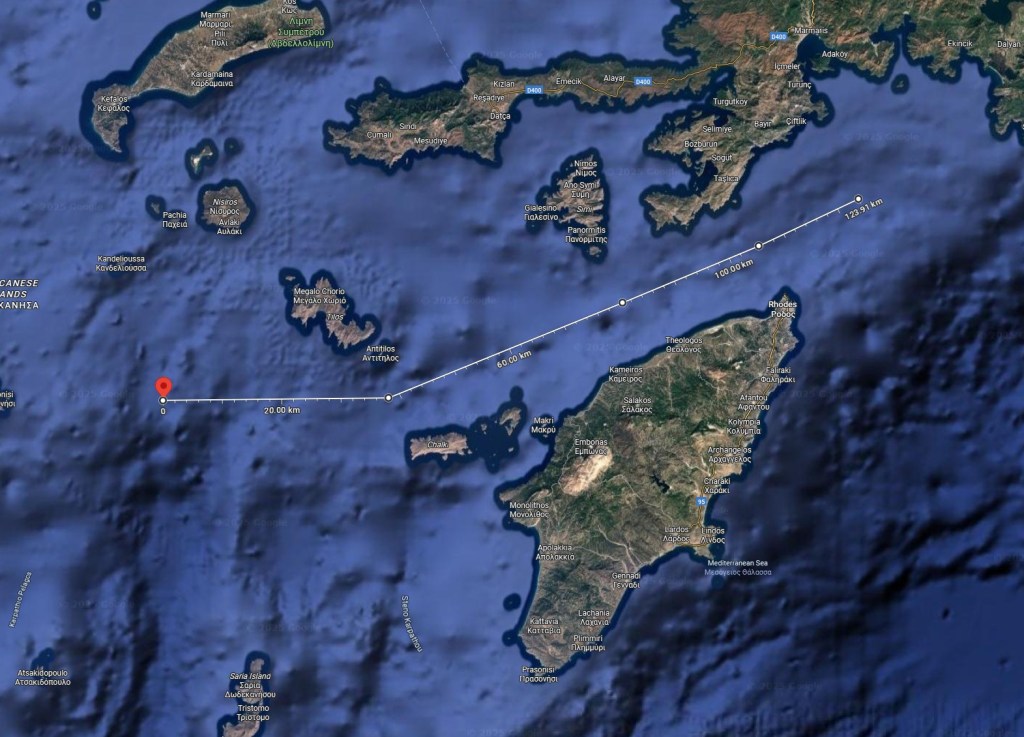
On Friday, 12 September, at 22:40, Aegean Boat Report was alerted to a sailboat in distress approximately 14 nautical miles southwest of the Greek island of Tilos.
According to passengers, the vessel was carrying around 80 people, including many children. The sailboat had lost engine power, was taking in water, and was in urgent need of rescue.
Videos sent from onboard show people crying desperately for help, while a Greek Coast Guard vessel circled the sailboat with searchlights. Eyewitnesses reported that the Coast Guard even fired shots against the sailboat — the reason remains unknown.
We published the case on social media to make public awareness, we feared that the group would be pushed back.
Greek Coast Guard Denies Finding the Boat
When Aegean Boat Report contacted the Greek Coast Guard, officials claimed they were “searching the area” but had “not found anything.”
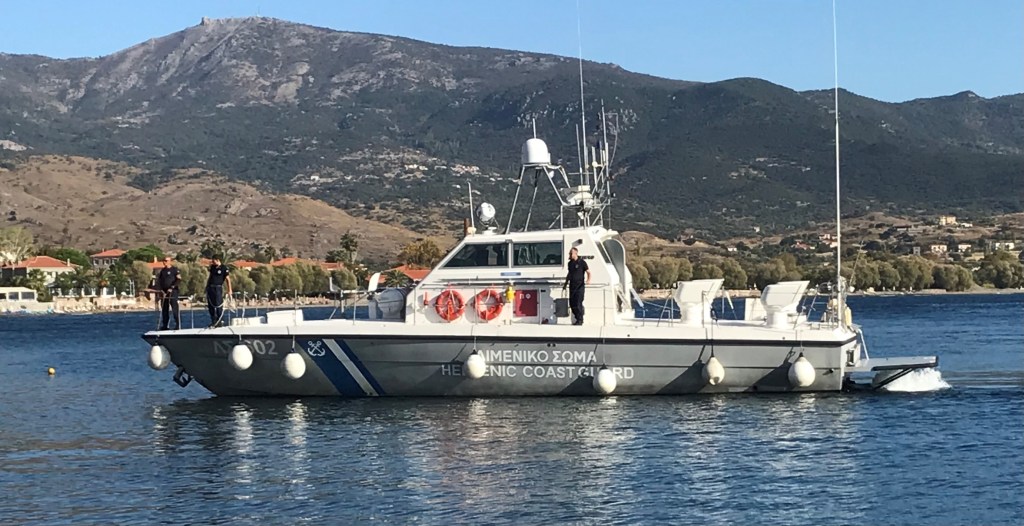
This was a blatant lie. At the same time as authorities denied knowledge, videos from the sailboat clearly showed a vessel with search lights circling close by, people onboard said it was a vessel with a Greek flag, grey with blue stripes in the front.
For those onboard, the situation was terrifying:
“They are here with big lights, but they don’t help us.” “Please, we need rescue, the boat is broken.”
Disappearance After “Rescue”
Later that night, Aegean Boat Report received information that the people had been taken onboard a Greek Coast Guard vessel. But contrary to maritime law and standard rescue procedures, nobody was brought to land. Instead, the entire group of ~80 people vanished without trace.
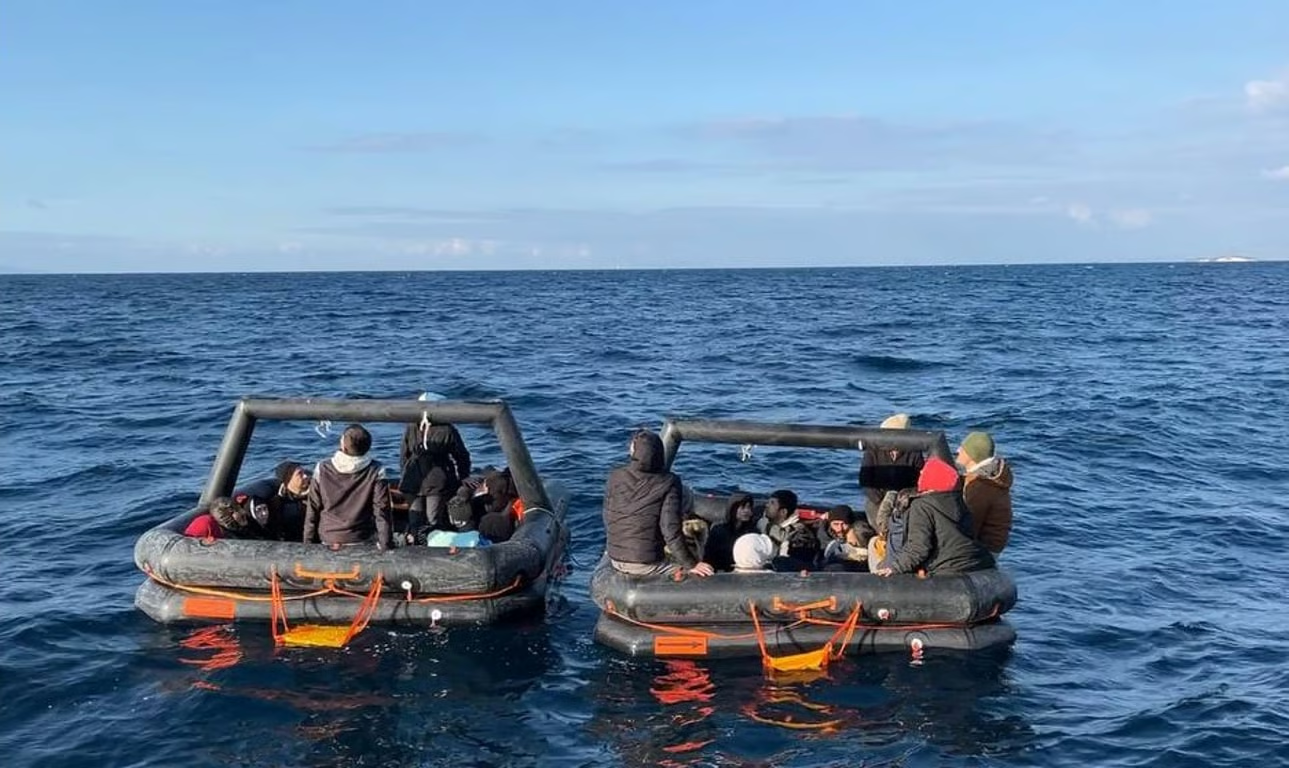
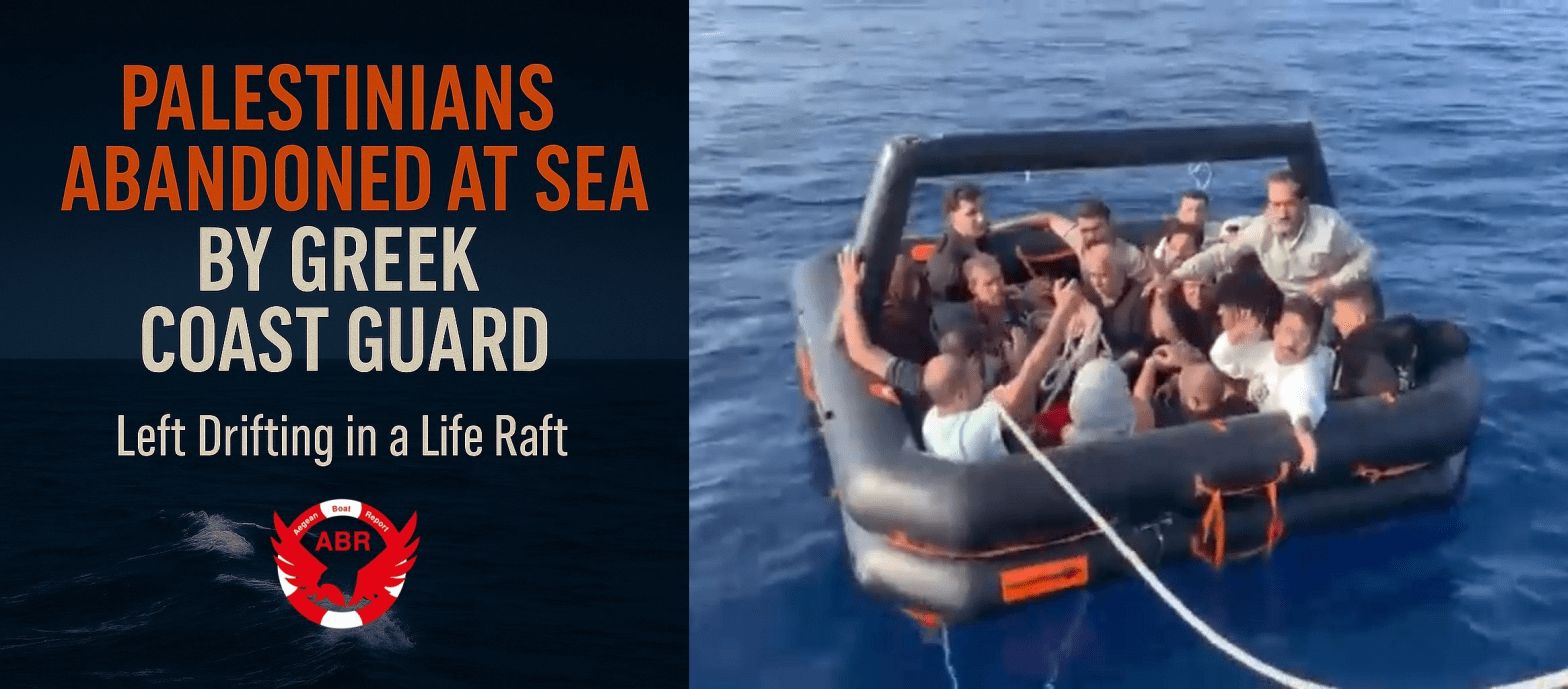
This disappearance fits a systematic pattern: people in distress are collected by Greek authorities, only to later reappear drifting in Turkish waters inside inflatable life rafts.
Found in Turkish Waters
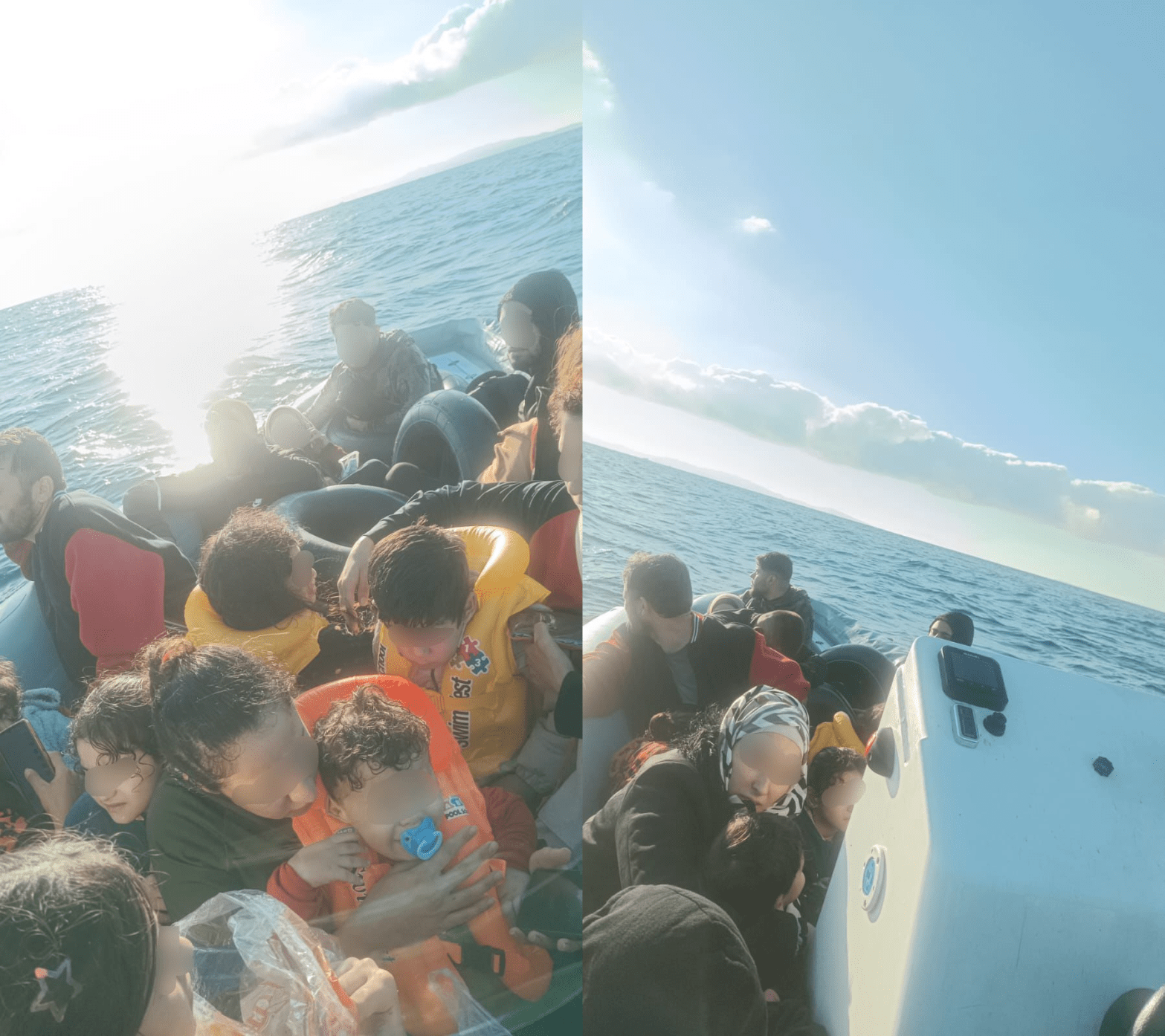
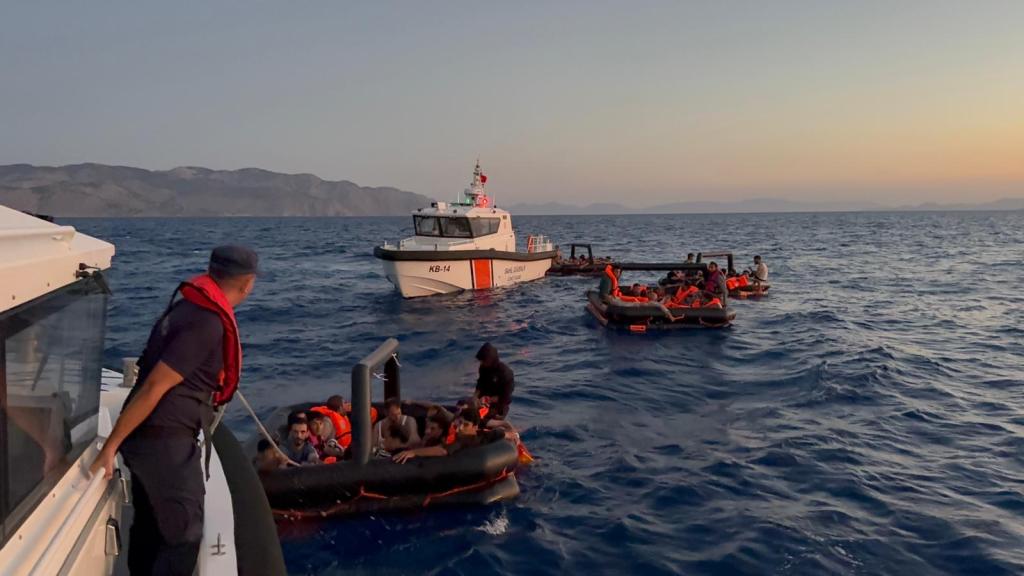
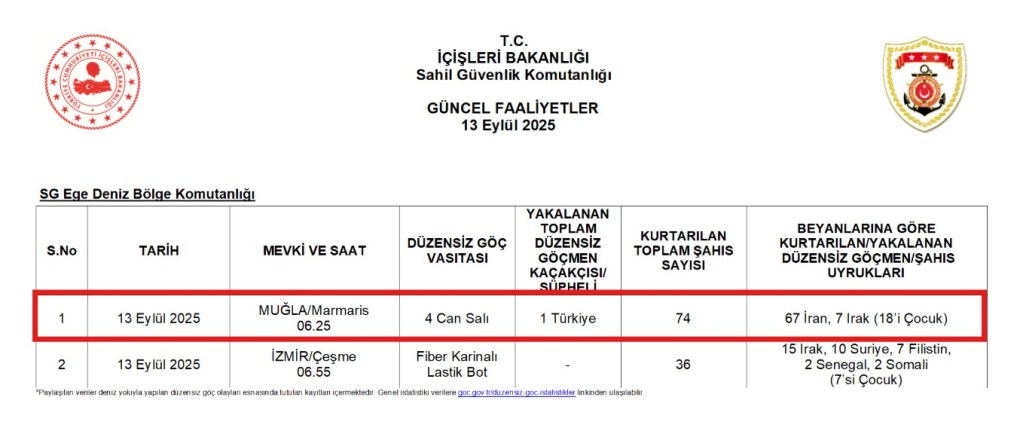
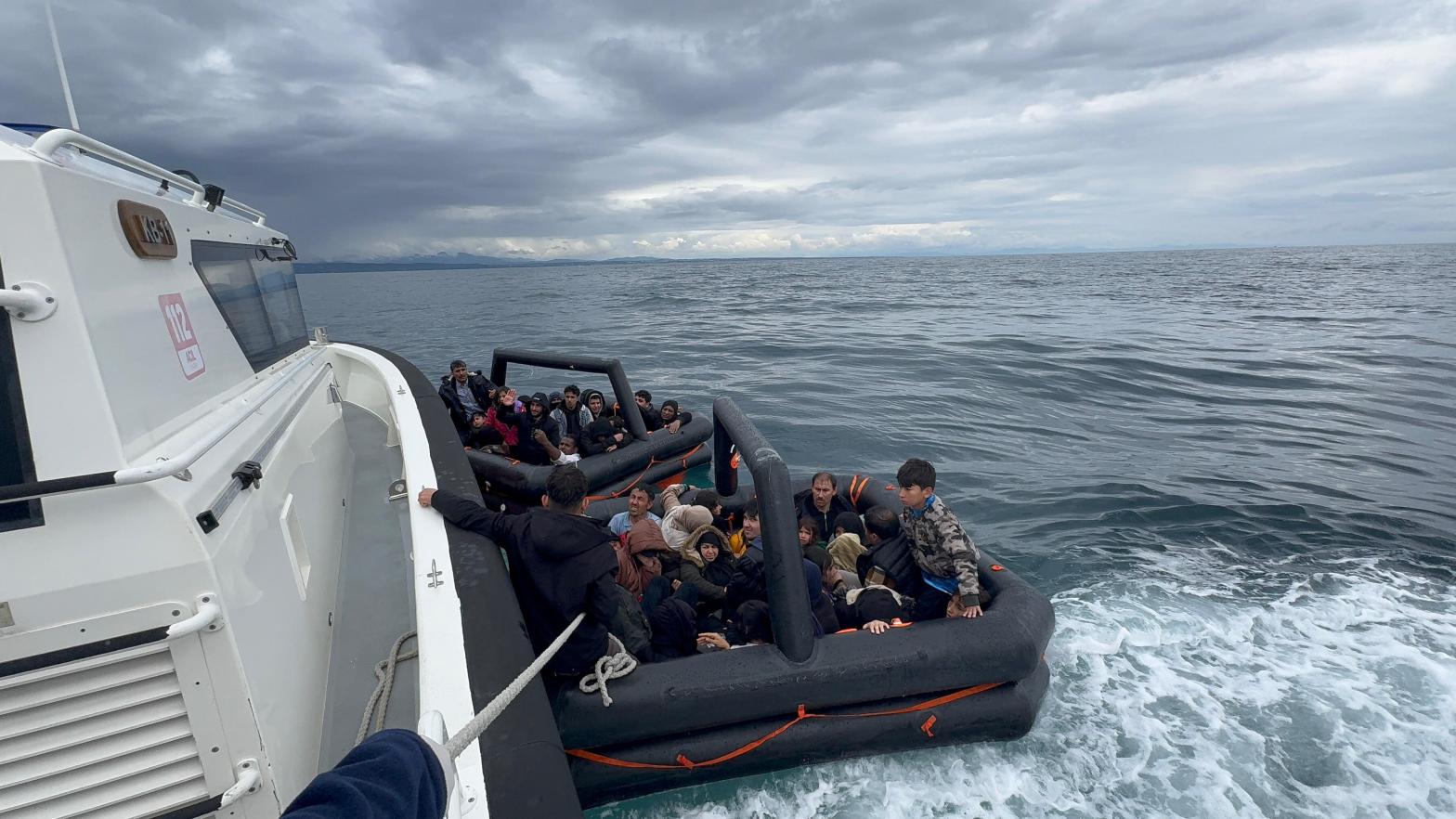
At 06:25 on Saturday, 13 September, the Turkish Coast Guard reported finding four life rafts off the coast of Marmaris, Muğla district.
74 people rescued, including 18 children
Nationalities: 67 Iranian, 7 Iraqi
1 suspected smuggler apprehended
Rescue carried out by vessels TCSG-26, KB-116, KB-14
Photographs released by the Turkish Coast Guard show the life rafts overcrowded with people, being recovered by patrol vessels.
74 People found drifting in life rafts by Turkish Coast Guard
This matches exactly the timeline and the number of people who disappeared after the Greek Coast Guard’s intervention near Tilos.
A Dangerous and Illegal Operation
Evidence strongly indicates that the Greek Coast Guard:
Approached the sailboat in distress
Fired shots to intimidate passengers
Took the people onboard their vessel
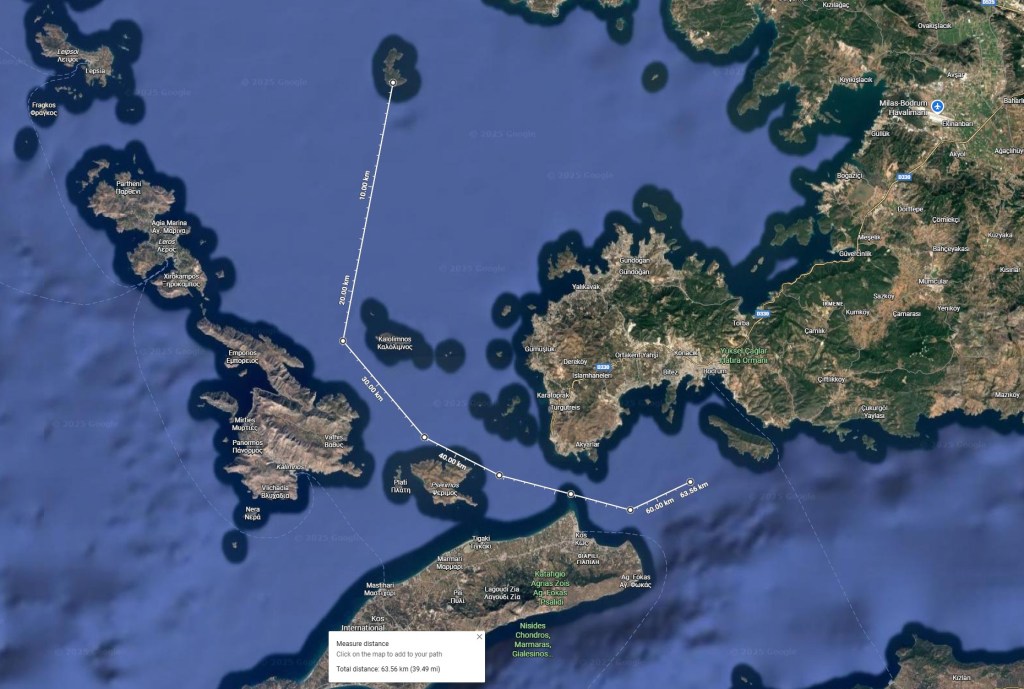
Transported them 67 neutical miles
Forced them into life rafts during the night
Abandoned them in Turkish waters
The Greek Coast Guard Transported the group 67 nautical miles befor leaving them drifting in life rafts
Such operations are not only illegal but extremely dangerous. The sailboat carried around 80 people — far beyond its safe capacity. Forcing them into small inflatable life rafts and leaving them adrift could easily have led to mass casualties.
Covering Up Crimes at Sea
The Greek Coast Guard’s official denial — claiming they never found the boat — stands in sharp contrast to overwhelming evidence:
GPS coordinates (14 nm SW of Tilos)
Video evidence from passengers
Eyewitness testimony of shots fired
Turkish Coast Guard reports and photos the following morning
By denying involvement while simultaneously carrying out a pushback, Greek authorities once again attempted to cover up serious human rights violations.
74 people found drifting in 4 life rafts by TCG
International Law and Human Rights Obligations
Under international maritime law, specifically the International Convention for the Safety of Life at Sea (SOLAS) and the International Convention on Maritime Search and Rescue (SAR Convention), Greece has a clear obligation to:
Respond immediately to distress calls
Rescue people in danger, regardless of nationality or status
Disembark survivors at the nearest place of safety
Under international human rights law, including the 1951 Refugee Convention and the European Convention on Human Rights, collective expulsions and pushbacks are strictly prohibited.
By forcing these 80 people back into Turkish waters, Greek authorities violated the principle of non-refoulement and denied their right to seek asylum.
A Systematic Practice
This incident is not isolated. Aegean Boat Report has documented hundreds of similar cases in recent years, involving tens of thousands of people.
Each case represents:
A human tragedy, where lives are endangered at sea
A direct breach of international law
A deliberate policy by Greek and European authorities to deny people their right to seek protection
Conclusion
On 12 September 2025, ~74 people in urgent need of rescue near Tilos were instead subjected to a violent and illegal pushback operation.
The Greek Coast Guard lied about not finding them.
People were fired upon, collected, and then disappeared.
Hours later, they were found in life rafts drifting in Turkish waters.
This case once again demonstrates how human rights are systematically violated at Europe’s borders — and how authorities work to conceal their crimes.
Who Will Speak Out?
On the night of 12 September, nearly 80 people vanished after being “rescued” by the Greek Coast Guard, only to reappear hours later drifting in life rafts in Turkish waters.
The evidence is clear — videos, coordinates, testimonies, and official Turkish Coast Guard records. Yet, apart from Aegean Boat Report, no one documented this case as it unfolded.
Why is it that, in one of the most active migration zones in Europe, other organisations remain silent? Why is it left to a single watchdog to expose systematic human rights violations that put countless lives at risk?
Until more voices join in, the question remains: Who will hold Europe accountable, if those on the ground choose to look the other way?
On Saturday, September 6, just after midnight, Aegean Boat Report was contacted by several people after they had arrived on the Greek island of Farmakonisi.
Farmakonisi is a Greek military outpost in the Aegean Sea. Besides the military base, there are no inhabitants on the island.
Since the island lies close to Turkey, people attempting to cross into Europe frequently arrive there — especially at night, in the dark, believing they have found safety. But arriving on Farmakonisi does not mean safety.
Some groups arriving are transferred to the Closed Controlled Access Centre (CCAC) on Leros. Others are robbed, beaten, stripped of their belongings, forced back to sea, and left drifting in life rafts. It seems almost random who gets what treatment.
This group of 19 people, who contacted us on Saturday, September 6, ended up in a life raft. Another group that arrived the next day was transferred to Leros.
We received pictures, videos, and location data from the Saturday group — there was no doubt they were on Farmakonisi.
⸻
Disappearance
Since Farmakonisi is a military zone, no one except Greek authorities is allowed there. There are also no private rescue vessels in the Aegean Sea, meaning that when people arrive on this island, options are extremely limited.
When people contact us from Farmakonisi, our only advice is to call 112 and walk towards the military camp to make their presence known.
To advise people to walk straight into the lion’s den isn’t something we do lightly. But hiding is not an option: there are no trees, no caves, no water, no food. Avoiding detection means risking death by dehydration or starvation.
This group did exactly that: they called 112, then started walking towards the camp. Shortly after, they were stopped by armed men in military uniforms.
At 02:31 local time, all phones went offline.
From that moment, we lost all contact.
⸻
Tracing the Group
We searched for them. • We checked Leros, but no record of transfer existed. • We contacted the Turkish Coast Guard — nothing. • We feared they had disappeared completely.
Then, on Sunday morning at 09:10, the Turkish Coast Guard announced that they had rescued 19 people from a life raft drifting outside Bodrum, Turkey.
Published By Turkish Authorities
On Monday, we received pictures and videos from the rescued group. We could confirm without any doubt: It was the same people who had contacted us from Farmakonisi.
⸻
Deliberate Abandonment at Sea
Due to weather conditions around Farmakonisi, the Greek Coast Guard transported the group over 35 nautical miles before abandoning them at sea outside Bodrum.
This was not accidental — it was calculated. If they had deployed the life raft near Farmakonisi, wind and current would have pushed it back towards Greece. By leaving them near Bodrum, they ensured Turkish waters would take them.
⸻
What the Victims Say
One of the survivors gave us this testimony:
“On Friday at 12 midnight we were on a Greek island. I sent the location and called three organizations, including yours. On the island, the army police caught us and kept us overnight in a dark room. They took all our belongings — money, phones, clothes, everything.
They told us a ship would take us to Leros island. A big ship came with four men. They handed over all our money, phones, and bags to them.
We were told we would be taken to Leros — but they lied.
Instead, they took us back into Turkish waters, inflated a rubber boat, put all of us into it, and left us drifting.”
The boat described was a Lambro 57 coastal patrol vessel belonging to the Greek Coast Guard.
“The color of their clothes was dark blue. They wore masks and black gloves. They said nothing more. Thank you for investigating and for wanting these people to be held accountable.”
⸻
A Systematic, Illegal Policy
This is not an isolated incident. This is systematic. This is policy.
For over five years, Greek authorities have denied involvement in illegal pushbacks, despite overwhelming evidence proving otherwise.
But Greece is not acting alone.
European Complicity • The European Commission funds these operations, framing them as “border management.” • Frontex, the EU’s border agency, has been repeatedly documented participating in and covering up pushbacks. • These acts are carried out in the name of European taxpayers, using EU-funded vessels, EU-funded personnel, and EU-funded policies.
⸻
Violation of International & European Law
These actions blatantly violate multiple legal frameworks: • 1951 Geneva Convention – guarantees the right to seek asylum. • European Convention on Human Rights – prohibits refoulement and inhumane treatment. • EU Charter of Fundamental Rights – Article 18 protects the right to asylum. • UNCLOS & SOLAS Maritime Conventions – obligate rescue at sea, not abandonment.
By forcing people back to Turkey, stripping them of their belongings, and abandoning them in unseaworthy life rafts, Greek authorities — supported and funded by the EU — are committing grave breaches of international and European law.
⸻
Where Do We Go From Here?
Is this normal behaviour for a European Union member state? Is it acceptable for a coast guard to deliberately put lives at risk instead of rescuing people? Is this what Europe has become?
These are not European values. At least, not the Europe we believed in. Somewhere along the way, we became cold. Somewhere along the way, we stopped seeing people as human beings.
⸻
Our Work Continues
At Aegean Boat Report, we will continue to document, investigate, and expose these practices. We will keep working so that the world cannot claim ignorance. We owe this to the people whose lives are put at risk every single day in the Aegean Sea.
Today, we keep watching. We keep documenting. We give a voice to those Europe tries to silence.
But we can’t keep going without you. Even a few euros a month helps us stay independent — and saves lives.
🧡 Every donation matters. Every voice counts.
All original material from this case will be made available for investigation purposes upon official request.
On Thursday, 28 August, at 20:30, Aegean Boat Report was informed about a sailboat in distress approximately 6.3 nautical miles southeast of the Greek island of Tilos.
According to the people onboard, 77 individuals, including 21 small children, were crammed onto the heavily overloaded vessel. The sailboat was drifting and in urgent need of rescue.
Rescue services were immediately informed, and two vessels from the Greek Coast Guard arrived on the scene. Shortly after their arrival, all communication with the people onboard was lost.
From the GPS position sent by the passengers, the sailboat was deep inside Greek territorial waters, between the Greek islands of Tilos and Rhodes, when the distress call went out.
⸻
Greek Coast Guard Denies Any Involvement
Strangely, the Greek authorities claim to have no recollection of any rescue operation in this area at that time and deny any responsibility for what happened to the group.
“Onboard are mostly women and children under the age of 15, many are sick, one woman with severe heart problems.”
“The coast guard has stopped us, we don’t know what to do, not sure exactly where we are.”
This denial stands in sharp contrast to eyewitness accounts, GPS data, and video evidence. For years, Greek authorities have been accused of illegally pushing back thousands of people from Greek waters in the Aegean Sea — a practice repeatedly condemned by the UN, European Court of Human Rights (ECHR), and numerous humanitarian organisations.
⸻
A Dangerous and Illegal Operation
Evidence strongly suggests that the Greek Coast Guard took control of the overloaded sailboat and towed it for several hours during the night — not to a place of safety, but away from Greek waters and into Turkish waters, forcing the passengers back and denying them the right to seek asylum.
The boat carried five times more people than its safe capacity, no life jackets, and included 21 small children. Towing such a vessel is extremely dangerous and can easily lead to capsizing and mass casualties.
Despite clear evidence of a pushback, the Turkish Coast Guard officially registered the incident as an “engine failure” — a practice that has become increasingly common over the last year as part of a political agreement between Greece and Turkey aimed at reducing tensions in the Aegean.
⸻
Covering Up Crimes at Sea
For over a year, Turkish authorities have deliberately mislabelled cases of forced returns as technical failures to shield Greek authorities from accountability and maintain a fragile diplomatic balance.
However, video footage taken onboard the sailboat clearly shows the searchlights of a Greek Coast Guard vessel. When comparing images from the passengers’ phones with those released by the Turkish Coast Guard after the rescue, there is no doubt this was the same group.
⸻
International Law and Human Rights Obligations
Under international maritime law, specifically the International Convention for the Safety of Life at Sea (SOLAS) and the International Convention on Maritime Search and Rescue (SAR Convention), all coastal states — including Greece and Turkey — have a clear legal obligation to: • Respond immediately to any distress call at sea • Rescue people in danger regardless of their nationality or legal status • Disembark survivors at the nearest place of safety
Furthermore, under international human rights law, including the 1951 Refugee Convention and European Convention on Human Rights, pushbacks are strictly prohibited.
Article 33 of the Refugee Convention explicitly enshrines the principle of non-refoulement, meaning that no one may be returned to a country where their life or freedom could be at risk.
The European Court of Human Rights has ruled multiple times that collective expulsions at sea — like this incident — violate fundamental rights and amount to serious breaches of international law.
By towing the sailboat back into Turkish waters, Greek authorities denied these 77 people their right to seek asylum, put their lives at extreme risk, and violated both EU and international legal obligations.
⸻
A Systematic Practice
This case is not an isolated incident. Aegean Boat Report has documented hundreds of similar pushbacks in recent years involving tens of thousands of people.
Each case represents not just a human tragedy, but also a direct attack on international law, European values, and the fundamental rights of people seeking safety.
For years, Greek authorities have carried out a systematic campaign to intimidate, criminalise, and silence those who expose human rights violations, illegal pushbacks, and the ill-treatment of vulnerable people at Europe’s maritime borders.
Aegean Boat Report, along with other frontline defenders, has been deliberately targeted:
Investigated repeatedly
Publicly discredited
Threatened with prosecution
In some cases, individuals have even faced arrest warrants
This is no coincidence. It is a calculated government strategy designed to isolate and weaken organisations that shine a light on violations the authorities want hidden.
A New Phase in Silencing Civil Society
The latest statements by Minister of Migration and Asylum Thanos Plevris mark an escalation. The government has announced plans for “administrative controls” on NGOs — including the power to deregister organisations that challenge migration policies or promote “alternative approaches.”
This is not just about regulation. It is about control.
The aim is clear: to intimidate NGOs into silence and ensure fewer organisations dare to expose illegal and inhumane practices.
A Divide-and-Isolate Strategy
For years, while frontline watchdogs and whistleblowers were being criminalised, many larger NGOs remained silent — fearful that standing in solidarity would jeopardise their ability to work in Greece.
Some severed communication with organisations like ABR entirely, hoping to “stay out of trouble.” The result? Watchdogs were isolated, their work made harder, and government pressure became even more effective.
Now, the same strategy that targeted a few is being extended to everyone. Even NGOs that once avoided “rocking the boat” are at risk if they challenge government policies or take legal action against unlawful practices.
A Chilling Effect on Democracy
This escalating crackdown has a profound chilling effect on democratic principles:
Freedom of association is under attack
Human rights defenders are intimidated into silence
Civil society is weakened, divided, and afraid to act
This Trump-like approach — punishing anyone who dares to criticise the authorities — threatens not only the rights of refugees and migrants but also the health of democracy itself in Greece.
ABR’s Position
Aegean Boat Report will not be silenced. We will continue to:
Document what others try to hide
Expose illegal pushbacks and abuses
Stand with every organisation and individual committed to defending human rights, transparency, and the rule of law
Silencing NGOs does not make violations disappear. It only makes them harder to prove — and easier to repeat.
We call on the European Commission, international partners, and the global human rights community to act now: Protect civil society. Defend democratic freedoms. Hold Greece accountable.
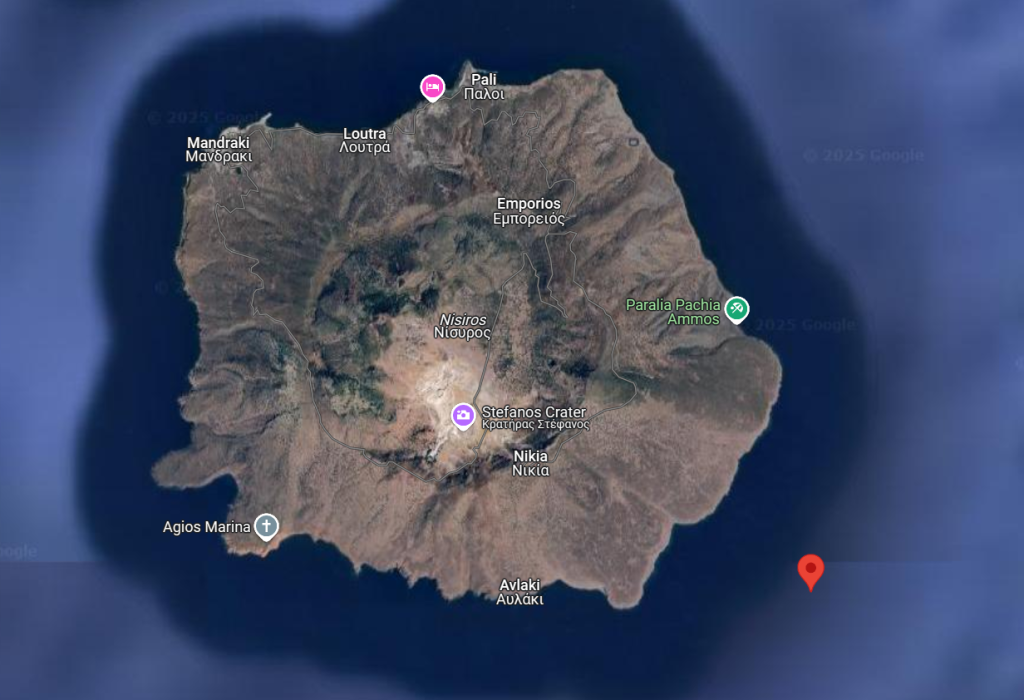
Before midnight on May 25th, Aegean Boat Report was contacted by passengers onboard a drifting vessel only 1.5 km from the southeastern shore of the Greek island of Nisyros.
People onboard informed us that the boat was drifting due to a malfunctioning engine, and that there were 100 passengers onboard, over 30 of them small children, mainly Syrians and Afghan families.
The current and wind direction was pushing the boat north west, straight toward the cliffs on the shores of Nisyros, wind speed 5-6 Beaufort, and we immediately contacted the Greek coast guard to alert them of the emergency situation.
Alerting the Greek coast guard about boat in distress carrying refugees in Greek waters, is many times a painstaking task, this time was no exception.
The call lasted almost 10 minutes, I was put on hold several times, and when they eventually found the time to talk to me, they were much more interested in who I was and how I had com across this information, than the emergency case I was trying to inform them about.
Over the years I have gotten used to discussing and arguing with the emergency call center of the Greek coast guard. After hundreds of calls they know very well who I am, but makes a point, every single time, pretending to not have the faintest idea. Waisting time seems to me the be the main objective, time that otherwise could have been used to save lives.
When boats are in distress in the Aegean Sea, the only option available is to contact the appropriate authorities in the area, there are no other rescue vessels as you can find in the Mediterranean. There is no international waters in this area, only Greek or Turkish waters, where NGO’s are not allowed to operate. If in distress in Greek waters, we are left with no option, even do we know that Greek authorities will do their utmost to push people back, no matter the consequences.
We remained in contact with the passengers of the drifting vessel, from videos received we could see that people were cramped inside and outside of the vessel. We didn’t register anyone wearing life jackets onboard, if the boat had hit the cliffs and capsizes, this would very quickly have become a disaster.
Shortly after midnight the passengers informed us that a boat was approaching. In the beginning only as search lights in the distance, people were shouting and flashing with their phones, relived, finally they would be rescued.
Their optimism fainted slightly when they released that the boat who was now pulling up alongside them, was most likely too small to take onboard 100 people, and the three men seen on deck in green uniforms, helmets, face covered, carrying battle rifles, didn’t seem like someone who was there to save them, quite the opposite.
Shortly after the Greek coast guard vessel arrived on location, we lost contact with all the phones on the boat, and we could only hope that the people in distress would be transported to the nearest port of safety.
We did several follow up calls to the Greek coast guard, whom we had previously spoken to, to try to get any indication on whether this was in fact a rescue operation, or a pushback.
Officers on call were extremely hostile, refusing to provide any information, denying having any information on an emergency case in the area, and would not confirm that there were an active operation ongoing. When I tried to explain that I was the one who had informed them about this case in the first place, he shouted something in Greek that i couldn’t make out, probably nothing good, and hung up the phone.
To be met with such extreme unprofessional behaviour, from an operator of a national emergency call centre, is just unbelievable, but when in contact with the Greek coast guard, this is unfortunately not uncommon.
From this point we were fairly certain that the boat that arrived on location was not there to rescue anyone, but rather to make sure that they didn’t set foot on Greek soil, and push them back.
In a video taken by one of the passengers on the drifting boat outside Nisyros, we can see a Lambro 57 coastal patrol vessel belonging to the Greek coast guard, and three men in Green uniforms, armed and in full tactical gear, ready to board.
The Greek coast guard use dark blue uniforms, not green as we can see on deck in the video.
From several previous investigations into the illegal practice of the Greek authorities, it’s commonly known that on all coast guards vessels, there are Greek Navy special forces deployed, O.E.A, or most like O.Y.K, Underwater Demolition Team. Highly motivated individuals carrying out direct order from the Greek authorities to the letter, no questions asked, pain, suffering and death follow in their footsteps.
For the next three hours we were unable to reconnect with anyone onboard the drifting vessel, all we could do was wait.
At 3.30am local time we received a new emergency call from the boat, but they were no longer close to the Greek island of Nisyros, not even in Greek waters.
The new location we received from the boat, showed that they were in Turkish waters, 3 kilometers south east of Bağlarözü, Datça, and over 10 kilometres from their previous location four hours earlier.
A boat carrying 96 people, 38 of them small children, was towed by the Greek coast guard for over three hours into Turkish waters. If something had gone wrong, like when they attempted to tow the Adriana, we would have had yet another tragedy on our hands. Non of the passenger hade life jackets, and the coast guard vessel was not equipped to perform a rescue operation of this scale.
Greek authorities would easily and very “logically” explain this as a “prevention of entry”, even do the boat was deep inside Greek territory waters at the time they were found drifting. They would also say that the boat voluntarily had turned around and gone back to Turkey, that the boat had no working engine, and had to drift against wind and current seems to be of no importance.
The problem is that they know they can basically say and do whatever they want, because no matter what they do, no matter how horrible the outcome is, no matter how many they kill, they have the full support of Frontex and the European Commission. The Pylos shipwreck, where over 650 people were killed by the Greek authorities, is a clear testimony to the lack of accountability, not only by Greece, but also the European Commission.
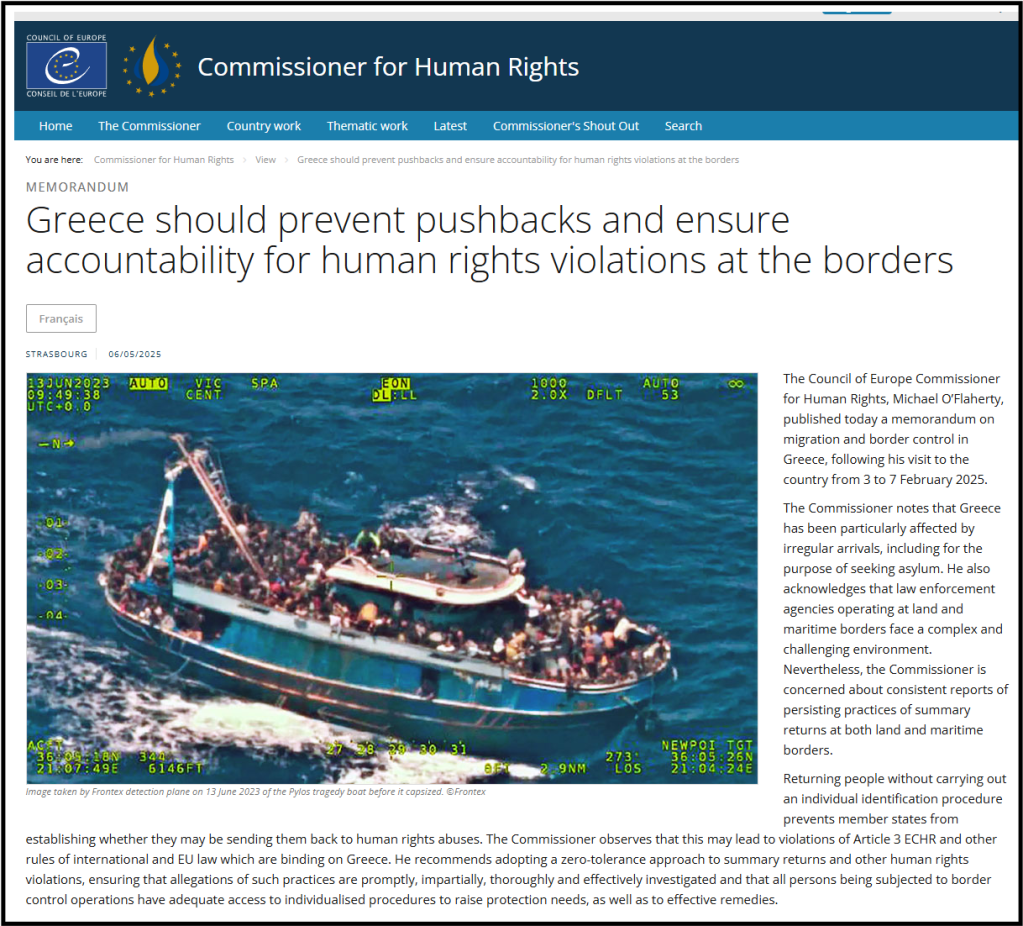
The Adriana, 650 people drowned after Greek authorities failed pushback attempt outside Pylos, Greece
When we regained contact with the boat, we immediately contacted the Turkish coast guard and informed them. In contrast to the call to the Greek coast guard 4 hours earlier, this call took only 43 seconds, in this short time we provided all necessary information, and also explained that the boat had been pushed back by Greek authorities. The operator could inform us that they had received an email from their Greek counterparts, with information and location of the drifting boat in Turkish waters, as routinely is done after they have pushed boats back.
While still adrift, one of the passengers explained what had happened.
Masked armed men carrying guns entered the boat.
Everyone was gathered together, and everyone was ordered to hand over their phones, those who refused were beaten.
At least two people managed to hide their phones, those phones were later used to call for help.
A rope was tied to the front of the vessel, and the coast guard started to tow the boat back toward Turkish waters.
After 3 hours the armed men removed the rope, went back to the coast guard vessel, who then just left them helplessly drifting.
This is the usual approach by Greek authorities when encountering larger vessels in Greek waters, they try to tow it out of Greek waters to avoid dealing with it. The same method was used outside Pylos, when they tried to tow the Adriana into Italian waters, which led to one of the worst shipwreck in modern times, killing 650 people.
People onboard were afraid of also the Turkish coast guard, they claimed that the Turkish coast guard would beat them similarly as the Greek coast guard had done.
At 04.30 the Turkish coast guard arrived on location, shortly after we lost contact with the two remaining phones on the boat.
The following day, when Turkish coast guard published their official report on the incident, they deliberately falsified the report to cover up for Greek human rights violations.
The incident was officially registered as a case where the Turkish coast guard had stopped a boat from crossing into Greek waters, even after the pushback had been confirmed by the passengers onboard, Aegean Boat Report and also by official email from the Greek coast guard.
This charade has been ongoing since last summer, hundreds of pushback cases have been deliberately registered incorrectly by the Turkish authorities, in an effort to mislead the public in believing that things are getting better, it most definitely haven’t.
So why would Turkey be interested in covering up Greek human rights violations? We actually don’t have an answer to that, but we suspect that they are not doing it out of kindness and consideration for the Greek authorities.
These deliberate cover ups by authorities on both sides of the Aegean, gives an illusion that there are less violations of the rights of people on the move, a smokescreen, in reality, it’s business as usual at Europe’s outer border, where systemic human rights violations takes place on a daily basis.
We fear that what we see today at Europe’s border, is only the beginning, and in the years to come escalate, to a point where human rights will be the privilege of the few, and those trying to cross through irregular routes can be shot on sight.
You might say “this will never happen”, but if I had predicted today’s reality in the Aegean Sea, 30 years ago, you would have said the same.
On 14 of June 2023, Greek authorities Killed 650 people in the sinking of the Adriana off the coast of Pylos, Messenia, Greece. Officers onboard was acting on direct orders from Greek authorities, fully aware that the order was illigal under Greek and international law.
On May 23, almost three years after the crime took place, the Greek naval court has charged 17 coast guard officers, amongst them the captain, of the Greek offshore patrol vessel LS-920, who attempted to tow the Adriana and caused it to capsize.
Greek authorities are now looking to find a scapegoat, someone to put the blame on for this tragedy, and to divert attention from those really responsible, from where the orders originated from, the Greek government, and especially it’s leader, prime minister Kyriakos Mitsotakis.
It sends out a clear signal, especially to the members of the Greek coast guard, that the one giving them these illegal orders, the Greek prime minister, won’t think twice about “throwing them under the bus” if caught after following his illegal orders, to save his own skin.
We have no illusions that those charged will ever be convicted in a Greek court, for that to happen, it needs to be lifted up to a European level.
Systematic human rights violations at the Greek sea border, has been ongoing for over 5 years. Almost 100.000 people have been illegally and violently removed from Greek territory, and pushed back towards Turkey, over 1.000 people have been killed in these illigal operations.
Greek authorities, supported by Frontex, have again been proven to be involved and responsible for human rights violations in the Aegean Sea. The question is, what will Frontex management board and the European Commission do to stop this?
We demand that the European Commission immediately launch infringement proceedings against Greece for systematic and widespread human rights violations, and we demand the ceasing of all Frontex operations in Greece in accordance to article 46 of the Frontex regulation.
In the morning of Thursday May 1, a boat in distress north of Samos, inside Greek territory waters, contacted Aegean Boat Report and asked for assistance.
They explained that they were on the way to Samos, but were brutally stopped by a vessel from the Greek coast guard. Masked men on the coast guard vessel had destroyed the engine by using long sticks with hooks, afterwards they were left drifting in the middle of the sea.
File Photo
The group informed us that their rubber boat had been drifting for hours and was slowly taking in water, they feared drowning or that their rubber boat Greek coast guard would push them back to Turkey.
Onboard the drifting boat was 44 people, 22 of them small children, the majority of the passengers were from Afghanistan.
People onboard told us they already had called 112 and informed of their situation, and had been told that local rescue assets would be informed. The only problem, those local rescue assets were already on location, and had no intention of rescuing them, they were actually the reason for them needing rescue in the first place.
The vessel seen in the videos, taken by the distressed group has been identified as a Lambro 57 coastal patrol boat, belonging to the Greek coast guard. Several of these vessels are stationed on Samos.
When boats are in distress in the border area, we routinely inform the coast guard on both sides of the border. The Turkish coast guard could inform us that the boat was inside Greek territory waters, but they were monitoring the situation in case something happened.
The Greek coast guard were not similarly cooperative, and was more interested in information about the one calling, than the emergency case we tried to inform them about. It took us 19 minutes from first call, until they agreed to take the information. That involved them hanging up the phone two times, and one time pretending not to understand English. In comparison the call to their Turkish counterparts took 37 seconds.
They told us that they had no information on current cases in the area, but they would look into it. When we informed them that we knew that the coast guard was already on location, since we had received videos from the drifting boat, the man mending the phone at the port police office on Samos, got very loud and angry, that resulted in him hanged up the phone for the third time.
If this had been a rare one time occurrence, when contacting the Greek coast guard, we could have written it off as a local coast guard officer just in a bad mood, unfortunately this is more like the rule than the exception. Whenever we are in contact with the Greek coast guard to inform them on distress cases at sea in Greek waters, we are usually met with a very hostile attitude. They show total lack of professionalism, and seem to be totally indifferent about the potential loss of human lives in their waters, as long as the people in question are refugees.
We had contact with the boat for almost three hours, in this time the boat was drifting with the current, steadily south west, deeper inside Greek territory waters. When realising this miscalculation, the coast guard had to do something, because the boat was drifting towards Samos, and not towards Turkish waters.
At 10 am local time, people onboard the drifting boat informed us that the Greek coast guard vessel quickly moved closer, “they are rescuing us now” they told us, people seemed skeptical but relieved that their ordeal was finally over, 12 minutes later we lost all contact on all phones from the boat.
One of the phones had shared live location on WhatsApp, and we could follow their movements towards Cape Prason on Samos for almost one hour, that could indicate a rescue and not a pushback, unfortunately this was not the case.
We searched for information about the group for hours, but couldn’t find anything about the coast guard on Samos bringing in people to port. The simple explanation became clear many hours later, when we were informed that the Turkish coast guard had located and rescued 44 people, amongst them 22 children, from two life rafts drifting north west of Didim, Turkey, over 40 miles south east of Samos.
While we had contact with the group, they shared pictures and videos that later became very important in proving, not only what happened to them, but also who were responsible.
When comparing pictures and videos taken onboard the drifting rubber boat, with the footage taken by the Turkish coast guard while rescuing them, there is absolutely no doubt, they are the same group.
The Turkish coast guard could inform us, that they had received an email from their Greek counterparts, informing them of people drifting in their sector, and a rescue operation had been initiated.
Watching the videos taken onboard the drifting boat, we could see that people had bags with them, when found drifting by the Turkish coast guard, nobody had any belongings. Further more, those few who actually had life jackets while onboard the drifting boat, had non when found in the life rafts.
The normal practice by the Greek coast guard, that has been thoroughly documented for years, is that whenever people are pushed back in these life rafts, the coast guard robes them of all belongings, bags, phones, money and other valuables, even life jackets, that could potentially save their lives if something goes wrong.
The group was transported over 40 miles in a Greek coast guard vessel, before being forced into two life rafts and left helplessly drifting in the middle of the sea, this shows Greek efforts and determination to stop people from reaching the Greek islands, by all means possible, even if this means killing people in the process.
When looking at official arrival data published by Greek authorities, no arrivals were registered on Samos on May 1, nor the days that followed.
We were also contacted by relatives of people in the drifting boat, who tried their best to provide some assistance to their family members in distress at sea.
For a week they haven’t been able to locate them in Turkey, from pictures they sent we can confirm that they were amongst those pushed back by Greek authorities outside Samos, and later found by the Turkish coast guard.
What usually happens, especially to Afghans, when picked up by Turkish authorities, after a failed attempt to reach Europe, is that they are taken to a removal centres, awaiting transportation to the Iranian border, where they will be deported back to Afghanistan through Iran. These deportation centre’s in Turkey are fully funded by the European Union.
A few days ago, The Council of Europe Commissioner for Human Rights, Michael O’Flaherty, published a memorandum on migration and border control in Greece, following his visit to the country from 3 to 7 February 2025.
The report is as clear as it could be, when it comes to the systematic human rights abuses at Greek borders in relation to pushbacks, similar to other reports by EU bodies on the subject over the last five years.
It didn’t take long for the Greek authorities to respond, and their reply didn’t shock anyone, it was a textbook answer. In all cases related to criticism towards the Greek authorities, throughout modern history, they have never ever admitted any wrongdoing, even when it’s staring them straight in the face, clear as day, they continue to deny, mislead and point the finger elsewhere.
The Minister of Migration and Asylum, Mavroudis Voridis, responded to the damming report by referring to what they on paper have put in place to make sure fundamental rights are protected in Greece. That’s great, if it hadn’t been for the overwhelming amount of evidence painting a very different picture of the situation over the last five years, something the minister is painfully aware of, nevertheless, he is desperately trying to mislead the general public in this futile attempt.
But it didn’t end there, even the Greek Supreme Court prosecutor’s categorically denied that systematic pushbacks are taking place at the Greek borders, once again raising grave concerns regarding the independence of the Greek judiciary, and their involvement in covering up Greek authorities human rights violations.
To put things in perspective, in the last five years, under the rule of “Nea Democratia”, we have registtered 3.388 pushback cases in the Aegean Sea, performed by the Hellenic coast guard, involving 93.072 men, women and children. 1.099 of these cases was performed by using rescue equipment/life rafts, 29.216 people was left drifting in 1.685 life rafts in the Aegean Sea.
That systematic human rights abuses is taking place in Greece on a daily basis, there is no longer any doubt, the overwhelming amount of evidence makes it impossible to come to a different conclusion. Nevertheless, no matter how much evidence is put on the table, the European Commission and Frontex continues to support Greece, they are even funding Greece, so that they can continue killing men, women and children at it’s borders, in the name of the “European way of life” and “border management”.
The pressure is building up against the Greek authorities, and their blatant disregard for fundamental rights. One would expect that they would tune down their systemic violations at their borders, at least temporarily, until the storm blows over, so why aren’t they?
The answer is very simple, they have never been held accountable, all treats have been empty words, no action has ever been taken by the European Commission nor Frontex against Greece for their systematic human rights violations, in fact, they are being rewarded by an endless stream of EU taxpayers money to continue, no strings attached, zero accountability.
Since the head of Frontex, Hand Leijtens took office two years ago, we have heard him “consider” taking action against Greece many times, due to well documented systemic human rights abuses. He has never concluded that this has been necessary, and always found a good excuse not to.
Hundreds of violent and illegal pushbacks have been documented by EU bodies, journalists, organizations, NGO’s, and even by Frontex themselves, throughout Serious Incident Reports. The amount of evidence stacking up against the Greek authorities is overwhelming, but still not serious enough for Hans Leijtens to take action, it remains to be seen if it ever will be.