
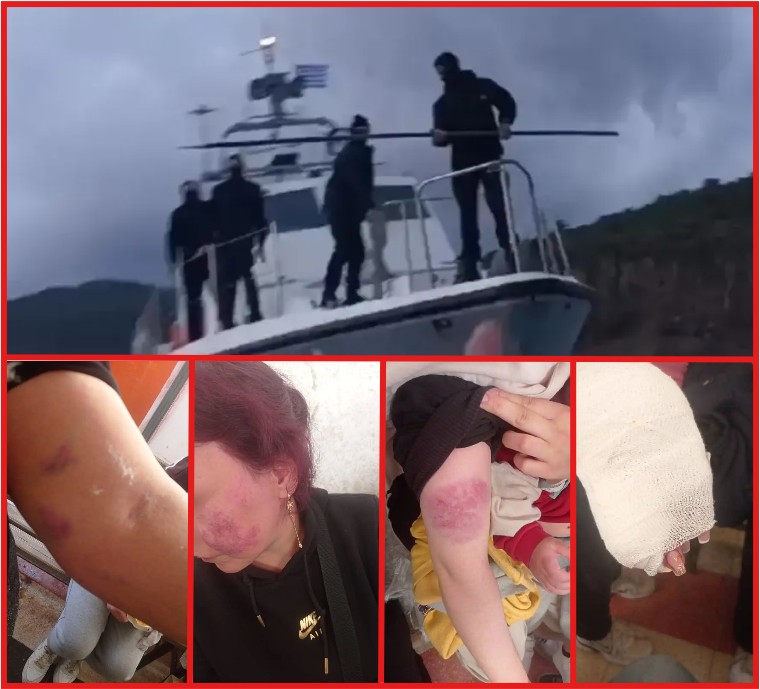
In the early hours of October 25, a boat carrying 34 people, including 11 small children, departed from Karaburun, Turkey. Their destination was the small Greek island of Pasas, northeast of Chios.


Deep inside Greek territorial waters, their boat was spotted and intercepted by a vessel from the Greek Coast Guard. Masked men in a RIB launched from the Coast Guard vessel threatened them at gunpoint, ordering everyone to hand over their belongings, bags, papers — and especially their phones.
Those who didn’t obey immediately or protested were brutally beaten, regardless of gender.
The engine was removed and thrown into the sea. A rope was attached to the bow, and they were towed back into Turkish waters.
One brave girl in the group had managed to hide her phone. At 02:36, she called for help — she called Aegean Boat Report. We immediately alerted the Turkish Coast Guard.
People were screaming hysterically over the phone, making it impossible to understand what was being said. We did our best to calm them down. Panic onboard a fragile, overloaded boat in the dark, filled with people who cannot swim, is an extremely dangerous situation.
After a few minutes, we managed to restore some calm and establish a normal conversation. We gathered vital information and received videos from the boat, which we immediately shared with the Turkish Coast Guard — unfortunately, they were nearly an hour away.
While waiting for rescue, we continued documenting the situation to ensure it could later be verified.
Videos from the boat clearly showed signs of violence: a man bleeding from a head wound, a woman bleeding from her hand.
It is almost incomprehensible that this could have been done by a European Coast Guard, officers sworn to protect life at sea — beating unarmed civilians seeking protection.
We stayed in contact until the Turkish Coast Guard arrived at 03:35.
The young girl contacted us again the following morning, describing in more detail what had happened and sharing photographs showing the brutality inflicted by the Greek Coast Guard.


For more than five years, Greek authorities have systematically kidnapped, beaten, tortured, and killed men, women, and children at Europe’s border — in the name of “border protection” — with complete disregard for human dignity, life, and international law.
Such actions directly violate:
• The 1951 Refugee Convention (Article 33, non-refoulement principle)
• The European Convention on Human Rights (Articles 2, 3 & 5 – right to life, prohibition of torture, liberty and security)
• The UN Convention Against Torture
• And the International Convention on Maritime Search and Rescue, which obliges all vessels to rescue those in distress at sea.
These are not allegations — they are documented crimes, confirmed through independent investigations, including by Frontex’s Fundamental Rights Office and the EU’s Anti-Fraud Agency (OLAF), both of which verified the existence of systematic pushbacks, cover-ups, and EU complicity.
Europe cannot claim to defend human rights while funding, enabling, and politically protecting those who violate them.
All 34 people in this group were Afghans from the Hazara minority, one of the most persecuted ethnic groups in Afghanistan.
After being intercepted at sea, such groups are routinely arrested by Turkish authorities and taken to EU-financed Removal Centres. From there, they are transferred to camps near the Iranian border and eventually deported to Afghanistan through Iran.


For Hazara deportees, this is not repatriation — it is a return to a country where their very identity puts them in mortal danger.
The Taliban has for decades targeted the Hazara population through mass killings, disappearances, forced displacement, and religious persecution, documented by the United Nations, Amnesty International, and Human Rights Watch.
Since the Taliban’s takeover in 2021, attacks against Hazara civilians — including bombings of schools and mosques — have intensified, prompting UN experts to warn of possible crimes against humanity and genocide.
When Hazara refugees are forcibly returned from Turkey, they face:
- Arbitrary detention or execution by the Taliban.
- Systematic discrimination and exclusion from education, work, and healthcare.
- Religious persecution as Shia Muslims in a Sunni extremist regime.
- For women and girls, a complete denial of basic human rights and increased risk of gender-based violence.
Returning them to Afghanistan under these conditions constitutes a clear violation of international law, including:
• Article 33 of the 1951 Refugee Convention (non-refoulement)
• Articles 2 & 3 of the European Convention on Human Rights (right to life, prohibition of torture)
• The UN Convention Against Torture
• EU Charter Of Fundamental Rights, Artical 18 & 19
Aegean Boat Report documents these violations every day — independently, without government funding.
Our work continues only because people believe the truth still matters.
💙 If you want us to keep exposing these crimes and protecting the rights of people on the move, please consider supporting us:
👉 whydonate.com/en/fundraising/ABR-Tommy-Olsen
Every contribution helps us stay in the field, document the facts, and hold Europe accountable.