
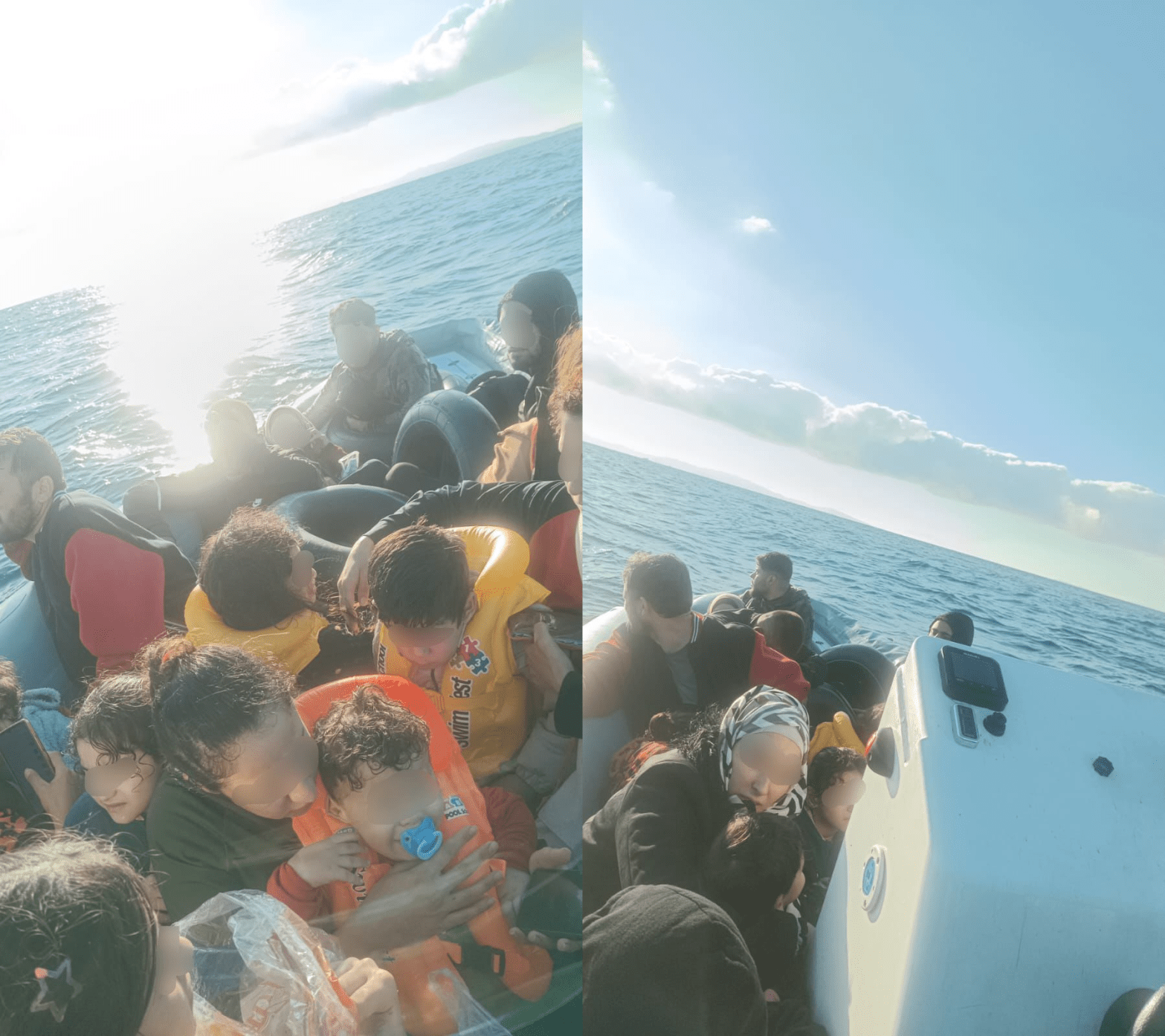
In the morning of Tuesday, September 30, a boat in distress south of Lesvos—reportedly carrying 27 people, including 14 small children—contacted Aegean Boat Report for assistance.


“Aegean Boat Report has been contacted by people onboard a drifting boat inside Greek waters, 7 nautical miles south of Lesvos. According to passengers, the boat is carrying 27 people—including 14 small children. The Greek Coast Guard has been informed. We hope they will immediately initiate a rescue operation in line with international and maritime law.”

No rescue followed. No one was brought to the camp on Lesvos that day. The Greek Coast Guard later claimed there were no rescue operations in the area and that they had not been alerted to a boat in distress. This is false. We alerted them directly and can document that we did so.


What we documented
- The boat was drifting inside Greek waters, south of Lesvos, with a failed engine. We informed the Greek Coast Guard and provided the location.
- A short time later, the same boat was found drifting off Karaburun, Turkey—around 10 km away—still with a failed engine.
- People onboard reported that masked men from a Lambro 57 coastal patrol vessel threatened them at gunpoint and seized their belongings, especially their phones. After that, we lost contact with the group.
- On the morning of September 30, the Turkish Coast Guard located 31 people—including 12 small children—inside Turkish waters off Karaburun, removed them from the boat, and transported them back to Turkey. As is routine in such cases, Turkish authorities were notified by email after the pushback.

This sequence does not require speculation. There is no plausible way a powerless boat drifted against the tide and wind from Greek waters to Karaburun without external intervention. We therefore maintain that the Greek Coast Guard intercepted the boat inside Greek waters and pushed the people back into Turkish waters—an illegal practice under international and maritime law.

Legal obligations
Under international maritime law, every vessel and coastal state has a duty to render assistance to any person in distress at sea (Article 98 of the UN Convention on the Law of the Sea, and the International Convention on Maritime Search and Rescue).
At the same time, human rights law—including the European Convention on Human Rights (Article 3 and Article 4 of Protocol 4) and the 1951 Refugee Convention (Article 33 on non-refoulement)—strictly prohibits returning people to a place where they risk persecution, torture, or inhuman treatment.
Pushbacks at sea violate all these obligations. When the Greek Coast Guard forcibly returns people to Turkish waters without assessing protection needs, they breach both maritime and human rights law. These are not political opinions—they are legal facts.
Pattern—and consequences
The Greek Coast Guard publicly denies such actions, insisting it would never endanger lives. Yet the pattern is consistent and well documented.
Yesterday, a separate boat bound for Lesvos—with at least 18 people—sank after encountering the Greek Coast Guard before reaching land; a young woman died.

The official account again claims the boat “moved dangerously,” that “signals” were used, and that a “mechanical failure” suddenly caused passengers to fall into the sea—an explanation recycled in multiple cases over recent years.
We believe these deaths are not accidents in isolation but the foreseeable outcomes of systematic, unlawful pushbacks. Greek authorities are pushing boats back—often violently—to prevent people from reaching shore and applying for asylum. When these operations go wrong, people die.
Our call
We call for an urgent, independent international investigation into “shipwrecks” and interdictions in Greek waters over the last five years. Too many lives have been lost under suspiciously similar circumstances.
We are convinced that many of these incidents are not mere accidents, but pushbacks gone terribly wrong—carried out by Greek authorities in clear violation of maritime and human rights law. Those responsible must be held to account.
Stand With Us
For years, Aegean Boat Report has documented these violations — often in real time — to make sure the truth cannot be erased.
We do this work independently, without government funding, because transparency and accountability matter.
If you believe that no one should be left to die unseen at Europe’s borders — stand with us.
Every message, every share, and every monthly donation helps us continue to monitor, document, and expose what others try to hide.
🧡 Every month matters — every voice counts.
Aegean Boat Report