For years, Greek authorities have carried out a systematic campaign to intimidate, criminalise, and silence those who expose human rights violations, illegal pushbacks, and the ill-treatment of vulnerable people at Europe’s maritime borders.
Aegean Boat Report, along with other frontline defenders, has been deliberately targeted:
Investigated repeatedly
Publicly discredited
Threatened with prosecution
In some cases, individuals have even faced arrest warrants
This is no coincidence. It is a calculated government strategy designed to isolate and weaken organisations that shine a light on violations the authorities want hidden.
A New Phase in Silencing Civil Society
The latest statements by Minister of Migration and Asylum Thanos Plevris mark an escalation. The government has announced plans for “administrative controls” on NGOs — including the power to deregister organisations that challenge migration policies or promote “alternative approaches.”
This is not just about regulation. It is about control.
The aim is clear: to intimidate NGOs into silence and ensure fewer organisations dare to expose illegal and inhumane practices.
A Divide-and-Isolate Strategy
For years, while frontline watchdogs and whistleblowers were being criminalised, many larger NGOs remained silent — fearful that standing in solidarity would jeopardise their ability to work in Greece.
Some severed communication with organisations like ABR entirely, hoping to “stay out of trouble.” The result? Watchdogs were isolated, their work made harder, and government pressure became even more effective.
Now, the same strategy that targeted a few is being extended to everyone. Even NGOs that once avoided “rocking the boat” are at risk if they challenge government policies or take legal action against unlawful practices.
A Chilling Effect on Democracy
This escalating crackdown has a profound chilling effect on democratic principles:
Freedom of association is under attack
Human rights defenders are intimidated into silence
Civil society is weakened, divided, and afraid to act
This Trump-like approach — punishing anyone who dares to criticise the authorities — threatens not only the rights of refugees and migrants but also the health of democracy itself in Greece.
ABR’s Position
Aegean Boat Report will not be silenced. We will continue to:
Document what others try to hide
Expose illegal pushbacks and abuses
Stand with every organisation and individual committed to defending human rights, transparency, and the rule of law
Silencing NGOs does not make violations disappear. It only makes them harder to prove — and easier to repeat.
We call on the European Commission, international partners, and the global human rights community to act now: Protect civil society. Defend democratic freedoms. Hold Greece accountable.
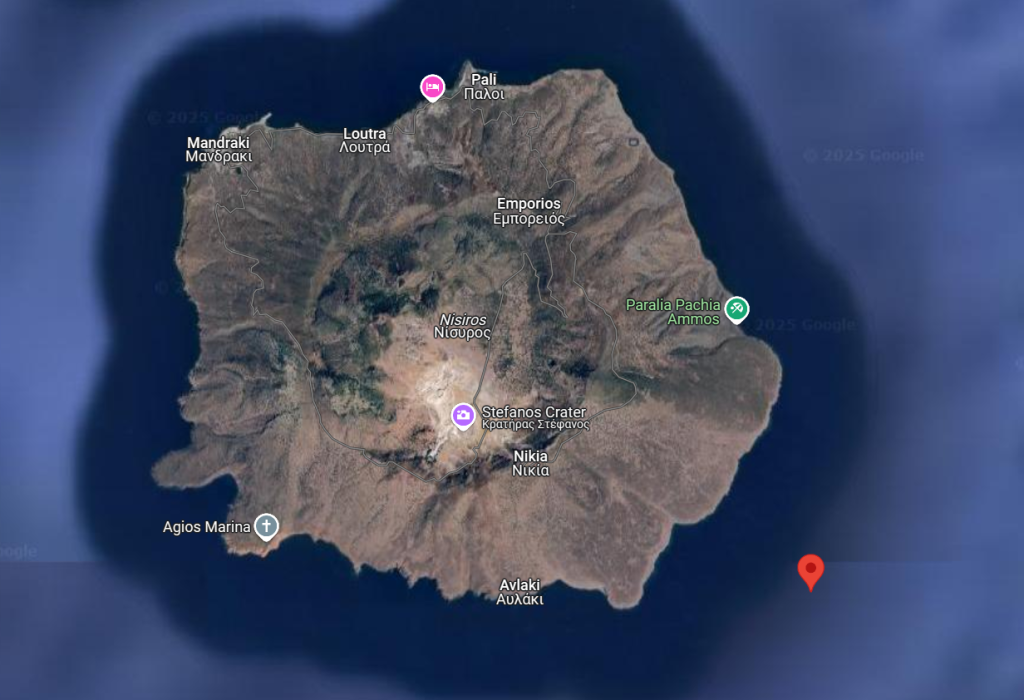
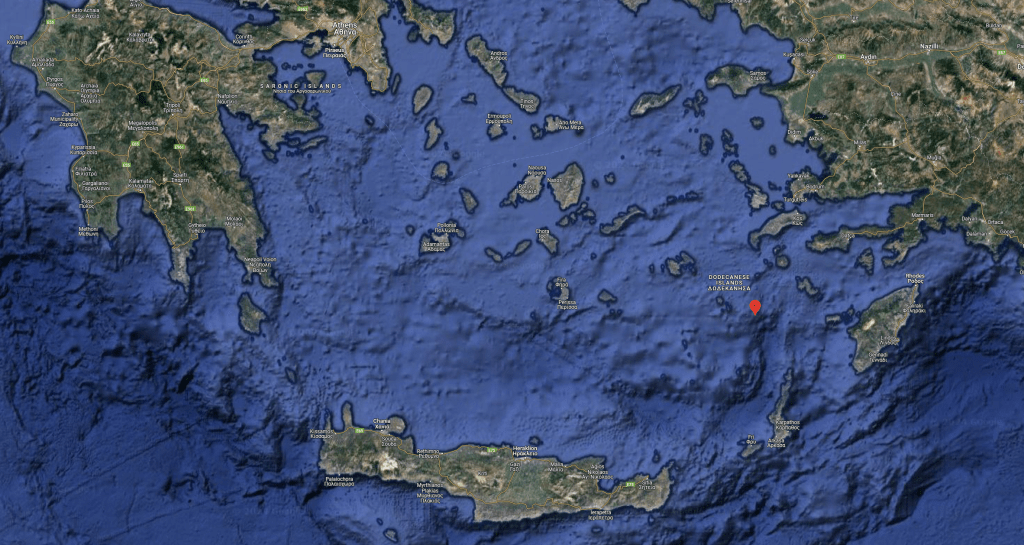
Before midnight on May 25th, Aegean Boat Report was contacted by passengers onboard a drifting vessel only 1.5 km from the southeastern shore of the Greek island of Nisyros.
People onboard informed us that the boat was drifting due to a malfunctioning engine, and that there were 100 passengers onboard, over 30 of them small children, mainly Syrians and Afghan families.
The current and wind direction was pushing the boat north west, straight toward the cliffs on the shores of Nisyros, wind speed 5-6 Beaufort, and we immediately contacted the Greek coast guard to alert them of the emergency situation.
Alerting the Greek coast guard about boat in distress carrying refugees in Greek waters, is many times a painstaking task, this time was no exception.
The call lasted almost 10 minutes, I was put on hold several times, and when they eventually found the time to talk to me, they were much more interested in who I was and how I had com across this information, than the emergency case I was trying to inform them about.
Over the years I have gotten used to discussing and arguing with the emergency call center of the Greek coast guard. After hundreds of calls they know very well who I am, but makes a point, every single time, pretending to not have the faintest idea. Waisting time seems to me the be the main objective, time that otherwise could have been used to save lives.
When boats are in distress in the Aegean Sea, the only option available is to contact the appropriate authorities in the area, there are no other rescue vessels as you can find in the Mediterranean. There is no international waters in this area, only Greek or Turkish waters, where NGO’s are not allowed to operate. If in distress in Greek waters, we are left with no option, even do we know that Greek authorities will do their utmost to push people back, no matter the consequences.
We remained in contact with the passengers of the drifting vessel, from videos received we could see that people were cramped inside and outside of the vessel. We didn’t register anyone wearing life jackets onboard, if the boat had hit the cliffs and capsizes, this would very quickly have become a disaster.
Shortly after midnight the passengers informed us that a boat was approaching. In the beginning only as search lights in the distance, people were shouting and flashing with their phones, relived, finally they would be rescued.
Their optimism fainted slightly when they released that the boat who was now pulling up alongside them, was most likely too small to take onboard 100 people, and the three men seen on deck in green uniforms, helmets, face covered, carrying battle rifles, didn’t seem like someone who was there to save them, quite the opposite.
Shortly after the Greek coast guard vessel arrived on location, we lost contact with all the phones on the boat, and we could only hope that the people in distress would be transported to the nearest port of safety.
We did several follow up calls to the Greek coast guard, whom we had previously spoken to, to try to get any indication on whether this was in fact a rescue operation, or a pushback.
Officers on call were extremely hostile, refusing to provide any information, denying having any information on an emergency case in the area, and would not confirm that there were an active operation ongoing. When I tried to explain that I was the one who had informed them about this case in the first place, he shouted something in Greek that i couldn’t make out, probably nothing good, and hung up the phone.
To be met with such extreme unprofessional behaviour, from an operator of a national emergency call centre, is just unbelievable, but when in contact with the Greek coast guard, this is unfortunately not uncommon.
From this point we were fairly certain that the boat that arrived on location was not there to rescue anyone, but rather to make sure that they didn’t set foot on Greek soil, and push them back.
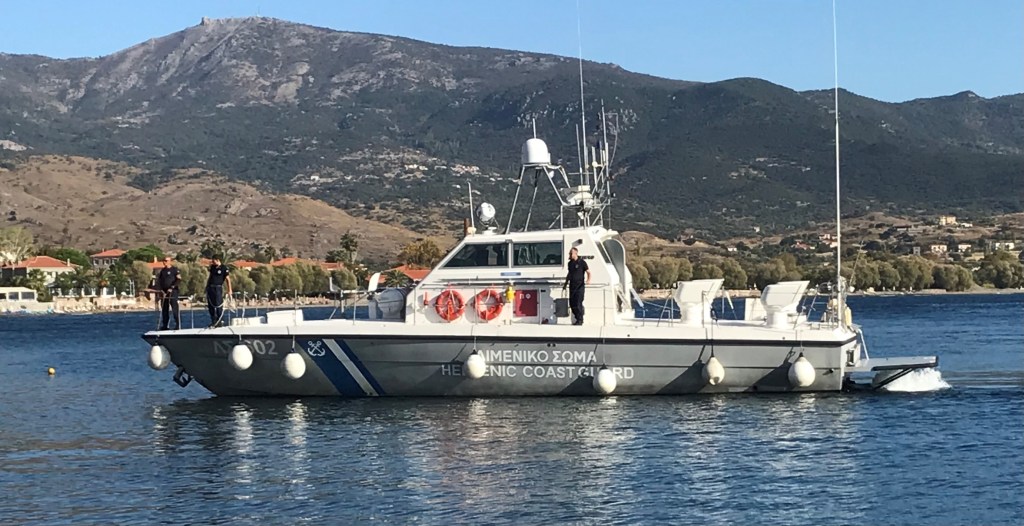
In a video taken by one of the passengers on the drifting boat outside Nisyros, we can see a Lambro 57 coastal patrol vessel belonging to the Greek coast guard, and three men in Green uniforms, armed and in full tactical gear, ready to board.
The Greek coast guard use dark blue uniforms, not green as we can see on deck in the video.
From several previous investigations into the illegal practice of the Greek authorities, it’s commonly known that on all coast guards vessels, there are Greek Navy special forces deployed, O.E.A, or most like O.Y.K, Underwater Demolition Team. Highly motivated individuals carrying out direct order from the Greek authorities to the letter, no questions asked, pain, suffering and death follow in their footsteps.
For the next three hours we were unable to reconnect with anyone onboard the drifting vessel, all we could do was wait.
At 3.30am local time we received a new emergency call from the boat, but they were no longer close to the Greek island of Nisyros, not even in Greek waters.
The new location we received from the boat, showed that they were in Turkish waters, 3 kilometers south east of Bağlarözü, Datça, and over 10 kilometres from their previous location four hours earlier.
A boat carrying 96 people, 38 of them small children, was towed by the Greek coast guard for over three hours into Turkish waters. If something had gone wrong, like when they attempted to tow the Adriana, we would have had yet another tragedy on our hands. Non of the passenger hade life jackets, and the coast guard vessel was not equipped to perform a rescue operation of this scale.
Greek authorities would easily and very “logically” explain this as a “prevention of entry”, even do the boat was deep inside Greek territory waters at the time they were found drifting. They would also say that the boat voluntarily had turned around and gone back to Turkey, that the boat had no working engine, and had to drift against wind and current seems to be of no importance.
The problem is that they know they can basically say and do whatever they want, because no matter what they do, no matter how horrible the outcome is, no matter how many they kill, they have the full support of Frontex and the European Commission. The Pylos shipwreck, where over 650 people were killed by the Greek authorities, is a clear testimony to the lack of accountability, not only by Greece, but also the European Commission.
The Adriana, 650 people drowned after Greek authorities failed pushback attempt outside Pylos, Greece
When we regained contact with the boat, we immediately contacted the Turkish coast guard and informed them. In contrast to the call to the Greek coast guard 4 hours earlier, this call took only 43 seconds, in this short time we provided all necessary information, and also explained that the boat had been pushed back by Greek authorities. The operator could inform us that they had received an email from their Greek counterparts, with information and location of the drifting boat in Turkish waters, as routinely is done after they have pushed boats back.
While still adrift, one of the passengers explained what had happened.
Masked armed men carrying guns entered the boat.
Everyone was gathered together, and everyone was ordered to hand over their phones, those who refused were beaten.
At least two people managed to hide their phones, those phones were later used to call for help.
A rope was tied to the front of the vessel, and the coast guard started to tow the boat back toward Turkish waters.
After 3 hours the armed men removed the rope, went back to the coast guard vessel, who then just left them helplessly drifting.
This is the usual approach by Greek authorities when encountering larger vessels in Greek waters, they try to tow it out of Greek waters to avoid dealing with it. The same method was used outside Pylos, when they tried to tow the Adriana into Italian waters, which led to one of the worst shipwreck in modern times, killing 650 people.
People onboard were afraid of also the Turkish coast guard, they claimed that the Turkish coast guard would beat them similarly as the Greek coast guard had done.
At 04.30 the Turkish coast guard arrived on location, shortly after we lost contact with the two remaining phones on the boat.
The following day, when Turkish coast guard published their official report on the incident, they deliberately falsified the report to cover up for Greek human rights violations.
The incident was officially registered as a case where the Turkish coast guard had stopped a boat from crossing into Greek waters, even after the pushback had been confirmed by the passengers onboard, Aegean Boat Report and also by official email from the Greek coast guard.
This charade has been ongoing since last summer, hundreds of pushback cases have been deliberately registered incorrectly by the Turkish authorities, in an effort to mislead the public in believing that things are getting better, it most definitely haven’t.
So why would Turkey be interested in covering up Greek human rights violations? We actually don’t have an answer to that, but we suspect that they are not doing it out of kindness and consideration for the Greek authorities.
These deliberate cover ups by authorities on both sides of the Aegean, gives an illusion that there are less violations of the rights of people on the move, a smokescreen, in reality, it’s business as usual at Europe’s outer border, where systemic human rights violations takes place on a daily basis.
We fear that what we see today at Europe’s border, is only the beginning, and in the years to come escalate, to a point where human rights will be the privilege of the few, and those trying to cross through irregular routes can be shot on sight.
You might say “this will never happen”, but if I had predicted today’s reality in the Aegean Sea, 30 years ago, you would have said the same.
On 14 of June 2023, Greek authorities Killed 650 people in the sinking of the Adriana off the coast of Pylos, Messenia, Greece. Officers onboard was acting on direct orders from Greek authorities, fully aware that the order was illigal under Greek and international law.
On May 23, almost three years after the crime took place, the Greek naval court has charged 17 coast guard officers, amongst them the captain, of the Greek offshore patrol vessel LS-920, who attempted to tow the Adriana and caused it to capsize.
Greek authorities are now looking to find a scapegoat, someone to put the blame on for this tragedy, and to divert attention from those really responsible, from where the orders originated from, the Greek government, and especially it’s leader, prime minister Kyriakos Mitsotakis.
It sends out a clear signal, especially to the members of the Greek coast guard, that the one giving them these illegal orders, the Greek prime minister, won’t think twice about “throwing them under the bus” if caught after following his illegal orders, to save his own skin.
We have no illusions that those charged will ever be convicted in a Greek court, for that to happen, it needs to be lifted up to a European level.
Systematic human rights violations at the Greek sea border, has been ongoing for over 5 years. Almost 100.000 people have been illegally and violently removed from Greek territory, and pushed back towards Turkey, over 1.000 people have been killed in these illigal operations.
Greek authorities, supported by Frontex, have again been proven to be involved and responsible for human rights violations in the Aegean Sea. The question is, what will Frontex management board and the European Commission do to stop this?
We demand that the European Commission immediately launch infringement proceedings against Greece for systematic and widespread human rights violations, and we demand the ceasing of all Frontex operations in Greece in accordance to article 46 of the Frontex regulation.
In the morning of Thursday May 1, a boat in distress north of Samos, inside Greek territory waters, contacted Aegean Boat Report and asked for assistance.
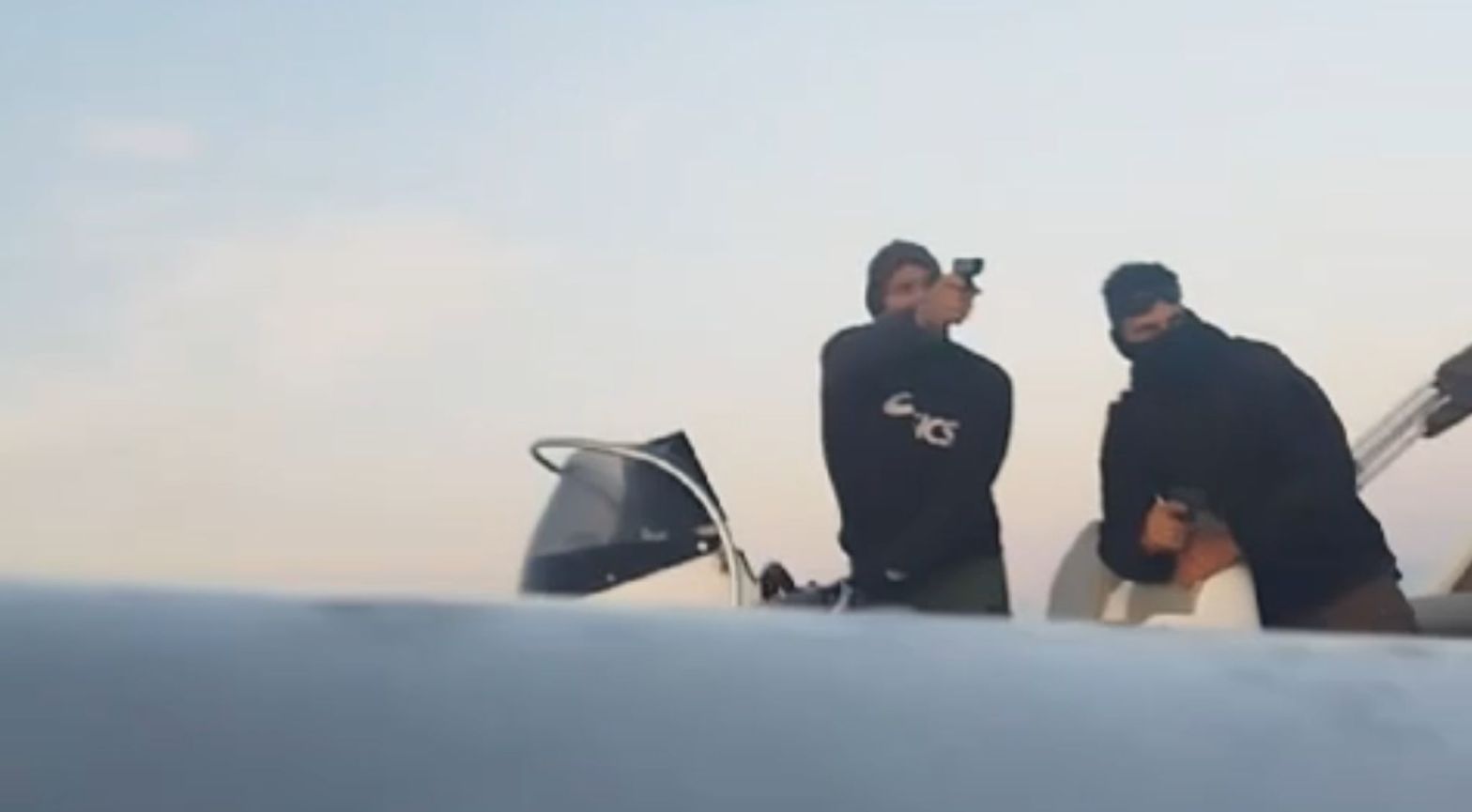
They explained that they were on the way to Samos, but were brutally stopped by a vessel from the Greek coast guard. Masked men on the coast guard vessel had destroyed the engine by using long sticks with hooks, afterwards they were left drifting in the middle of the sea.
File Photo
The group informed us that their rubber boat had been drifting for hours and was slowly taking in water, they feared drowning or that their rubber boat Greek coast guard would push them back to Turkey.
Onboard the drifting boat was 44 people, 22 of them small children, the majority of the passengers were from Afghanistan.
People onboard told us they already had called 112 and informed of their situation, and had been told that local rescue assets would be informed. The only problem, those local rescue assets were already on location, and had no intention of rescuing them, they were actually the reason for them needing rescue in the first place.
The vessel seen in the videos, taken by the distressed group has been identified as a Lambro 57 coastal patrol boat, belonging to the Greek coast guard. Several of these vessels are stationed on Samos.
When boats are in distress in the border area, we routinely inform the coast guard on both sides of the border. The Turkish coast guard could inform us that the boat was inside Greek territory waters, but they were monitoring the situation in case something happened.
The Greek coast guard were not similarly cooperative, and was more interested in information about the one calling, than the emergency case we tried to inform them about. It took us 19 minutes from first call, until they agreed to take the information. That involved them hanging up the phone two times, and one time pretending not to understand English. In comparison the call to their Turkish counterparts took 37 seconds.
They told us that they had no information on current cases in the area, but they would look into it. When we informed them that we knew that the coast guard was already on location, since we had received videos from the drifting boat, the man mending the phone at the port police office on Samos, got very loud and angry, that resulted in him hanged up the phone for the third time.
If this had been a rare one time occurrence, when contacting the Greek coast guard, we could have written it off as a local coast guard officer just in a bad mood, unfortunately this is more like the rule than the exception. Whenever we are in contact with the Greek coast guard to inform them on distress cases at sea in Greek waters, we are usually met with a very hostile attitude. They show total lack of professionalism, and seem to be totally indifferent about the potential loss of human lives in their waters, as long as the people in question are refugees.
We had contact with the boat for almost three hours, in this time the boat was drifting with the current, steadily south west, deeper inside Greek territory waters. When realising this miscalculation, the coast guard had to do something, because the boat was drifting towards Samos, and not towards Turkish waters.
At 10 am local time, people onboard the drifting boat informed us that the Greek coast guard vessel quickly moved closer, “they are rescuing us now” they told us, people seemed skeptical but relieved that their ordeal was finally over, 12 minutes later we lost all contact on all phones from the boat.
One of the phones had shared live location on WhatsApp, and we could follow their movements towards Cape Prason on Samos for almost one hour, that could indicate a rescue and not a pushback, unfortunately this was not the case.
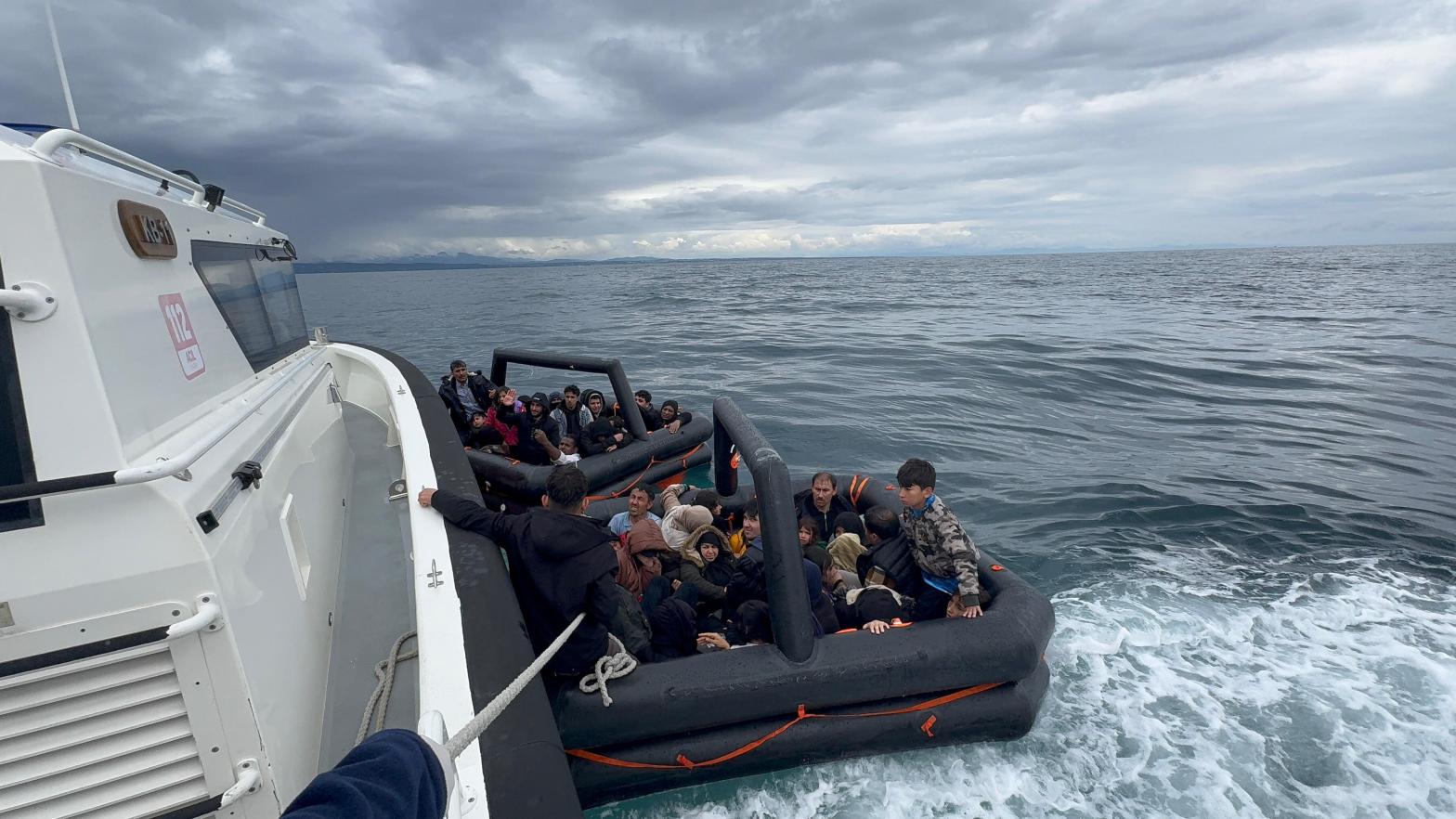
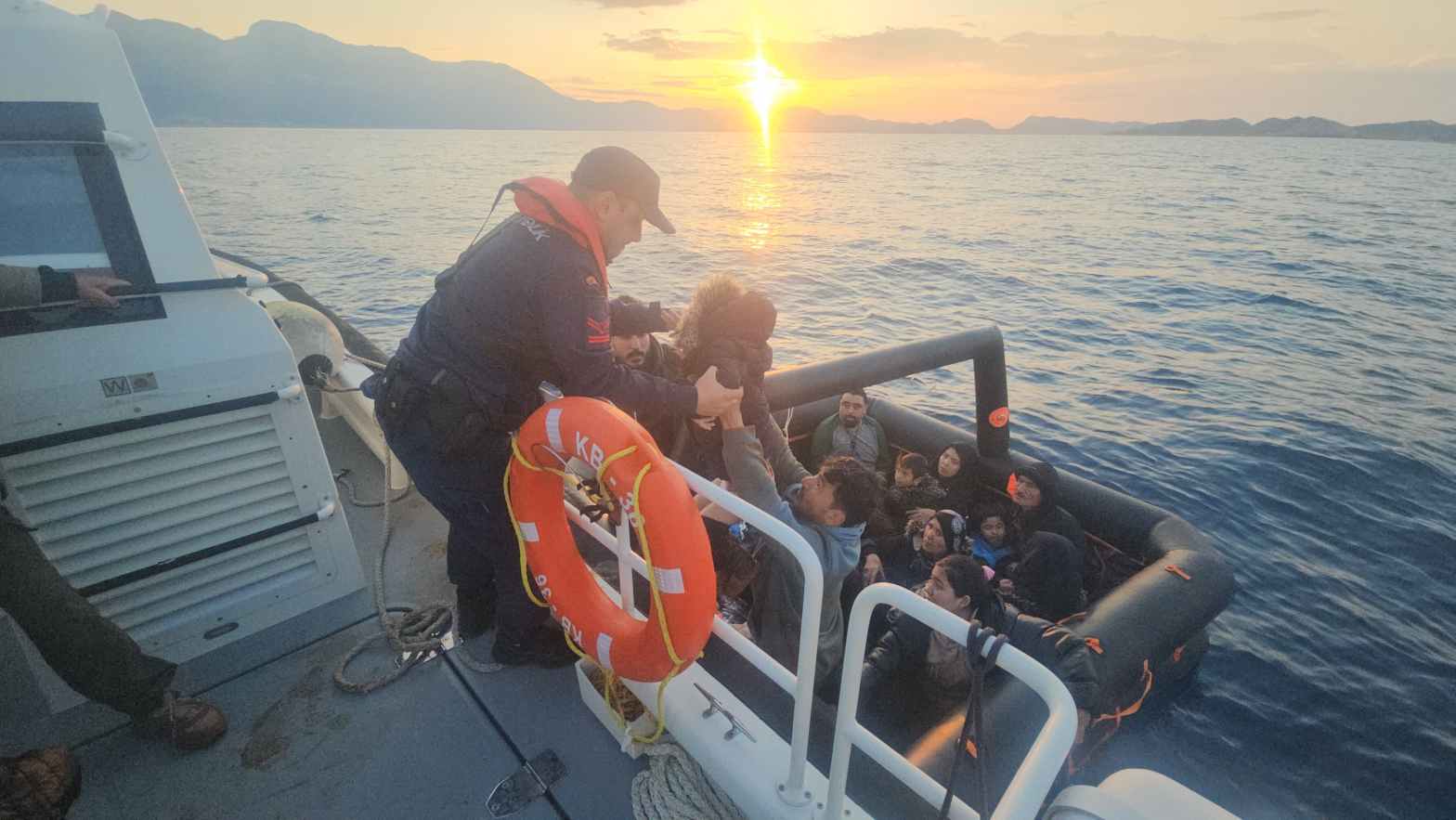
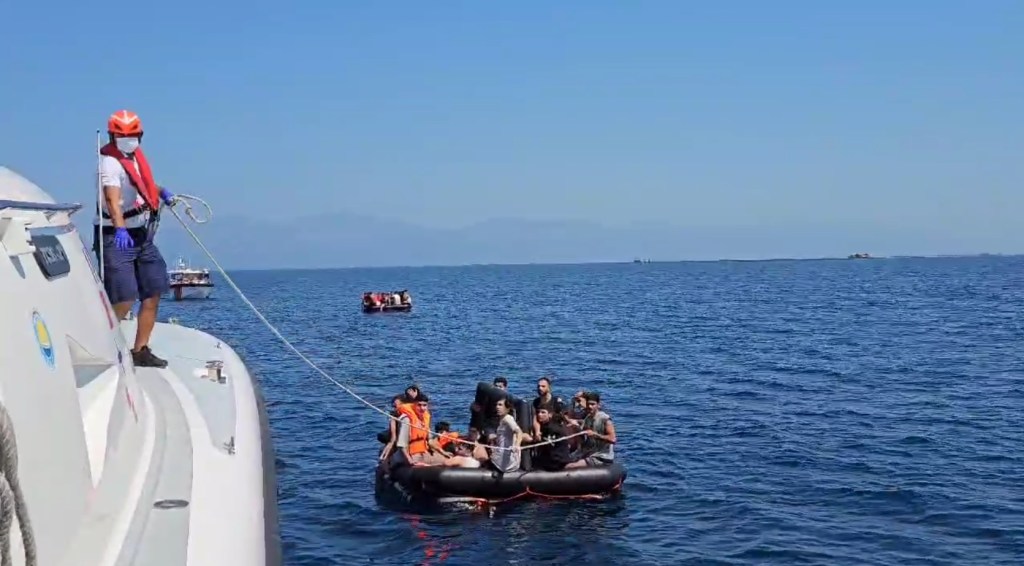
We searched for information about the group for hours, but couldn’t find anything about the coast guard on Samos bringing in people to port. The simple explanation became clear many hours later, when we were informed that the Turkish coast guard had located and rescued 44 people, amongst them 22 children, from two life rafts drifting north west of Didim, Turkey, over 40 miles south east of Samos.
While we had contact with the group, they shared pictures and videos that later became very important in proving, not only what happened to them, but also who were responsible.
When comparing pictures and videos taken onboard the drifting rubber boat, with the footage taken by the Turkish coast guard while rescuing them, there is absolutely no doubt, they are the same group.
The Turkish coast guard could inform us, that they had received an email from their Greek counterparts, informing them of people drifting in their sector, and a rescue operation had been initiated.
Watching the videos taken onboard the drifting boat, we could see that people had bags with them, when found drifting by the Turkish coast guard, nobody had any belongings. Further more, those few who actually had life jackets while onboard the drifting boat, had non when found in the life rafts.
The normal practice by the Greek coast guard, that has been thoroughly documented for years, is that whenever people are pushed back in these life rafts, the coast guard robes them of all belongings, bags, phones, money and other valuables, even life jackets, that could potentially save their lives if something goes wrong.
The group was transported over 40 miles in a Greek coast guard vessel, before being forced into two life rafts and left helplessly drifting in the middle of the sea, this shows Greek efforts and determination to stop people from reaching the Greek islands, by all means possible, even if this means killing people in the process.
When looking at official arrival data published by Greek authorities, no arrivals were registered on Samos on May 1, nor the days that followed.
We were also contacted by relatives of people in the drifting boat, who tried their best to provide some assistance to their family members in distress at sea.
For a week they haven’t been able to locate them in Turkey, from pictures they sent we can confirm that they were amongst those pushed back by Greek authorities outside Samos, and later found by the Turkish coast guard.
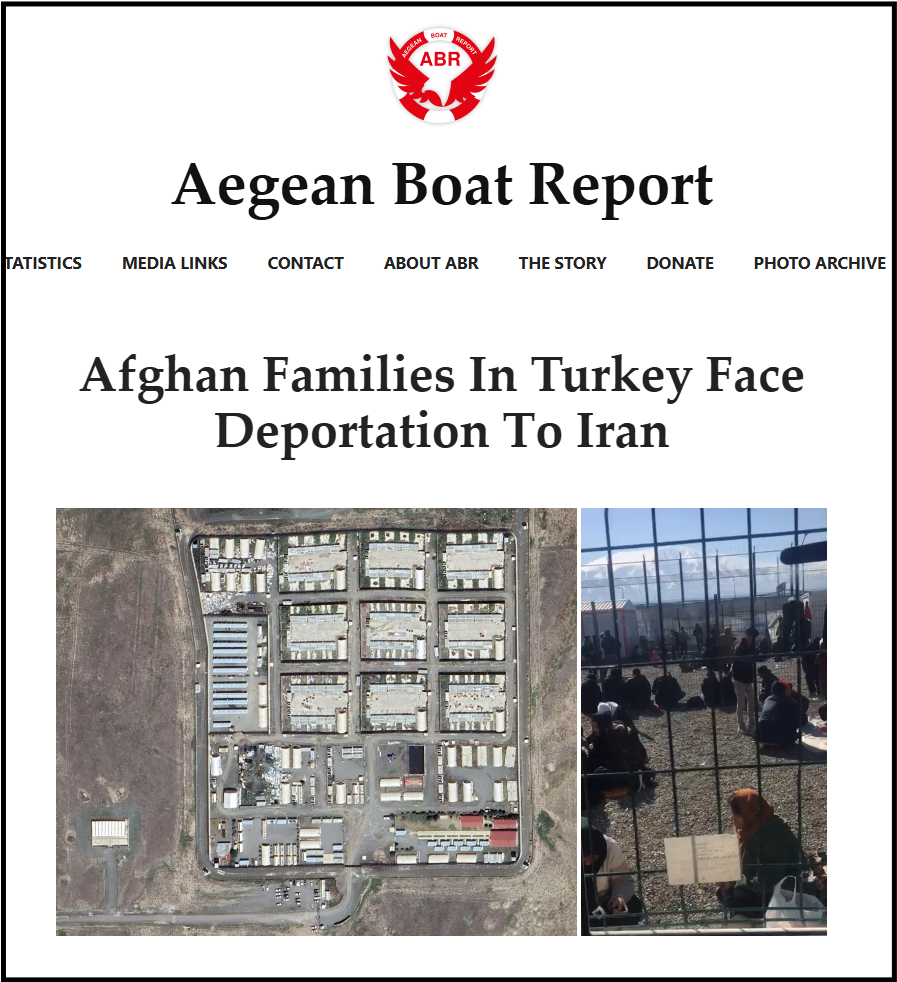
What usually happens, especially to Afghans, when picked up by Turkish authorities, after a failed attempt to reach Europe, is that they are taken to a removal centres, awaiting transportation to the Iranian border, where they will be deported back to Afghanistan through Iran. These deportation centre’s in Turkey are fully funded by the European Union.
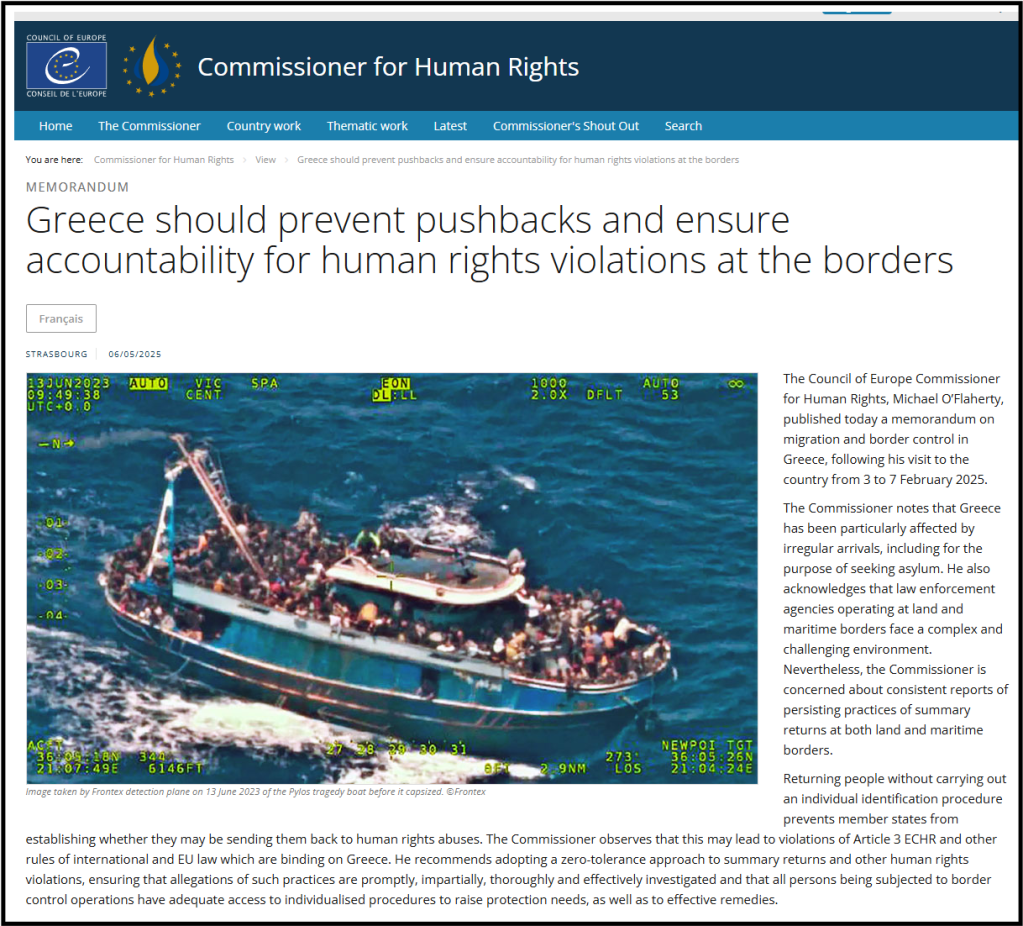
A few days ago, The Council of Europe Commissioner for Human Rights, Michael O’Flaherty, published a memorandum on migration and border control in Greece, following his visit to the country from 3 to 7 February 2025.
The report is as clear as it could be, when it comes to the systematic human rights abuses at Greek borders in relation to pushbacks, similar to other reports by EU bodies on the subject over the last five years.
It didn’t take long for the Greek authorities to respond, and their reply didn’t shock anyone, it was a textbook answer. In all cases related to criticism towards the Greek authorities, throughout modern history, they have never ever admitted any wrongdoing, even when it’s staring them straight in the face, clear as day, they continue to deny, mislead and point the finger elsewhere.
The Minister of Migration and Asylum, Mavroudis Voridis, responded to the damming report by referring to what they on paper have put in place to make sure fundamental rights are protected in Greece. That’s great, if it hadn’t been for the overwhelming amount of evidence painting a very different picture of the situation over the last five years, something the minister is painfully aware of, nevertheless, he is desperately trying to mislead the general public in this futile attempt.
But it didn’t end there, even the Greek Supreme Court prosecutor’s categorically denied that systematic pushbacks are taking place at the Greek borders, once again raising grave concerns regarding the independence of the Greek judiciary, and their involvement in covering up Greek authorities human rights violations.
To put things in perspective, in the last five years, under the rule of “Nea Democratia”, we have registtered 3.388 pushback cases in the Aegean Sea, performed by the Hellenic coast guard, involving 93.072 men, women and children. 1.099 of these cases was performed by using rescue equipment/life rafts, 29.216 people was left drifting in 1.685 life rafts in the Aegean Sea.
That systematic human rights abuses is taking place in Greece on a daily basis, there is no longer any doubt, the overwhelming amount of evidence makes it impossible to come to a different conclusion. Nevertheless, no matter how much evidence is put on the table, the European Commission and Frontex continues to support Greece, they are even funding Greece, so that they can continue killing men, women and children at it’s borders, in the name of the “European way of life” and “border management”.
The pressure is building up against the Greek authorities, and their blatant disregard for fundamental rights. One would expect that they would tune down their systemic violations at their borders, at least temporarily, until the storm blows over, so why aren’t they?
The answer is very simple, they have never been held accountable, all treats have been empty words, no action has ever been taken by the European Commission nor Frontex against Greece for their systematic human rights violations, in fact, they are being rewarded by an endless stream of EU taxpayers money to continue, no strings attached, zero accountability.
Since the head of Frontex, Hand Leijtens took office two years ago, we have heard him “consider” taking action against Greece many times, due to well documented systemic human rights abuses. He has never concluded that this has been necessary, and always found a good excuse not to.
Hundreds of violent and illegal pushbacks have been documented by EU bodies, journalists, organizations, NGO’s, and even by Frontex themselves, throughout Serious Incident Reports. The amount of evidence stacking up against the Greek authorities is overwhelming, but still not serious enough for Hans Leijtens to take action, it remains to be seen if it ever will be.
Just after midnight, on Saturday April 5, Aegean Boat Report was contacted by a group of 24 people, 10 of them small children, and a cat, who a few hours earlier had arrived on the Greek island of Kastellorizo.
The group reported being wet and could and stated “please we need help urgently, it’s dark and we need help, there are many children with us that is freezing, everyone is wet and cold”.
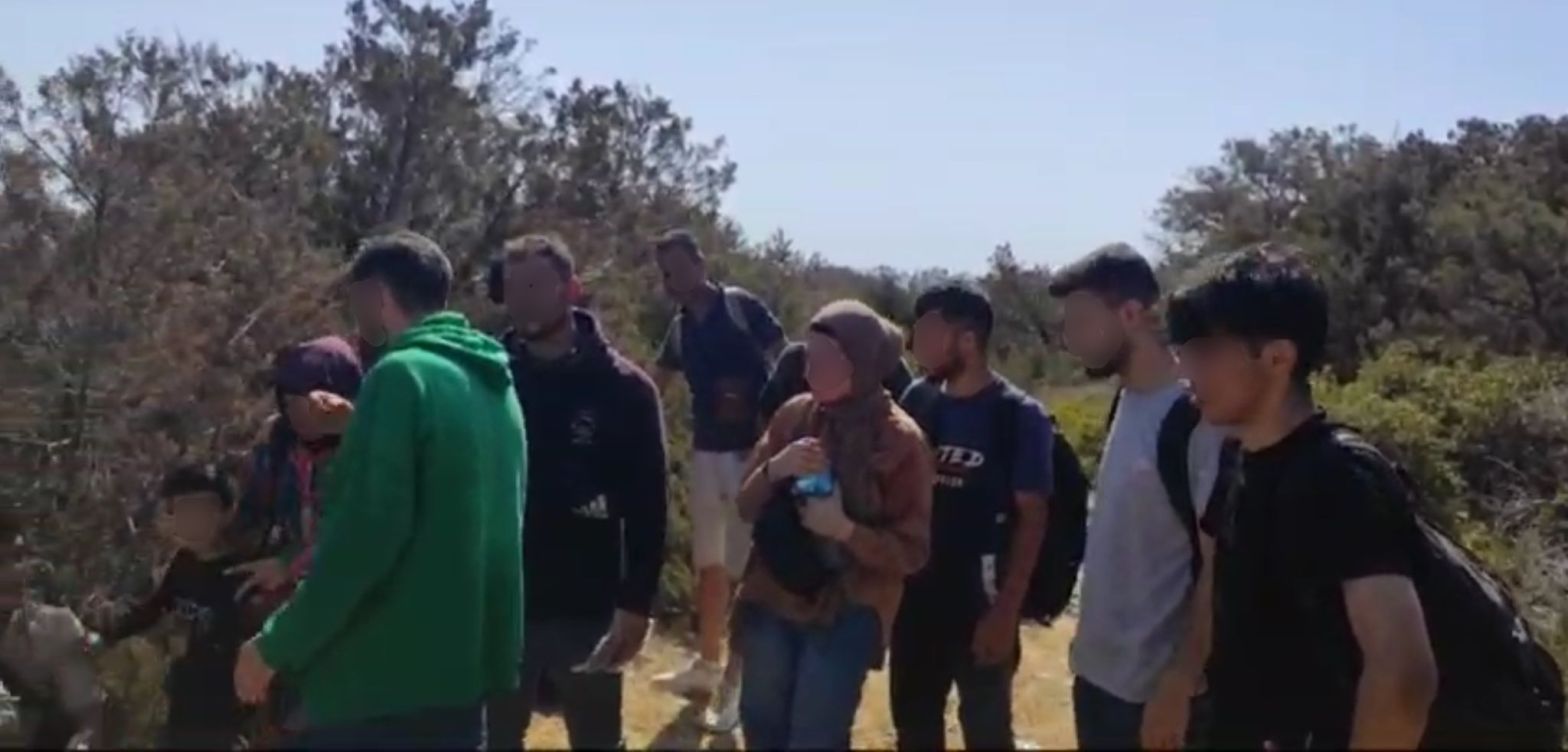
Video Filmed On Kastelloritzo after arrival 05.04.2025
We informed them, as we routinely do when people arrives on Kastellorizo, that there is no organization on the island that can assist, and that we recommend them to move towards a more populated area, and call 112 to inform authorities of their presence on the island.
Shortly after we lost all contact with the group, as a precaution, since they had told us that there were some medical issues in the group, without elaborating, we contacted local authorities. They first didn’t want to take the information we had, but after some “convincing”, the operator on the phone, reluctantly, agreed to take the information and said they would look into it.
Since we were unable to reconnect with the group, we did a follow up call to the local port police in the morning, whomwe had spoken with previously. This time they told me that they had no knowledge of any incidents on the island, and had most likely developed amnesia, because they had received no calls regarding arrivals on the island.
From that point, we suspected that the group that arrived on Kastellorizo the previous night, was no longer on the island, and in fact had been kidnapped, forced back to sea, and left drifting by the local coast guard.
After communicating with the Turkish coast guard, they could confirm that their patrol boats had found two separate groups drifting in life rafts, after first being alerted by email from the Greek coast guard.
The first group of 24 people, 10 of them small children, was found drifting in a life raft at 07.00 in the sea area south east of Kaş, Antalya district. The second life raft carrying 18 people, was located at 11.15 closer to land in the same area.
After reviewing the Turkish coast guard footage from the rescue operation involving 25 people, and comparing it with footage taken by the refugees on Kastellorizo, it’s clear as day, no doubt what so ever, it’s the same group that contacted Aegean Boat Report in the early hours of April 5, from land on Kastellorizo.
The port police on Kastellorizo tried their best to cover up and mislead, little did they know that we had hard evidence of the refugees presence on the island, and there can be only one conclusion. No arrivals was registered on Kastellorizo this day, nor the following day.
Local police and coast guard on Kastellorizo kidnapped a group of 24 people, amongst them 10 small children, forced them back onto a Greek coast guard vessel, took them back out to sea, and left them helplessly drifting in a life raft. We have unfortunately no information what happened with the cat the refugees had brought with them to Kastellorizo.
TCG footage arriving in port Kas, Antalya District
For months people who actually have arrived on the larger islands like Lesvos, Samos, chios and Rhodes, have not been in any imminent danger of being pushed back, on the small islands things have been different.
We have documented in the past that pushbacks from smaller island, where there are less watchful eyes, no organization, or no people living at all, like Inousses, Pasas, Farmakonisi, Simi, and Kastellorizo, have continued. The chance of local coast guard and police to be “caught in the act”, is less probable, but not zero.
Documenting these cases is many times very challenging, due to lack of enough evidence. In this case the people arriving documented their arrival, and sent the information to Aegean Boat Report. It unfortunately didn’t save them, but we can at least show the world what Greek authorities did to them.
For this group that don’t help, the damage is already done, but perhaps, if enough of these cases are properly documented, and not least published, this could potentially discourage Greek authorities to do the same to the next group arriving on Kastellorizo.
We will continue to monitor the situation in the Aegean Sea as long as it is needed, try to assist when possible, and publish our findings to the public, to make awareness on how Greek authorities systematically violate the rights of people, in the name of border protection.
There have been many efforts by Greek authorities to silence Aegean Boat Report, it has not been successful, and never will.
What on the other hand can silence us, is lack of funding. So please, support our monitoring project, that has been ongoing for seven years, by becoming a monthly donor.
10 Euros a mont might seem insignificant, even pointless, but if many enough contribute, this is actually enough to keep this vital support for people on the move running in the year to come.
So far over 200 people have registered as a monthly donor for Aegean Boat Report, perhaps you can afford doing the same?
With your support we will never be silenced!
To support our work and help us continue assisting vulnerable people on the move, you can donate by clicking on the link below👇
Since the start of 2024, 228 people have been arrested under suspicion of being ‘people smugglers’, a 53% increase compared to 2023, according to Hellenic Coast Guard official data.
If the people arrested had in fact been real hardcore smugglers, criminals whose only goal was to make money on others misery, I guess most of us would welcome this “achievement”. Unfortunately, most of those arrested are neither criminals nor smugglers.
In most cases – I’m not saying all, but most – the smugglers who sell spaces on boats simply do not travel on them themselves, especially in the case of rubber dinghies and small boats.
Instead, when people are getting on the boat, one of the refugees, normally a male, perhaps the last one onboard, or someone who looks capable enough to handle it, is told to steer the boat. They may be given a short instruction if they have no prior experience with boats, and pointed in the right direction.
There is no time to argue, everything must happen quickly to avoid detection, and suddenly the person is sitting there with the responsibility to get everyone across safely.
They are not paid to do this task, and most likely had no choice. They may even have tried to refuse, but are ‘persuaded’ by the real smuggler, carrying a gun.
In other cases, especially with larger vessels and sailboats, the real smugglers start by driving the boat, but before entering Greek waters, they abandon the vessel, and are picked up by a speedboat. The people on board are left on their own.
Those people are left with few options. Someone has to try to steer, as the alternative if nobody takes responsibility is that everyone could drown.
When arriving on the Greek islands or rescued by the coast guard in Greek waters, passengers are asked “who steered the boat”?” Fingers are easily pointed towards the one randomly picked by the smuggler on the Turkish shore, or the one brave and resourceful enough to have rescued all the other passengers. This person is then arrested, and charged with smuggling.
If a refugee with no experience in seafaring tries everything they can to prevent a shipwreck, but fails, and the boat goes down, they will be charged with “illegal transportation of third-country nationals into Greek territory” (smuggling), and with aggravating circumstances of endangering the life of people onboard.
If someone dies, which is often the case with shipwrecks, they will also be charged with causing the deaths.
Greek prisons are packed with thousands of people charged and convicted for smuggling. Most are not smugglers at all, just normal refugees trying to reach safety in Europe, but used as a tool of deterrence so that others would think twice before doing the same.
These charges against refugees arriving on the Greek islands have been used systematically by the Greek state for several years as a deterrent.
The Greek legislation used considers any person found to have driven a vehicle across Greek borders carrying people seeking protection to be a smuggler.
The arrests that follow these often-unfounded accusations of smuggling are arbitrary, and the trials flout basic standards of fairness. Police officers might accuse the person holding the tiller of steering the boat, the one who communicated with the coast guard to call for help, or simply anyone who speaks English, of being a smuggler.
Without sufficient evidence, they are usually arrested upon arrival, and kept in pre-trial detention – in jail – for several months.
When their case finally comes to court, their trials last on average only 30 minutes. The average prison sentence is 44 years, and some people have been jailed for more than 150 years.
Even those who are fined are deliberately done so in a way which means they can never ever pay: some people have been fined a ludicrous €400,000.
This is an obvious total lack of fair trial standards which would be expected in a European country.
When these cases have been taken up by real lawyers afterwards, sentences have been drastically reduced, and in many cases people have been released for time already served. But there are thousands of people in Greek prisons, who will never get a fair trial, and will spend the rest of their lives behind bars.
Most of these boats carrying people trying to seek protection on the Greek islands, come from Turkey, so if the smugglers were piloting the boats, it would perhaps be logical that at least some of the arrested would be Turkish nationals.
So, it’s interesting to note that none of the 228 people arrested for smuggling so far in 2024 were Turkish, while seven of them were Greek nationals.
In most cases, the real smugglers are rarely near the boats, and in most cases not on them. An overloaded standard rubber boat on its way to the Greek islands travels at an average speed of 5-7 km/h, so it’s only meant to reach the islands, or at least Greek waters, and never intended to go back to Turkey again.
It would be a strange “business model”, if the smugglers intentionally and willingly, drove these boats over, for them to spend the rest of their lives in a Greek prison: it’s not very logical, nor plausible.
There are certainly a few exceptions. There are speedboats going back and forth between the islands and Turkey, but those are actually trying to get back home to Turkey, not fleeing in fear of their lives.
Thousands of innocent people, all male, are rotting in Greek prisons, based on the idea that to transport yourself and your family across the border, with the intention to apply for asylum, is a crime, as long as it is done in a vehicle. If you walk or swim you are all good.
The Greek government – with the backing of the wider EU and many states outside the bloc – finds it convenient, and in the case of those fined, actually lucrative, to pretend that people seeking refuge, as is their legal right, are in fact ‘people smugglers’.
The result is not only a system of dishonesty, but one in which people are not only punished and vilified for seeking safety, but are also attacked for helping to save people from death at sea.
It is far from the only thing of which Greece, the EU and the wider world should currently be ashamed. But it is certainly one, and very far from a cause for ‘celebration’ as the Greek government pretends.
The EU’s official ‘border agency’ Frontex has once again been proven to have taken part in illegal pushbacks in Greece.
A newly released Serious Incident Report (SIR) by Frontex’ own Fundamental Rights Office, details a pushback performed in February by the Greek coast guard, assisted by Bulgarian Frontex, outside Lesvos.
In previous cases where Frontex vessels have been investigated by the Fundamental Rights Office, their crew have at least admitted being on location, stopping boats carrying refugees inside Greek territorial waters, and handing them over to the Greek coast guard before leaving the scene.
But in this case, the captain of the Bulgarian Frontex vessel ‘Balchik’ straight out lied when questioned in the Fundamental Rights Office’s Serious Incident Report investigation.
At first light on 19 February this year, a boat carrying 37 people, 13 of them small children, ended up in distress in Greek waters south east of Plomari, Lesvos south.
The first vessel on scene the Bulgarian coast guard’s ‘Balchik’, funded by the EU Internal Security Fund to be stationed on Lesvos as part of the European Border and Coast Guard Agency Frontex’s Operation Poseidon.
Lesvos 19.02.2024
Despite this, and despite his vessel being caught on video taking part in the pushback, the boat’s captain denied it was there, and denied that they had any encounter with migrant boats during their 19 February shift.
He did admit that the blue vessel shown in the video was the ‘Balchik’ – he had little choice – but he claimed, falsely, that the video was taken at an earlier time, during another operation in the area. He also claimed that the rigid hulled inflatable boat (RHIB) in the video looked similar to the one carried by the ‘Balchik’, but was not theirs.
This was an extraordinary claim, not least because the RHIB in the video was carrying the Bulgarian coast guard’s Ensign. It’s very clear that the Bulgarian coast guard is lying to cover up a crime committed in cooperation with its Greek equivalent.
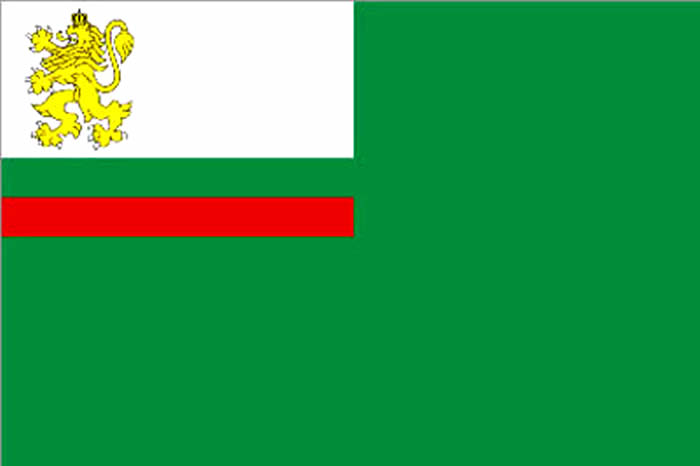
Bulgarian coast guard’s Ensign
As is always the case, the Greek coast guard itself denied everything. It claims that: ‘The allegations are not confirmed,‘ (they are). ‘Moreover, the alleged practice does not correspond to the operational procedures of the Hellenic Coast Guard,’ (anyone who pays even the slightest shred of attention to the Hellenic Coast Guard knows very well that it corresponds to its operational procedures very closely). ‘Nor does it reflect the procedures followed for the management of incidents involving third country nationals in the area of its jurisdiction.’ (ditto).
We had expected nothing less than a total denial of this kind, as this is what the Greek Coast Guard does in all cases, even when the evidence against them is – as in this case – absolutely overwhelming.
We investigated this case, and found that there was absolutely no question who was involved or who was responsible, we published our findings on 19 May this year.
This case was also featured in the documentaries, “Dead Calm, Killing in The Med”, and “Das Frontex-Dilemma”.
One reason we knew what was happening in this case was that Aegean Boat Report was in direct contact with the refugees on board the rubber boat on that morning, 19 February. We informed and provided all necessary documents to Frontex’ Fundamental Rights Office on the same day.
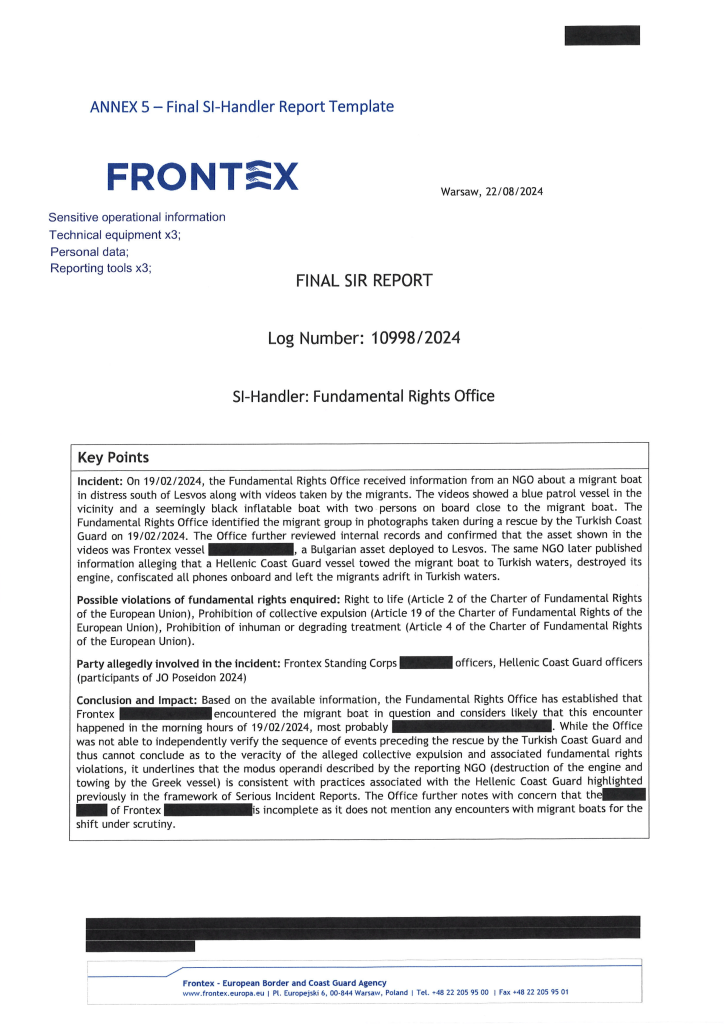
On 8 March, the Office launched a Serious Incident Report (SIR 10998/24) investigation, to “clarify the circumstances and the potential role of the Frontex assets and crew in the incident.”
Their findings and conclusion were crystal clear: the group of 32 people was illegally and violently pushed back from Greek territory waters, and it’s proven without any doubt that the Bulgarian Frontex vessel ‘Balchik’ was involved.
The investigation found that ‘Balchik”s captain falsified his mission report on return to shore, leaving out the encounter with the boat carrying refugees deep inside Greek waters, to cover up their involvement, and the crime committed by their Greek counterparts.
The Office’s report states: “Correct and complete operational reporting is essential to the proper functioning of Frontex joint operations to ensure accountability and enable follow-up, particularly in a context where reports of alleged fundamental rights violations are frequent.
“Against this backdrop, the Fundamental Rights Office notes with concern that the mission report from the captain of the Bulgarian Frontex vessel ‘Balchik’ is incomplete, as it does not mention any encounters with migrant boats in the shift under scrutiny.
“Officers of the ‘Balchik’ repeatedly stated they have no recollection of such encounter despite having confirmed earlier that the vessel shown in the footage is theirs.”
We do not know Bulgarian law, but we would be surprised if falsifying official documents is legal in Bulgaria. It certainly is not elsewhere in the EU, and we cannot help but wonder whether ‘Balchik”s captain will be charged for his crime, even as we fear he will instead be more likely to receive recommendations and a medal for a ‘job well done’.
The simple reality, confirmed by the Frontex Fundamental Rights Office, is that the refugees’ boat was in Greek waters. They were intercepted, their lives were put at risk by the Greek coast guard, they were subjected to a prohibited collective expulsion, and both Frontex and the Greek coast guard deliberately covered up their crime by filing incorrect and incomplete information in their mission reports.
These Frontex reports are not publicly available, but it is of utmost importance that what they contain – proof and clear statements of lawbreaking by publicly funded uniformed services – is seen by the world. They are in the public interest, and we have again decided to publish the entire report.
This report proves again that Greek authorities, supported by Frontex, are involved in and responsible for human rights violations in the Aegean Sea.
We must ask: will Frontex’ head Hans Leijtens finally take responsibility? He promised when he took office, replacing the disgraced Fabrice Leggeri, now somehow a member of the European Parliament despite having been forced to resign in shame having broken international law as head of Frontex, to govern the agency’s work with three principles: accountability, respect for fundamental rights, and transparency. He has failed, miserably.
We wonder if Leijtens will, since he said he was responsible for the agency’s activities, actually, take responsibility for its illegal acts, performed by its officers under Operation Poseidon. Will he resign from his well-paid post as head of Frontex?
At the absolute best, Leijtens has made no significant changes at Frontex, and created zero meaningful improvements. In the most flattering of all possible lights, he is nothing more than a puppet doing the EU Commission’s bidding. He is a bad reflection of Leggeri; perhaps in new wrapping, but containing the same poison Fabrice always had.
Leijtens is far from the only person of whom questions must be asked, however.
It is clear that the Greek government is insufficiently honest to admit its serial law-breaking, but we must also ask when the European Commission will take seriously its responsibility for the rule of law and fundamental rights in Europe?
We demand the Commission immediately launches infringement proceedings against the Greek government for systematic and widespread human rights violations, and we demand the cessation of all Frontex operations in Greece, in accordance with article 46 of the Frontex regulation.
We must also note that this case – and the few others like it – are only the tip of the iceberg. It is only when organisations can present solid data on pushbacks that the Fundamental Rights Office will even investigate incidents, let alone declaring guilt.
But the cases where evidence has been presented have resulted in a series of confirmations of Frontex involvement in illegal pushbacks from Greece: it is extremely clear that Frontex is deeply involved in human rights violations.
The case also highlights another worrying reality.
There are very few organisations – perhaps only one – which takes the time to document these cases properly, and share its findings in detail with the publick.
It’s actually dangerous, as the founder of Aegean Boat Report has discovered. Those who seek and dare to report the truth are targeted by Greek authorities, who go to extreme lengths in their efforts to try to silence their critics.
Greek arrest warrant issued for the founder of Aegean Boat Report, Tommy Olsen, in May this year.
If Aegean Boat Report hadn’t brought this, and many previous, cases to the attention of the FRO, they would never have been investigated.
If this organization hadn’t for years documented and pushed these cases to journalists, the attention paid to these crimes would have been far less.
But Aegean Boat Report, which has worked tirelessly and systematically, contributing an exceptional amount of the light shed on the Greek government’s astonishing human rights violations in the Aegean Sea, is regarded an outcast in the humanitarian community, without any official support from organisations working on the ground.
Due to systematic targeting by Greek authorities, we are now also without financial support, and in imminent danger of being forced to close down.
Who will pick up the ball if we close down?
Most likely nobody.
Who would benefit most?
Definitely not the people on the move.
This is where we are heading.
Aegean Boat Report is currently running on fumes. We cannot continue to do our work without your help.
To support our work and help us continue saving lives in the Aegean, please donate through PayPal by clicking on the link below 👇
This summer, the Greek Coastguard has escalated its illegal and vicious violence against people travelling to seek safety, by opening fire on boats carrying men, women and children, including shooting one man dead.
How much more has to happen, and for how long, before the EU pays attention, and takes action against this horrifying practice?
For many years, people of different nationalities and from all walks of life, have tried to reach safety in Europe by crossing from Turkey to Greece’s Aegean Islands, in flimsy rubber boats.
The trip might appear easy: the distance from Turkey to the islands is in some places only a few kilometres. But there are many hidden dangers lurking, and most of them are not due to the often treacherous sea.
In the last five years, countries who have experienced huge increases in arrivals of refugees, including Spain, Malta, Italy and Greece, have tried different methods – some legal, most absolutely illegal – to reduce arrivals to their shores. In many cases, this has resulted in more people dying in the attempt to reach Europe.
Greek coast guard pushing back a boat outside the Greek island of Kos
Spanish coast guard near Malilla North Africa
On land, countries wishing to break the law believe fences and walls can be efficient, despite the clear failures of ‘the wall’ former US president Donald Trump claimed he would build. At sea, they aren’t even an option.
Greek border fence with Turkey
The solution hit upon by governments of coastal countries when they wish to break the law, is to turn boats carrying people seeking protection in Europe, around at sea, towing boats out of their waters, removing people after they have arrived on land, placing them in life rafts at sea, refusing to rescue boats carrying refugees in distress in their SAR Zones, taking legal action against rescue boats and banning them from operating, and providing dictatorships and even failed or failing states like Libya with funding and equipment to stop people from leaving the country.
There are deals the European Union has made to prevent people moving, including funding the so-called Libyan coast guard (in practice, as the EU is well aware, nothing but a sea-militia armed and equipped by the EU), the EU-Turkey deal, and numerous deals with African countries.
The simple fact is that people’s right to leave their country if they are in or believe they may soon face danger is not considered important. What the EU believes is important is that those people must be prevented – including by breaking the law – from arriving on EU soil.
Article 13.2 of the Universal Declaration of Human Rights states: “Everyone has the right to leave any country, including his own, and to return to his country… in accordance with UN human rights practices”.
Its Article 14 states: “Everyone has the right to seek and to enjoy in other countries asylum from persecution.”
The 1951 Refugee Convention, of which every EU rule related to people movement opens by claiming not to be in any way in contravention, defines refugees as: “(any person who) owing to well-founded fear of being persecuted for reasons of race, religion, nationality, membership of a particular social group or political opinion, is outside the country of his nationality and is unable or, owing to such fear, is unwilling to avail himself of the protection of that country; or who, not having a nationality and being outside the country of his former habitual residence as a result of such events, is unable or, owing to such fear, is unwilling to return to it.”
And in its address to the United Kingdom government regarding the right to asylum under the law (UNHCR: UNHCR Observations on the New Plan for Immigration policy statement of the Government of the United Kingdom, May 2021), UNHCR, the world authority on refugee rights and the law relating to people seeking safety, noted: “The right to seek and enjoy asylum does not depend on the (means by which) an asylum-seeker arrives to a country. In reality, asylum-seekers are often forced to arrive at or enter a territory without prior authorisation.
“In order to meet their obligations under the 1951 Convention, States are required to grant individuals seeking asylum access to their territory and to fair and efficient procedures, before taking action to effect their removal.”
These are laws signed up to by every EU member state – indeed, by almost every state in the world.
Nowhere in these laws is there a provision that allows government-employees or anyone else to beat, rob from, sexually assault, torture, or forcibly push back people attempting to reach safety: these are illegal acts, which the Greek Coastguard has been carrying out for more than four years.
And certainly, these laws do not contain a provision allowing the firing on boats carrying men, women and children trying to reach safe places to live.
Yet that is precisely what the Greek Coastguard has been doing for the last three months: starting in May this year, it has four times opened fire on boats carrying men, women and children who have broken no law and are exercising their legal right to travel to seek safety.
The EU and its member states have, in the last decade, made a grave out of the Mediterranean – the sea the Romans once called ‘Mare Nostrum’ – ‘our sea’.
IOM’s Missing Migrants projects lists at least 28,000 people as having drowned in the Mediterranean trying to reach Europe since 2014. At least some, and arguably a very large proportion, of these deaths are directly linked to national authorities failing to carry out search and rescue efforts, and carrying out illegal pushbacks.
There are simply – and shamefully – far tragedies involving people on the move in ‘Our Sea’ to list here.
But some of the major ones include:
In March 2009, more than 200 African people drowned after their boat sank off the coast of Libya
In October 2013, 366 people, mostly Eritrean, died when their boat caught fire and sank near Lampedusa
In August 2014, around 170 people were feared dead after another boat sank off Libya
In September 2014, more than 500 people died after their boat sank off the Malta coast
In June 2023, more than 650 people died off the coast of Pylos, Greece, after the Greek authorities tried to tow an overcrowded fishing vessel into the Italian SAR Zone
The Adriana June 14 2023
These large shipwrecks get huge coverage by the international press, but this attention does not last: most are never properly investigated, and are soon forgotten. They and those killed within them become just another number in the statistics, in the list of the dead in Our Sea.
And those are the large disasters.
Most shipwrecks are small, and are never investigated, nor mentioned by the press. It is an inescapable fact that they have become ‘normal’, just another shipwreck, killing just another group of people the EU and its members states do not want, and do not want us even to think of as people.
And in the last three months, specifically at the hands of the Greek Coastguard, violence towards people seeking protection in Europe has escalated even further.
It’s no longer enough, it seems, for the Coastguard (seldom has a title been so poorly-deserved) to push them back and leave them helplessly drifting at sea, now it seems to be ok to open fire on men, women and children.
Shooting Chios 05.07.2024
In the last three months, there have been at least four shootings by the Greek coast guard against boats carrying refugees, sending several people to hospital, and killing one.
These incidents were:
On May 30, the Greek Coastguard fired against a boat carrying 25 refugees outside Chios, claiming the boat was manoeuvring dangerously. One person ended up in hospital with gunshot injuries. No official information was provided by the coast guard
On July 5, the Greek Coastguard opened fire on a boat carrying 24 people outside Chios, claiming that the boat refused to stop, and was manoeuvring dangerously. In this case, the smuggler onboard returned fire, before heading back towards Turkey.
On July 20, the Greek Coastguard opened fire on a boat carrying 15 people outside Chios, claiming that the boat refused to stop, and was manoeuvring dangerously. One person was transported to hospital with a bullet wound. The Greek Coastguard issued a press release in which it left out the shooting altogether
On August 23, the Greek Coastguard opened fire against a boat carrying refugees outside Simi, claiming the boat refused to stop, and was manoeuvring dangerously. The Coastguard’s shooting killed one man, who was shot in the head by the armed officers
As you will have noted, in every one of these cases, case the Greek Coastguard has claimed the boats carrying refugees have “manoeuvred dangerously”, putting their (the Coastguard) vessel “at risk”.
It is unfortunate that the Greek Coastguard has earned itself such a reputation for, let us say “misleading people about events in which it has been involved”, because it appears the agency is now demanding that we simply take its word as truth on each of these shootings.
Because although the Greek Coastguard has a legal responsibility to get everything on video, so that what it does is documented in case something goes wrong, in every incident of the Coastguard shooting at boats carrying refugees, and the men, women and children inside them, all its video equipment seems to have been malfunctioning.
This is very unfortunate.
The Greek Coastguard has not provided one single piece of evidence that boats carrying refugees, which the Coastguard has opened fire on, have been “manoeuvring dangerously”.
In fact, the videos that do exist, and Frontex investigations, show that it’s the Greek Coastguard vessels which are manoeuvring dangerously, putting the lives of refugees at risk.
Shooting incident Chios 05.07.2024
And sadly, the Greek media has been seemingly happy to back the Coastguard in its misreporting of these events.
In the August 23 incident, in which the Coastguard shot a man in the head and killed him, it claimed – entirely without evidence – that “a smuggler” tried to sink their vessel, and so they were acting “in self-defence”.
The Coastguard did not explain how a rubber boat could possibly sink a coast guard vessel, which seems… difficult, to say the least.
In its broadcast regarding the killing, Greek national media, including Star News, used background footage not of the incident in which the man was killed, but footage from the July 5 incident off Chios, in which a people-smuggler returned fire at the Coastguard. Star never once mentioned that the video was from a totally different case, instead leaving the viewer to consider that perhaps the killing of the man at Simi – or at least the Coastguard’s claim of ‘self-defence’ – was somehow justified.
To back the Greek Coastguard, the news media deliberately misled their viewers: less ‘informing’ and more ‘misinforming’ the Greek public.
In most of the four incidents, the Coastguard claimed it was only firing warning shots in safe sectors, or shooting to disable the engine, as a last resort in self-defence.
But as we already noted: what kind of danger could a rubber boat carrying men, women and children possibly pose to a Coastguard vessel?
And to try to hit a small engine from a distance without hitting people sitting next to it would take an excellent marksman, using a sniper rifle. But the Coastguard is using handguns and assault rifles, ‘aiming at’ a very small target on a moving rubber boat, while the shooter is standing also on a moving vessel. It’s basically impossible to safely make such a shot. Yet, they are ‘attempting’ it.
To open fire on a boat filled with men, women and children, just because they refuse to stop, or there is a smuggler suspected to be onboard, shows a total lack of respect for human lives: extreme, illegal, violent and murderous measures by Greek authorities in the name of ‘border protection’.
And of course, it’s a new and dangerous escalation: if one side is using firearms, the other side, in this case a real smuggler, will potentially bring a gun to be able to fire back.
Smugler shooting back at HCG outside Chios 05.07.2024
Law enforcement should be attempting to de-escalate potentially violent situations, to protect the lives of innocent people.
The problem is that Greek authorities have repeatedly shown, and Greek politicians repeatedly stated, that they do not see refugees as innocent. They wrongly claim – in fact pretend – that they are criminals, and openly state that they are not wanted, and can and should be stopped by all means possible.
This now appears to include cold-blooded killing.
We should also point out that on the vast majority of boats crossing from Turkey towards Greece, there are no smugglers onboard, only refugees.
In these cases, one or more refugees are ordered to drive the boat: when they arrive in Greece, they are arrested and charged with human trafficking, facing long prison sentences.
The Greek government gives every indication it believes that lying about people’s actions and identities to break the law by denying people their right to enter the asylum system, is a small price to pay for – in fact, an added bonus in – preventing people from outside Greece from entering the country.
More than 2,000 refugees are locked up in Greek prisons, because they steered a boat bringing people to safety.
Meanwhile, the Greek Coastguard has been investigated numerous times by the EU border agency Frontex for human rights violations. Greek authorities categorically deny any involvement, but the investigations have consistently found that in fact, the Greek Coastguard has consistently violated the rights of men, women and children attempting to reach Greece by sea.
These systematic crimes by the Greek authorities have been documented by EU bodies, journalists and organizations for years. Still, there has been no reaction from the European Commission: it’s as if it is still pretending these things are not happening.
In only one previous case – when the government of Victor Orban had been violently and illegally victimising and harming refugees entering Hungary – has Frontex acted on its duty to halt funding or operations or cancel a planned operation because of serious and persistent violations of fundamental rights related to its activities.
Even this came only after years of warnings and an EU court ruling.
The illegal, barbaric, behaviour of the Greek government and its employees towards people traveling to seek safety has now been ongoing for four years.
In this period, Frontex’ Fundamental Rights Officer (FRO), Jonas Grimheden, has repeatedly called for the agency to suspend operations in Greece due to systematic violations of fundamental rights. His calls have so far not been acted upon.
And in fact, nothing whatsoever has been done.
The EU Commission behaves as if it knows nothing, while the EU Parliament’s EPP group, to which Greece’s governing Nea Dimokratia party belongs, pretends there is nothing to know.
This summer, the Greek Coastguard added to its record of killing people by illegally pushing them away from Greece, or illegally pulling them into another country’s Search and Rescue Zone, the killing of people seeking safety by shooting them.
There is no justification for the EU sitting back and doing nothing about this. But if it needs a justification to act to end this disgusting practice – other than the obvious, that human life is sacred and must be our prime priority – it should consider this: if gunfire is normalised against people fleeing for their lives, how soon will it be normalised for those people to respond in kind?
The Greek government, and the Coastguard it uses as an attack-force against civilians exercising their legal rights, is creating a fire-fight on the Mediterranean. It is a chapter we – the EU Commission included – must prevent being opened in Our Sea.
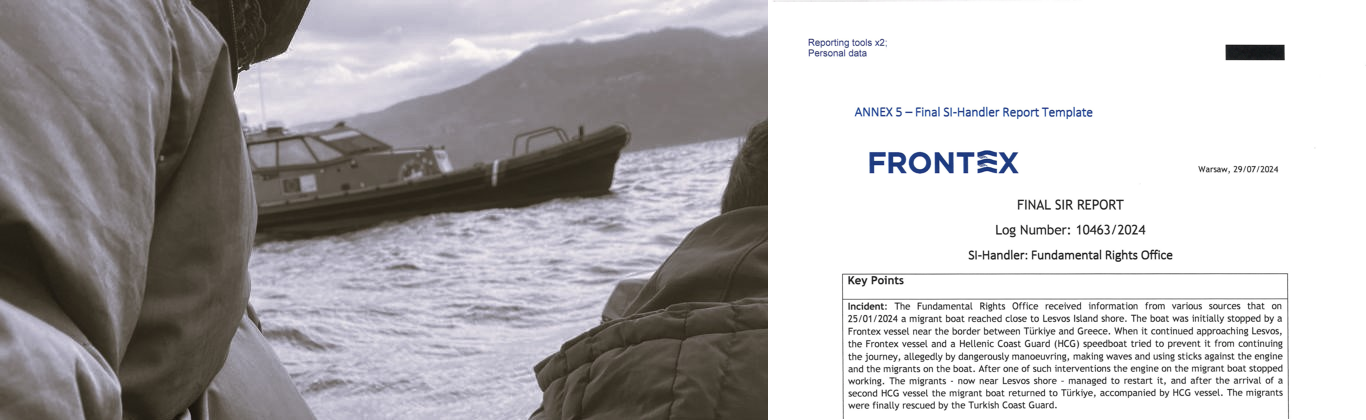
Frontex involvement in illegal pushbacks in Greece, are ones again proven, this time in a newly released serious Incident Report(SIR) by Frontex own Fundamental Rights Office, from a pushback performed by Greek coast guard outside Lesvos, assisted by Latvian Frontex.
In the afternoon of 25 January, a boat carrying 38 people, all Afghans, had almost reached land in the north of Lesvos, when they were stopped by Latvian Frontex and two vessels from the Greek Coast guard, and illegally pushed back to Turkey.
Greek authorities denied any involvement, as usual, and claimed that they only stopped a boat from entering Greek territory waters, or as they put it, a “prevention of departure”.
On February 2, Frontex Fundamental Rights Office launched a Serious Incident Report(SIR 10463/2024), to “clarify allegations of use of violence at sea and a collective expulsion of migrants”.
Their findings and conclusion is crystal clear, the group was illegally and violently pushed back from Greek territory waters by the Greek coast guard, assisted by the Latvian Frontex vessel.
Latvian Frontex then covered up for the Greek authorities in their mission report, so that the crime could go unnoticed, business as usual in the Aegean Sea.
“The Office notes with regret that reporting of the incident by the Frontex vessel crew in the mission report, as well as by the Greek authorities in**, was incomplète and incorrect, with missing information about the migrants’ presence in Greece, and the second handover of the Incident from Frontex to HCG”
The boat was in Greek waters, they were intercepted, their lives were put at risk on several occasions by the Greek coast guard, they were subjected to a prohibited collective expulsion, and both Frontex and the Greek coast guard deliberately covered up the crime by putting incorrect and incomplete information in their mission reports.
Since these Frontex reports are not publicly available, and have a high public interest, we have again decided to publish the entire report. It is of the utmost importance that the these reports are made available to everyone, and not only seen by EU politicians and journalists.
Greek authorities, supported by Frontex, have again been proven to be involved and responsible for human rights violations in the Aegean Sea. The question is, what will Frontex management board and the European Commission do to stop this?
We demand that the European Commission immediately launch infringement proceedings against Greece for systematic and widespread human rights violations, and we demand the ceasing of all Frontex operations in Greece in accordance to article 46 of the Frontex regulation.
In the morning of Tuesday, August 20, a group of 22 people, 17 adults and 5 children, contacted Aegean Boat Report for assistance, after they had arrived on the Greek island of Farmakonisi in the Dodecanese.
The group was scared, and asked for assistance, so that they could be taken to the nearest port of safety, provided with food, water and medicine attention, and given the opportunity to apply for asylum in accordance with international law.
“Hi , how are you? We are on the island here, and we don’t know where to go , we are separated from food and drinks, and there are kids with us .”“We are 17, or 18 people, exactly I don’t know, we have elderly person with us, he is very sick, and there small kids with us, we don’t have water for them, and they are so tired .”
The problem was that they had arrived on a desert island, and the only people present were military personnel from the base on the island, and the only way off this island was to inform Greek authorities.
Farmakonisi is a small uninhabited Greek island in the Dodecanese, present only a Greek military garrison.
The group provided pictures, videos and geolocation data, that proved without a doubt that they were on Farmakonisi.
We advised them to go to the military station, to make their presence known, not because it’s a safe solution, it’s definitely not, but because it’s the only solution on this island, and that they first contacted 112 and informed that they were on the island.
As far as we know they didn’t go to the military base, they said they had several people in the group with mobility issues, especially an old man with heart problems.
They said “ we called 112 and they told us that we should stay in our location, help would come to us”, this was the last we heard from the group, after that, all five phones they had used to contact us with went offline, time was 10.11 am.
We assumed that the military personnel on the island had been informed, and that they had located the group, who was hiding in the bushes a short distance from the base.
Normally, when people have been found on the island, they are taken to a fenced in area down by the dock, only shelter is an old shed, no toilets, no water. We assume this was also done in this case.
People are locked up until a coast guard vessel arrives to take them off the island, preferably they would then be taken to the camp on Leros. Unfortunately, in many cases when people have arrived on Farmakonisi, they never end up in any Greek camp, but in a life rafts drifting in the middle of the sea.
We searched for information about the group on Leros, unfortunately, we were not able to locate them, a group of 26 had arrived on Leros, but they had come from a different location, and not from Farmakonisi.
Just after midnight on Wednesday August 21, Turkish coast guard found and rescued 22 people, 17 adults and 5 children, from a life raft drifting outside Bodrum, Turkey.
Turkish authorities could inform us that they had received a email from the Greek coast guard, informing them about a group of people drifting inside Turkish territory waters. You can ask yourself how did the Greek coast guard know, if they hadn’t been involved?
This is the normal routine, whenever Greek coast guard leave people drifting in life rafts in the Aegean Sea, they send a email to inform the Turkish coast guard. Over the last four years thousands of these emails have been sent, and every single time people are being found drifting in life rafts. So ask yourself, how does the Greek coast guard know?..
When we compare pictures and videos sent to us from the group on Farmakonisi, with the pictures and videos taken by the Turkish coast guard from the rescue operation outside Bodrum, there is absolutely no doubt, it is the same group.
22 people, men, women, small children and elderly people, where captured on Farmakonisi by Greek authorities, robbed, kidnapped, locked up, taken back out to sea, transported by a Greek coast guard vessel 32 nautical miles, forced into a life raft, and left helplessly drifting in the middle of the sea in the dark.
14 hours after we lost contact with them on Farmakonisi, they were found drifting in a life raft. Greek authorities probably expect us to believe that they suddenly got the urge to go back to Turkey, found a fully functioning life raft, and paddled with their shoos 32 nautical miles back to Turkey.
It’s clear as day what happened here, and who is responsible, strangely enough, Greek authorities categorically denies any involvement. These pushback cases have been documented and proven hundreds of times by journalists, organizations, EU bodies and Frontex, but they just continue to deny it.
In the last four years 1.600 life rafts have been found drifting in the Aegean Sea, carrying over 27.000 people, not ones have the EU Commission raised concerns over this “phenomenon”, not ones has there been launched independent investigations, it has not even been discussed. You should ask yourself why, it’s definitely not because they don’t know what is going on, or the lack of evidence.
To look the other way while crimes against humanity are being committed, to deny it’s existence even do the facts speaks for itself, is unconscionable. The European Commission is not only suppressing these crimes, they are financing it with European taxpayers money, and deliberately covering up for the Greek authorities.
Europeans seem to have learned nothing from crimes committed in our names in recent history.
It’s time to stand up, it’s time to raise our voices and say “not in our name, not anymore, never again!”
All original evidence in this case, and previous cases, will be made available for journalists, researchers, lawyers, independent investigators, national and international bodies, upon official request. We have nothing to hide, but they do.
Tuesday night, August 13, a sailboat reported to be carrying 87 people, 72 adults and 15 children, contacted Aegean Boat Report for assistance after they ended up in distress 14 nautical miles south east of Syrna in the Dodecanese.
The Smugler originally driving the boat, had left on a small speedboat, and headed back to the Turkish shore before sundown. Engine was no longer working due to flooding in the engine room, they were drifting and needed assistance. Weather in the area was reported to be rough, windy and high waves.
We immediately informed the appropriate authorities, the Hellenic coast guard, and provided all necessary information, so that the sailboat could be located, and people onboard could be taken to the nearest port of safety.
We maintained contact with the boat for over three hours, they appeared to be very scared, and told that they believed that the boat would sink. We tried to ensure them that help was on the way, and that they soon would be rescued.
The Hellenic coast guards search and rescue center informed us that a vessel had been dispatched to the area, but so far not located the sailboat. We could only hope that they reached them in time, but to the people onboard, to try to keep their spirits up, we told them that they would soon be rescued.
At midnight all contact with the people onboard the sailboat was lost, and the Greek coast guard, who previously had been very helpful, suddenly didn’t want to provide any information, not even confirming that they had received the information in the first place, nor sent any vessel to the area.
We didn’t know what had happened to the sailboat and the people onboard, and could only hope that they had been rescued. The coast guard, who is the only who could assist them, were no longer interested in providing any information, there were no others we could turn to.
When comparing pictures and videos received from the people onboard the sailboat the previous night, with the footage taken by the Turkish coast guard under the rescue operation, we could confirm, without any doubt, that the people in the life rafts came from the sailboat.
We were of course relieved that that the group hadn’t drowned, but at the same time appalled that a coast guard, who has sworn an oath to protect life at sea, could treat other human beings in such a despicable way. First rescue them, then force men, women and children into life rafts, and leave them helplessly drifting in the middle of the sea.
87 people, 15 of them small children, was “rescued” by the Greek coast guard, transported on a coast guard vessel, (most likely financed by the European Union) and left drifting in 4 life rafts (most likely paid for by EU) in the middle of the sea. They were transported 62 nautical miles before being forced into these life rafts, the efforts put into this is enormous, there is absolutely no doubt who is responsible.
If this had been a one time occurrence it would indeed have been shocking, major headlines in the international press, “Coast guard abandoning refugees at sea”, because it’s basically illegal. If a civilian vessel had placed people in life rafts and left them at sea, both crew and captain would have ended up in jail for attempted murder.
But as we all know, this is not a one time occurrence, this is happening every single day in the Aegean Sea, where Greek Coast Guard risks the lives of thousands of vulnerable people, men, women and children, seeking protection at Europe’s borders. And since this is happening every single day, it has become normal, no longer of any interest for the press.
Monday August 12, another sailboat was stopped by the Greek coast guard deep inside Greek territory waters, a group of 100 people, 20 of them small children, was left drifting in five life raft in the middle of the night inside Turkish waters north east of Rhodes.
Just to understand the scale of this, the systematic approach by the Greek authorities and the European Commission, it’s necessary to use numbers. Over the last four years 86.000 people have been illegally pushed back by Greek authorities in the Aegean Sea, 27.000 of them were found drifting in 1.600 life rafts abandoned at sea by the Greek coast guard.
1.600 life rafts, packed with people, men, women and children, abandoned at sea by a European country, member of the EU, and not one single investigation has been conducted by the European Commission into these crimes, it’s just totally unbelievable.
Some might find it strange that these kinds of atrocities is happening in Europe, but as long as there are no consequences for the people responsible, in this case the Greek authorities, it will continue, and not only that, it will increase, as a result more people will die.
We could conveniently put all responsibility on the Greek authorities, since they are a sovereign nation, and are the ones performing these crimes. But they would have no chance pulling this off by themselves, they basically lack the resources.
Behind the scenes The European Commission is pulling the strings, providing all necessary equipment, manpower and funding. At the same time they refuse to open infringement proceedings against Greece, or start independent investigation into these hideous crimes, claiming it is the responsibility of the Greek authorities to investigate themselves.
The guardian of the treaties is no longer guarding, they actively and vigorously supporting the killings of thousands of people at Europe’s borders, all in the name of “border management”.
The “European way of life”, and “European values”, seems to have become only words on paper, without any real meaning, purpose or value.
We can’t avoid, and definitely shouldn’t, pointing out that Frontex, The European Border and Coust Guard Agency, is heavily involved in these widespread illegal activities at our borders. As the head of Frontex, Hans Leijtens pointed out, “if we are present we are involved”, and they most definitely present.
One would assume that Frontex involvement in illegal activities would have gone down after the former head of Frontex, Fabrice Leggeri, resigned in April 2022.
When Hans Leijtens took office in March 2023, he promised to stop all illegal practices and human rights abuses that had been ongoing under the his predecessor, but did that really happen?
If we compare the last 18 months under Leggeri, and the first 18 months under Leijtens, there is actually an increase of 42% in illegal pushbacks in the Aegean Sea. So instead of going down under new management, Frontex involvement in illegal pushbacks is actually drastically increasing.
If nobody is putting the spotlight on these crimes against humanity, and nobody is supporting those very few who dares to speak up against this, it will never ever end.
For those who stay silent in these dark times in fear of reprisals, for those who refuse to stand behind those who actually dare to speak up, for those who hide behind organization guidelines and policies ment for self preservation, I would like to say this;
“If you are neutral in situations of injustice, you have chosen the side of the oppressor.”