
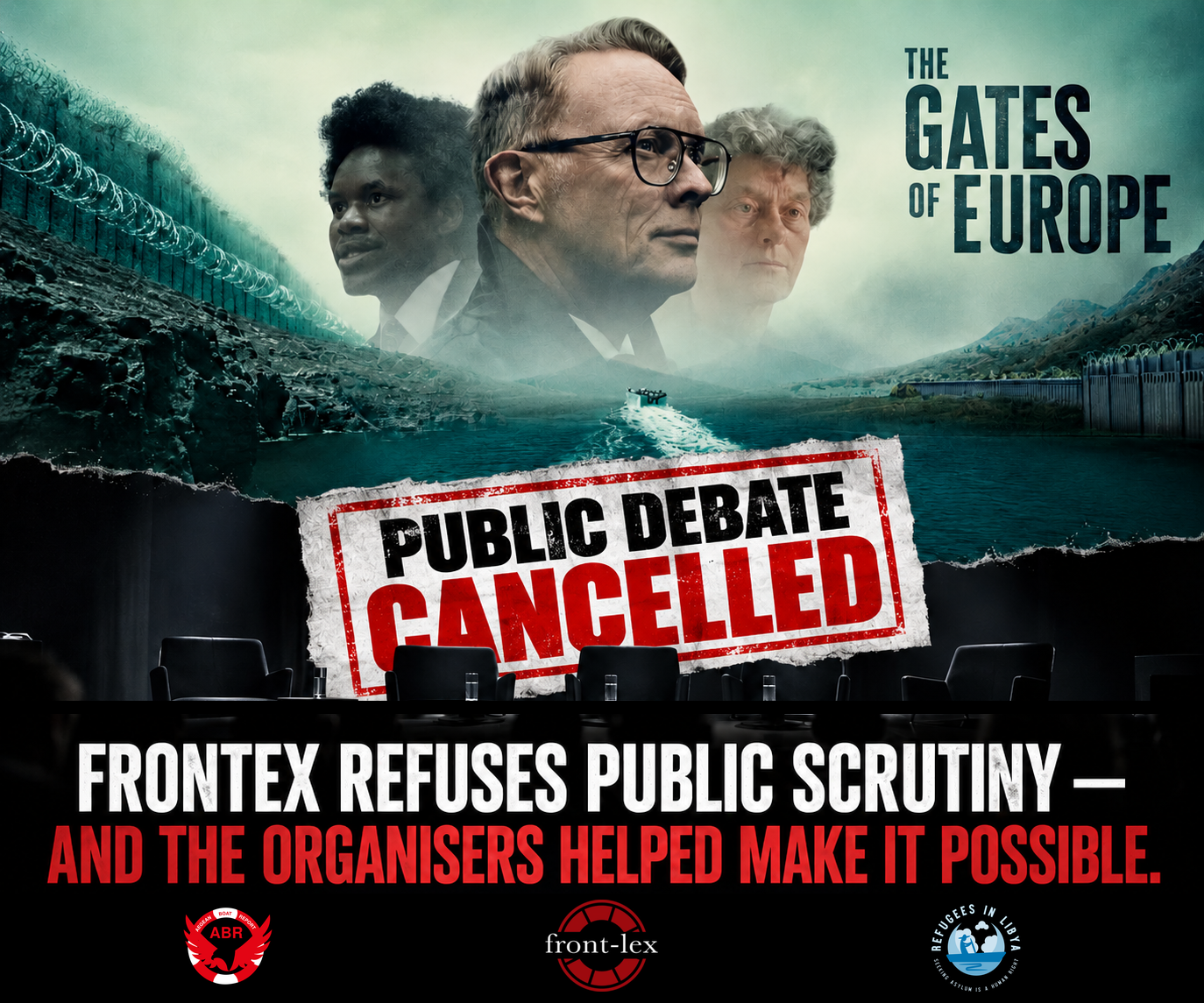
Frontex refused to face one of its strongest critics in public. The organisers tried to accommodate that refusal. And another outspoken critic, who spent three years participating in the documentary, was never invited.
This is what the filmmakers behind The Gates of Europe apparently consider an open debate about accountability.
On 21 October, the filmmakers and Pakhuis de Zwijger announced the cancellation of their planned public debate with Frontex Executive Director Hans Leijtens in Amsterdam.
Their explanation is extraordinary.
According to their own statement, Frontex refused to allow Leijtens to engage in a direct public debate with David Yambio of Refugees in Libya, citing unspecified legal reasons.
Instead of insisting on equal conditions, the organisers attempted to accommodate Frontex’s refusal.
David could present his experiences and criticism. Leijtens could answer questions from the audience. But a direct public confrontation between them was apparently off the table.
They even proposed a private meeting.
A private meeting. Away from the cameras, the audience, and public scrutiny.
David refused to accept these unequal conditions, and the event was cancelled.
Yet the organisers’ explanation places considerable emphasis on David’s withdrawal rather than Frontex’s original refusal.
David Yambio did not prevent public accountability. Frontex refused to face him, and the organisers attempted to accommodate that refusal.
The organisers now regret losing an opportunity to hold Frontex accountable. But accountability cannot depend on whether the institution being scrutinised finds the conditions acceptable.
WHY WAS AEGEAN BOAT REPORT NEVER INVITED?
Our founder, Tommy Olsen, was extensively filmed over three years and is one of the documentary’s main characters, alongside Hans Leijtens, Tineke, David Yambio and Romy.
For three years, Tommy invested enormous time in the production, providing the filmmakers with access to his work, documentation and evidence of what happens at Europe’s borders.
Before broadcast, he withdrew his participation because of serious concerns about the documentary’s portrayal of Frontex and its leadership.
Following its release, Aegean Boat Report, Front-LEX and Refugees in Libya publicly condemned what we considered the documentary’s whitewashing of Frontex.
Yet when the filmmakers organised a public debate about their own controversial documentary, Aegean Boat Report was not even invited.
They were willing to spend three years filming Tommy Olsen, documenting his work and using his experiences to tell their story. But when it came time to publicly defend that story against criticism, Aegean Boat Report was nowhere on the programme.
Our work was important enough for their documentary. Apparently, our criticism was not important enough for their debate.
Not even an invitation to participate remotely.
Why?
We cannot know the organisers’ private reasoning, but we have our own assessment.
Perhaps because Tommy would have challenged not only Hans Leijtens, but the filmmakers themselves.
He knows what information they had, what evidence was available, and what questions should have been asked.
He would have confronted them about their editorial decisions, their portrayal of Frontex, and why their own journalistic accountability document acknowledges extensive evidence of human rights violations while leaving fundamental questions about their editorial choices unanswered.
Perhaps that is precisely the kind of criticism they did not want on stage.
THIS IS NOT ACCOUNTABILITY. IT IS MANAGED CRITICISM.
The filmmakers spent three years documenting Frontex, gaining extraordinary access to its leadership while possessing extensive evidence of pushbacks and serious human rights violations.
Yet three participating human rights organisations publicly condemned the resulting documentary for whitewashing the agency.
Now, when an opportunity arises to confront these criticisms, Frontex refuses direct public scrutiny, David Yambio is offered unequal conditions, and another central character and outspoken critic was never invited.
This is not simply a failed debate. It raises fundamental questions about who controls the narrative, whose criticism is considered acceptable, and who gets excluded when that criticism becomes uncomfortable.
The filmmakers and organisers owe the public an explanation.
Why did they attempt to accommodate Frontex’s refusal to face David Yambio instead of insisting on a direct public debate?
Why was one of the documentary’s central characters and strongest critics never invited?
And how can they claim to have created an opportunity for meaningful accountability when direct confrontation with Frontex was not guaranteed and one of the documentary’s most outspoken critics was absent from the programme?
You cannot spend three years documenting power, then allow that power to determine the conditions under which it will be questioned.
And you cannot claim to defend independent journalism while failing to provide a platform for those who challenge your editorial decisions.
For three years, the filmmakers were willing to listen to our evidence, film our work and use our experiences to tell their story.
But when it came time to defend that story publicly, our criticism apparently had no place in the debate.
Frontex refused to face David Yambio. Aegean Boat Report was never invited. And the organisers call this a lost opportunity for accountability.
We call it something else.
A demonstration of exactly how powerful institutions can be protected from the scrutiny they claim to welcome.
Aegean Boat Report
SUPPORTING DOCUMENTS
For transparency, we are making the following documents available so readers can examine the organisers’ explanations and the filmmakers’ editorial justifications for themselves.
- Joint statement by Pakhuis de Zwijger and the organisers of The Gates of Europe, 21 October 2026, concerning the cancellation of the public debate.
- Journalistic Accountability Document — The Gates of Europe, outlining the filmmakers’ editorial approach and decisions.
We encourage readers to examine both documents and draw their own conclusions.