
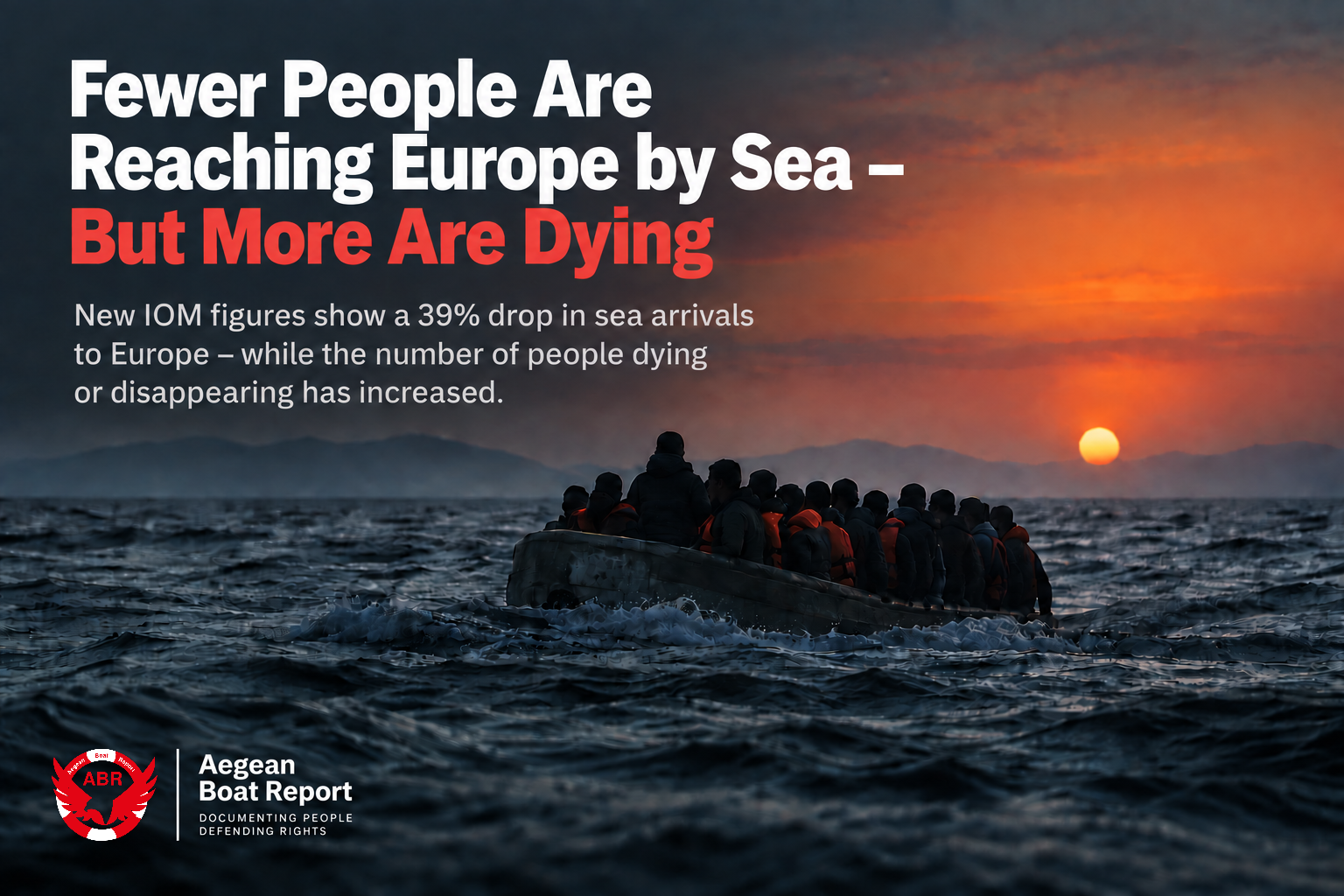
New figures from the International Organization for Migration reveal a disturbing development at Europe’s borders: significantly fewer people are reaching Europe by sea, while more are dying or disappearing trying.
Almost 60,000 refugees and other people on the move reached Europe by sea between January and 15 September 2026, according to new figures released by the International Organization for Migration (IOM).
During the same period last year, 98,040 people arrived.
That represents a 39% decrease in sea arrivals.
But the number of people dying or disappearing on these journeys has moved in the opposite direction.
At least 2,292 people have died or gone missing on Mediterranean and Atlantic routes towards Europe so far this year, compared with 1,999 during the same period in 2025.
The figures tell two very different stories.
Europe is recording substantially fewer arrivals.
It is not recording fewer deaths.
Fewer arrivals, more dangerous journeys
The figures come from IOM’s Displacement Tracking Matrix and Missing Migrants Project and cover verified arrivals and incidents through 15 September.
IOM warns that the actual number of people who have died or disappeared is likely considerably higher.
Shipwrecks can happen without witnesses. Boats can disappear without ever being reported, bodies are never recovered, and many deaths and disappearances at sea therefore never enter official statistics.
IOM Director General Amy Pope said the figures demonstrate that people are undertaking increasingly dangerous journeys.
“Nearly every death and disappearance at sea is preventable,” Pope said.
The trend can be seen across several of the principal routes towards Europe.
Central Mediterranean: arrivals down 55%, deaths increase
The sharpest reduction in arrivals was recorded on the Central Mediterranean route towards Italy.
By 15 September, 21,393 people had arrived, compared with 48,231 during the same period last year.
That is a decrease of 55%.
Yet deaths and disappearances increased.
IOM recorded 996 people dead or missing on the Central Mediterranean route this year, compared with 844 during the same period in 2025.
So while fewer than half as many people reached Italy on this route, more people died or disappeared attempting the journey.
Eastern Mediterranean: fewer arrivals to Greece, 47% more dead or missing on the route
A similar development can be seen in the Eastern Mediterranean.
Greece recorded 20,428 arrivals, compared with 25,427 during the same period in 2025 – a decrease of almost 20%.
At the same time, deaths and disappearances recorded across the Eastern Mediterranean route increased from 284 to 417.
That is an increase of 47%.
The distinction is important: the 417 figure concerns the wider Eastern Mediterranean route monitored by IOM, while the arrival figure refers specifically to Greece.
One significant development within this region is the rapidly growing sea route from eastern Libya towards Crete and Gavdos.
Nearly 14,000 people have reportedly reached Crete from eastern Libya so far this year.
Unlike many crossings between Turkey and the eastern Aegean islands, where the shortest distances can be only a few kilometres, people departing eastern Libya face hundreds of kilometres of open Mediterranean before reaching Greek territory.
It is a fundamentally different and considerably longer journey.
From the Aegean towards Crete
Aegean Boat Report has been monitoring this change throughout the year.
For years, islands such as Lesvos, Chios, Samos, Kos and Rhodes have been among the principal entry points into Greece for people crossing from Turkey.
They are also areas where Aegean Boat Report has documented systematic illegal pushbacks at sea and from Greek territory.
Thousands of people attempting to reach the Greek islands are intercepted by Turkish authorities before reaching Greece. Others have reached Greek waters or Greek territory only to be illegally returned.
At the same time, arrivals from eastern Libya towards Crete have increased substantially.
Reporting accompanying the new IOM figures identifies increased movement from eastern Libya towards Crete as one factor behind the rising death toll in the Eastern Mediterranean.
The IOM statistics do not establish that illegal pushbacks or increased border enforcement in the Aegean have caused people to use the Libya–Crete route.
There are many factors determining which routes people take, including nationality, conflicts, departure points, smuggling networks, border controls and conditions in countries of transit.
But the developments raise an important question.
What happens when one route towards Europe becomes increasingly difficult to use?
Restricting one route does not remove the reasons people are moving.
Movement can instead shift towards different routes – and those alternatives can be significantly longer and more dangerous.
Gavdos – the people behind the statistics
The danger of the Libya–Crete route was demonstrated again only days ago.
On 13 September, Alarm Phone reported being contacted by a boat carrying 77 people south of Crete and alerted Greek authorities.
Hours later, a vessel was found partially submerged around 38 nautical miles south of Gavdos.
Fifty-one people survived.
One person was confirmed dead, while around 25 people were initially reported missing.
The incident should not be treated as representative of every crossing, nor does it by itself explain IOM’s statistics.
But it demonstrates the risks involved in a journey across hundreds of kilometres of open Mediterranean in boats that are frequently overcrowded and unsuitable for such a crossing.
Engine failure, bad weather, lack of fuel or a boat taking on water can quickly turn such a journey into a disaster.
And the crossings continue.
Only days after the Gavdos disaster, several more boats in distress were reported south of the island.
More than 17,000 intercepted and returned to Libya
There is another figure in IOM’s report that is crucial to understanding what declining European arrival numbers actually mean.
Between January and mid-September, 17,067 people were intercepted at sea and returned to Libya, according to Libyan Coast Guard figures tracked by IOM.
Those 17,067 people are not counted among Europe’s arrivals.
This illustrates one of the fundamental limitations of using arrival numbers alone to measure what is happening along migration routes.
Arrival statistics tell us how many people successfully reached European territory.
They do not tell us how many attempted the journey.
They do not include those intercepted and returned before reaching Europe.
They cannot fully account for boats that disappeared without trace.
And they cannot tell us how many people changed routes after being prevented from travelling another way.
What does a 39% reduction actually tell us?
European governments have increasingly focused on reducing irregular arrivals, strengthening external borders and preventing departures towards Europe.
Measured solely by the number of people reaching European territory, the latest figures show a substantial reduction.
Sea arrivals have fallen by 39%.
But that figure cannot be considered in isolation.
During the same period:
At least 2,292 people died or disappeared trying to reach Europe.
Deaths and disappearances increased despite substantially fewer arrivals.
On the Central Mediterranean route, arrivals fell 55%, while deaths increased.
On the Eastern Mediterranean route, deaths and disappearances increased by 47%.
More than 17,000 people were intercepted at sea and returned to Libya.
Taken together, these figures demonstrate why developments at Europe’s borders cannot be assessed simply by counting how many people reach European shores.
Behind every number is a person
IOM has called for greater international cooperation to save lives, protect people on the move, combat trafficking and exploitation, and expand safe and regular pathways.
“Behind every number is a human being, a family, a community,” Amy Pope said.
That is perhaps the most important part of these statistics.
A reduction in arrivals does not mean that the conflicts, persecution, insecurity and desperation that cause people to leave have disappeared.
Nor does preventing someone from reaching Europe necessarily mean their journey has ended.
Restricting one route can contribute to movement shifting towards another – potentially exposing people to even greater risks.
Sea arrivals to Europe have fallen by almost 40%. Yet the number of people recorded dead or missing has increased.
That should challenge any assessment of European border policy based primarily on how many people are prevented from reaching European shores.
A falling arrival figure tells us how many people reached Europe.
It does not tell us how many tried, how many were intercepted and returned, how many shifted towards other routes, or how many disappeared without ever being recorded.
And if fewer people are reaching Europe while more are dying or disappearing on the journey, declining arrivals cannot, on their own, be presented as evidence that Europe’s borders have become safer.
Sources: International Organization for Migration (IOM), Displacement Tracking Matrix and Missing Migrants Project, covering verified arrivals and incidents through 15 September 2026; IOM statement published 17 September 2026; Aegean Boat Report monitoring and documentation.
Aegean Boat Report is an independent organisation documenting arrivals, illegal pushbacks and human rights violations at Greece’s borders.
If you appreciate the work we do, and want to help us continue documenting what is happening at Europe’s borders, please consider supporting Aegean Boat Report. Every donation, no matter the size, helps us continue our work.
Donate through WhyDonate:
https://whydonate.com/en/fundraising/aegean-boat-report