
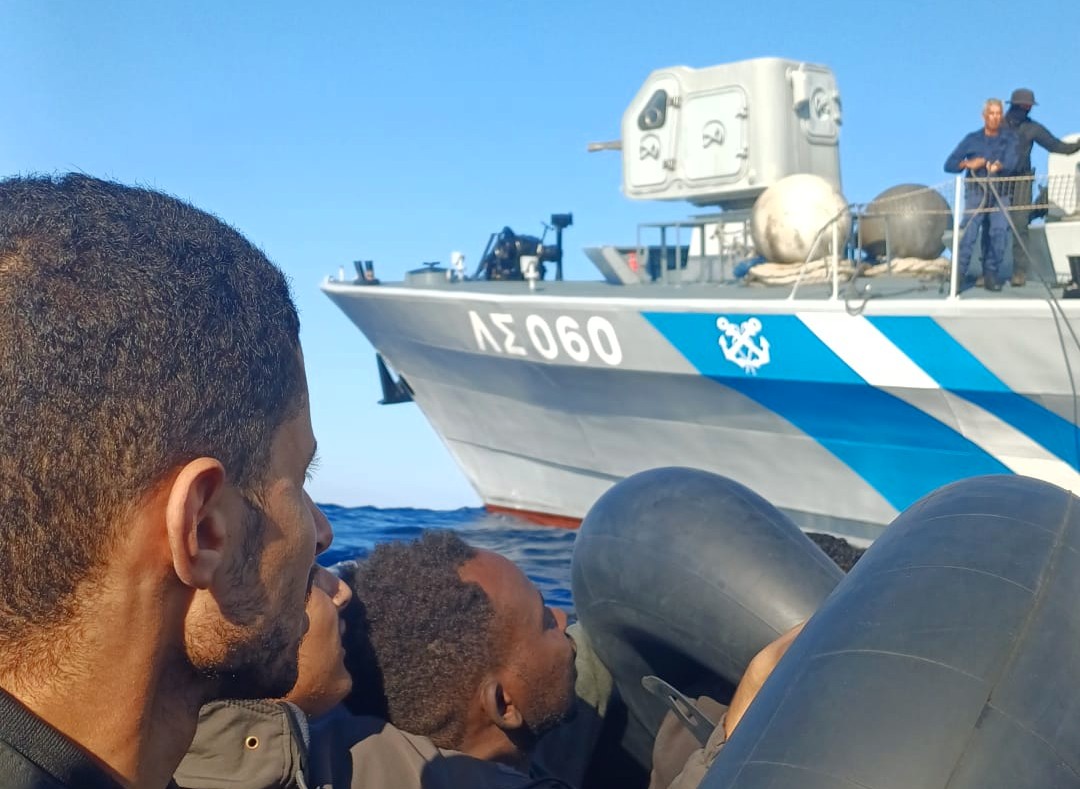
People in distress called the Greek emergency service and were told help was coming. They then photographed and filmed Greek Coast Guard vessel LS-060 alongside them. Hours later, Turkish authorities recorded the rescue of 27 people from a life raft and stated that they had been pushed back by Greek assets.
4 September 2026 – Aegean Sea
EVIDENCE PUBLISHED WITH THIS INVESTIGATION
This report is based on contemporaneous messages and location information sent directly to Aegean Boat Report, photographs and video recorded by members of the group, visual identification of Hellenic Coast Guard vessel LS-060, and the subsequent official Turkish Coast Guard record of 27 people rescued at sea.
Where the available evidence establishes a fact, we state it as such. Where identity, intent or events cannot be established from the available material, we say so.
On the morning of 4 September, 27 people attempting to reach Greece found themselves in distress in the Aegean Sea.
Their engine had stopped. Waves were hitting the boat and, according to messages sent to Aegean Boat Report, water was entering the craft.
They asked for help.
What happened next is documented through contemporaneous messages, location data, photographs and video sent directly from the group, together with the subsequent official record of the Turkish Coast Guard.
The material establishes something particularly important:
Greek authorities encountered this group.
The people photographed the Greek Coast Guard vessel that reached them.
Its identification number is clearly visible:
ΛΣ 060 – LS-060
Hours later, Turkish authorities recorded the rescue of 27 people from a life raft in the Menderes area and stated that they had been pushed back into Turkish territorial waters by Greek assets. The Turkish Coast Guard records the rescue at 13:05 on 4 September, involving Coast Guard boat KB-89 and ship TCSG-311.
The question Greece must answer is therefore not whether Greek authorities encountered these people.
The photographs show that they did.
The question is:
What happened to these 27 people after LS-060 reached them?

A Call for Help
At approximately 06:40, Aegean Boat Report was in contact with the group.
They reported that there were 27 people on board.
Their engine had stopped and they were in distress at sea.
At 06:40, the group sent their location:
37.752712, 26.368059
They wrote:
“We are stuck at sea.”
Seconds later:
“In need of urgent help.”
At 06:44, they told ABR they were:
“Near the island of Ikaria.”
When asked what had happened to their boat, they replied:
“Motor is not working.”
Shortly afterwards:
“The boat is taking water and waves are very high.”
And:
“We have women with us.”
The group reported 27 people on board, including 11 women.
They also expressed another fear:
“We are afraid of pushback.”
Aegean Boat Report advised them to call the European emergency number 112 and request immediate assistance.
They did.
At 06:57, they wrote:
“We dialed 112.”
Shortly afterwards:
“The Greece response was there are going to send help.”
For the people on the boat, this should have meant rescue.


Photographs sent by the group shortly after contacting Aegean Boat Report and reporting that their engine had stopped and their craft was taking on water.
“Greek Coast Guard Is Coming Our Way”
For more than 40 minutes there was no further communication.
Then, at 07:43, the group sent another photograph.
At 07:44, they wrote:
“Greek coast guard is coming our way.”
The approaching vessel was Greek.
As it came closer, members of the group began photographing it.


The Hellenic Coast Guard vessel approaching the group after they had requested emergency assistance. The photographs were sent between approximately 07:43 and 07:47.
LS-060 Comes Alongside
The Coast Guard vessel eventually came close enough for its identification to become unmistakable.
A photograph taken directly from the group’s craft clearly shows:
ΛΣ 060
The vessel was LS-060 Fournoi of the Hellenic Coast Guard.
At this point, identification does not depend on comparing silhouettes, radar equipment, vessel shape or paintwork.
Its number is visible in the original photograph.

What the Video Shows
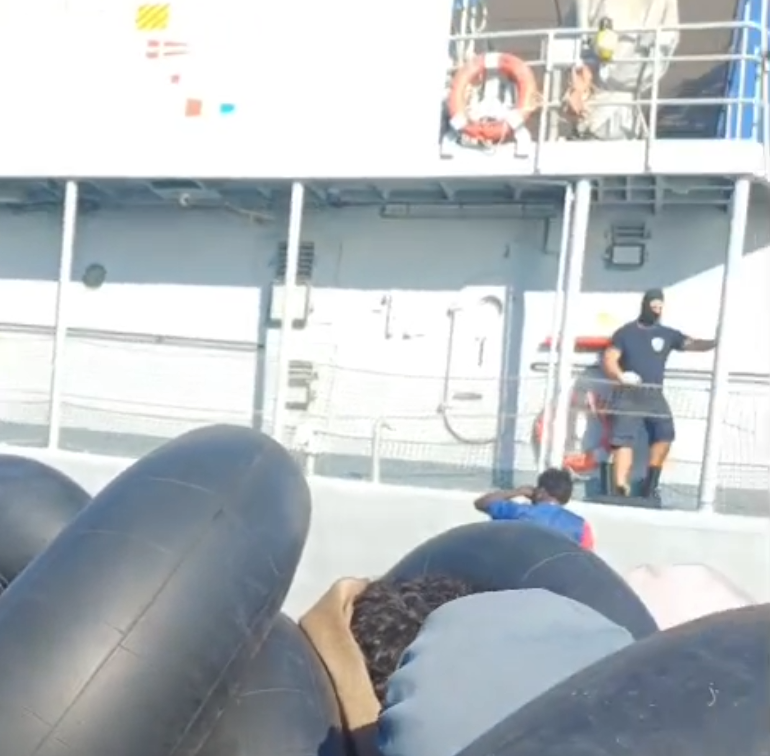
At approximately 07:50, the group sent Aegean Boat Report video recorded from only metres away from LS-060.
The footage is particularly important.
It does more than identify the vessel.
It provides a close visual record of personnel aboard LS-060 while the Coast Guard vessel was alongside the group.
Video sent to Aegean Boat Report by the group at approximately 07:50 on 4 September 2026. Greek Coast Guard vessel LS-060 is alongside their craft. Several personnel can be seen aboard the vessel, including individuals who appear to have their faces covered.
Masked Men on Board LS-060
Several people can be seen aboard the Greek Coast Guard vessel.
At least two appear to have their faces covered.
For Aegean Boat Report, this is a disturbingly familiar sight.
For more than six years, ABR has documented and received testimony concerning masked or unidentified men involved in reported pushback operations across the Aegean — both aboard Greek Coast Guard vessels at sea and during operations on Greek islands after which people seeking protection have disappeared.
Masked personnel involved in alleged Greek pushback operations have also been independently documented.
And there is an especially relevant historical connection to 060 itself.
In June 2020, Bellingcat investigated footage showing masked men operating a Hellenic Coast Guard RHIB during a pushback near Lesvos.
Investigators compared distinctive characteristics of the RHIB and concluded that the craft was likely ΛΣ-060. They also established that, at the relevant time, the RHIB carrying the 060 designation had been embarked on HCG patrol vessel ΛΣ-080.
Bellingcat — Masked Men On A Hellenic Coast Guard Boat Involved In Pushback Incident
That investigation concerned events in June 2020.
More than six years later, footage sent directly to Aegean Boat Report again appears to show masked personnel aboard LS-060 during an operation involving people seeking protection at sea.
A Man in Green
Another detail visible in the footage deserves scrutiny.
One person aboard LS-060 is dressed noticeably differently from personnel wearing the dark-blue clothing associated with the Hellenic Coast Guard.
He appears to be wearing green military-style clothing.
That raises an obvious question:
Was personnel from another Greek security or military unit participating in the operation?
Green military-style clothing can be associated with military or specialised personnel, but clothing alone is not sufficient to establish a person’s unit or role.
Aegean Boat Report therefore cannot identify this person as a special-operations operator from the video alone.
What the footage does establish is that a person wearing clothing distinctly different from the other visible personnel was aboard LS-060 during the operation.
Greek authorities can explain who he was and which service or unit he represented.

Who Was Watching From the Bridge?
There is another potentially important detail in the footage.
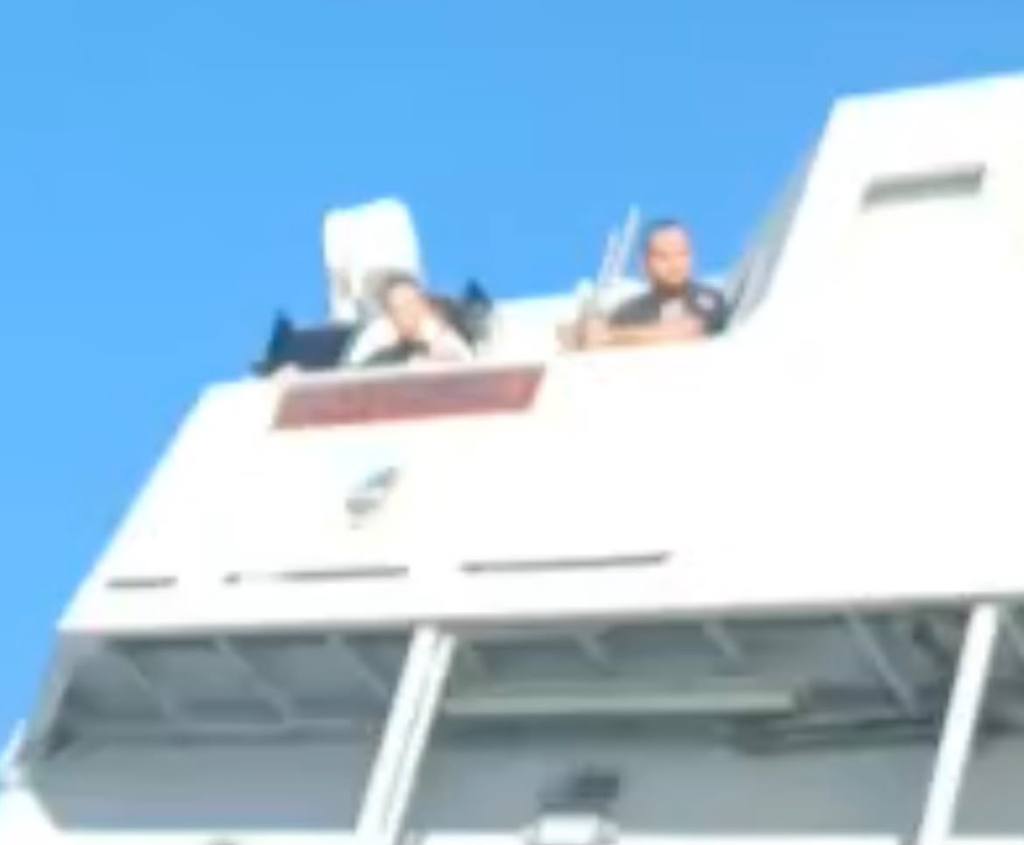
While the operation is taking place alongside LS-060, a person can be seen on or immediately around the vessel’s bridge, apparently observing what is happening below.
Because of his position, this person could be a senior crew member or the vessel’s commanding officer.
The footage does not allow Aegean Boat Report to establish his identity or rank, and we therefore cannot state that he is the captain.
But what the footage does show is important:
The operation alongside the group’s craft was taking place in view of personnel aboard the Coast Guard vessel itself.
This raises obvious questions concerning supervision and command responsibility.
What happened alongside LS-060 cannot simply be attributed, without further explanation, to unidentified masked individuals operating beyond the knowledge of the vessel’s regular crew.
Greek authorities should disclose who commanded LS-060 that morning, who was aboard, which units they belonged to and who authorised and supervised the operation.
Then Contact Was Lost
After LS-060 reached the group, communication eventually stopped.
The people who had called Greece for help did not subsequently appear in a Greek reception facility.
Instead, hours later, information emerged from the other side of the Aegean.
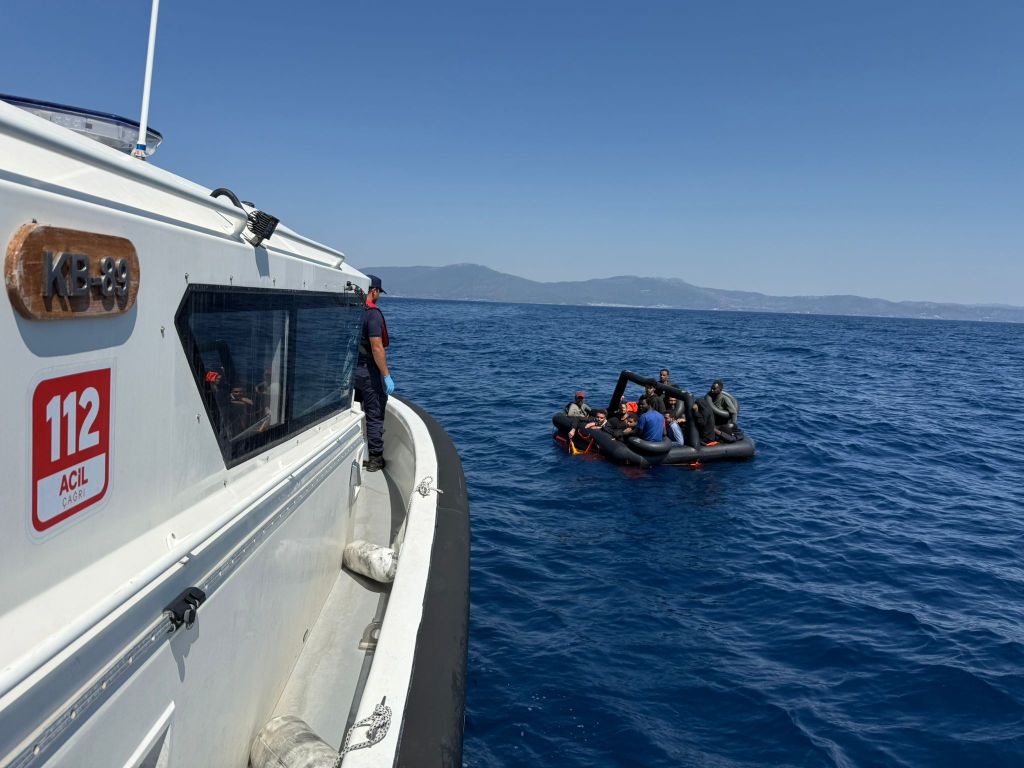
The Turkish Coast Guard’s official account states that at 13:05 on 4 September, 27 people were rescued from a life raft off the coast of Menderes, İzmir, by Turkish Coast Guard boat KB-89 and ship TCSG-311.
Crucially, the Turkish Coast Guard states that the life raft had been:
“pushed back into Turkish territorial waters by Greek assets.”
The Turkish records list the 27 people as:
10 Yemeni, 7 Somali, 7 Sudanese, 2 Chadian and 1 Ethiopian.
Total:
27 people.

The Turkish Rescue
Photographs from the subsequent Turkish operation document the rescue.
The Chain of Evidence
Taken together, the available material provides a remarkably detailed chronology.
Twenty-seven people contacted Aegean Boat Report while in distress at sea.
They reported that their engine had stopped, that their craft was taking on water and that there were high waves.
They called 112 and requested rescue.
According to their contemporaneous messages, Greek emergency services told them that help was coming.
A Hellenic Coast Guard vessel approached.
They photographed it.
Its number was clearly visible:
ΛΣ 060
They filmed personnel aboard LS-060, including individuals who appear to have their faces covered.
Communication with the group was subsequently lost.
Hours later, Turkish authorities recorded the rescue of 27 people from a life raft in the Menderes area and stated that they had been pushed back by Greek assets.
This leaves one central question requiring an answer from Greece:
What happened between LS-060 reaching these 27 people and those 27 people subsequently being recovered at sea by Turkey?
Why This Raises Serious Legal Questions
A pushback is not simply another term for preventing irregular migration.
States are entitled to control their borders. They are not entitled to do so outside the law.
If people were forcibly returned without access to the procedures and safeguards required by law, several separate legal obligations are engaged.
People seeking international protection cannot simply be removed as a group without procedures capable of examining their individual circumstances and protection claims.
Article 19 of the EU Charter of Fundamental Rights expressly states:
“Collective expulsions are prohibited.”
It also protects against removal to a state where there is a serious risk of specified forms of grave harm.
EU Agency for Fundamental Rights — Article 19
The principle of non-refoulement similarly prevents states from simply forcing people back without considering whether protected risks exist.
A maritime border does not make these protections disappear.
And this case contains another crucial element.
These people had requested rescue.
Their engine had stopped.
They reported that their craft was taking on water.
They called 112.
According to their contemporaneous communications with ABR, they were told that help was coming.
The vessel that came was LS-060.
If a rescue response instead resulted in people being forcibly returned and left at sea, this raises additional serious questions concerning Greece’s obligations towards people in distress at sea.
The distinction is fundamental:
Border control does not cancel rescue obligations or fundamental rights.
LS-060 Fournoi Has Been Here Before
The significance of identifying LS-060 does not end with this incident.
The designation 060 has previously appeared in reporting and investigations concerning serious allegations involving operations against refugee boats in the Aegean.
2015 — 58 Syrians near Didim
On 12 November 2015, LS-060 was identified in contemporary reporting concerning an incident involving 58 Syrian refugees near Didim.
Video footage was reported to show Greek Coast Guard personnel using a pointed implement against the inflatable craft before the people were subsequently rescued by the Turkish Coast Guard.
Anadolu Agency — November 2015 LS-060 incident
The Hellenic Coast Guard disputed the Turkish account of the incident and characterised what was shown as part of a rescue operation.
That dispute is relevant and should be acknowledged.
2020 — Masked men and RHIB 060
In June 2020, Bellingcat analysed video showing masked men operating a Hellenic Coast Guard RHIB during a pushback near Lesvos.
Through detailed visual analysis, investigators concluded that the RHIB involved was likely ΛΣ-060.
Bellingcat — Masked Men on a Hellenic Coast Guard Boat Involved in Pushback Incident
A later investigation by Bellingcat, Lighthouse Reports and European media organisations documented another pushback on 8 June 2020, during which HCG RHIB 060 approached a boat carrying 47 people at least twice. A Romanian Frontex vessel was also involved during the operation.
Bellingcat — Frontex at Fault: European Border Force Complicit in Illegal Pushbacks
2021 — 85 people
On 2 April 2021, the Turkish Coast Guard reported rescuing 85 people from two inflatable boats off Denizköy/Dikili.
According to the official Turkish account, their fuel tanks had been removed and the boats pushed towards Turkish territorial waters by Greek Coast Guard asset LS-060 and another Greek Coast Guard vessel.
Turkish Coast Guard — 2 April 2021 pushback incidents
Previous cases do not by themselves prove what happened on 4 September 2026.
The evidence from this case must stand on its own.
But the history makes the identification of LS-060 particularly significant.
The same vessel designation has appeared in allegations concerning pushback operations spanning more than a decade.
And in this case, its presence is not based on witness recollection.
It was photographed and filmed by the people themselves.
Frontex Has Been Informed
Aegean Boat Report has submitted the case and supporting material to Frontex and asked the Agency to establish whether LS-060 Fournoi was participating in, supporting, or otherwise connected to Frontex Joint Operation Poseidon at the relevant time.
ABR is not claiming that Frontex participated in the illegal pushback. That is a question for investigation. Frontex should establish which operational and surveillance assets were present, what records exist, and whether the incident has been referred to its fundamental-rights mechanisms.
Questions Frontex must answer
Was LS-060 Fournoi participating in, supporting, or otherwise connected to Frontex Joint Operation Poseidon at the time of the incident?
Did Frontex have any personnel, vessels, aircraft or surveillance assets monitoring the area?
What operational records exist, and has the incident been referred to the Frontex Fundamental Rights Office?
Questions Greece and Frontex Must Answer
- Was LS-060 dispatched following the group’s emergency call to 112?
- Who commanded LS-060 on the morning of 4 September 2026?
- Which personnel and units were aboard LS-060?
- Why do some personnel visible in the footage appear to have their faces covered?
- Who is the person wearing green military-style clothing, and which service or unit did he represent?
- What happened to the 27 people after LS-060 reached them?
- Were any members of the group transferred aboard a Greek vessel at any stage?
- Were their phones, engine, fuel, money or other belongings taken, damaged or destroyed?
- Were the 27 people given an opportunity to request international protection?
- How did 27 people encountered by LS-060 subsequently come to be recorded at sea by the Turkish Coast Guard?
- What GPS/AIS data, bridge logs, radio communications, operational reports and video recordings exist from LS-060 and other participating assets for this operation?
These are not abstract questions.
The vessel is known.
The date is known.
The approximate times are known.
The number of people is known.
And the presence of the Greek Coast Guard is documented photographically.
27 People Called for Help
At its core, this case is remarkably simple.
Twenty-seven people were in trouble at sea.
They called Europe for help.
They called 112.
They were told help was coming.
A Greek Coast Guard vessel came.
They photographed it.
They filmed the people aboard it.
Its number was:
LS-060
Hours later, Turkish authorities recorded the rescue of 27 people from a life raft in the Menderes area and stated that they had been pushed back by Greek assets.
Greece now needs to explain what happened in between!

Aegean Boat Report is an independent organisation relying entirely on donations to document human rights violations in the Aegean and assist people seeking protection.
Please support our work if you can:
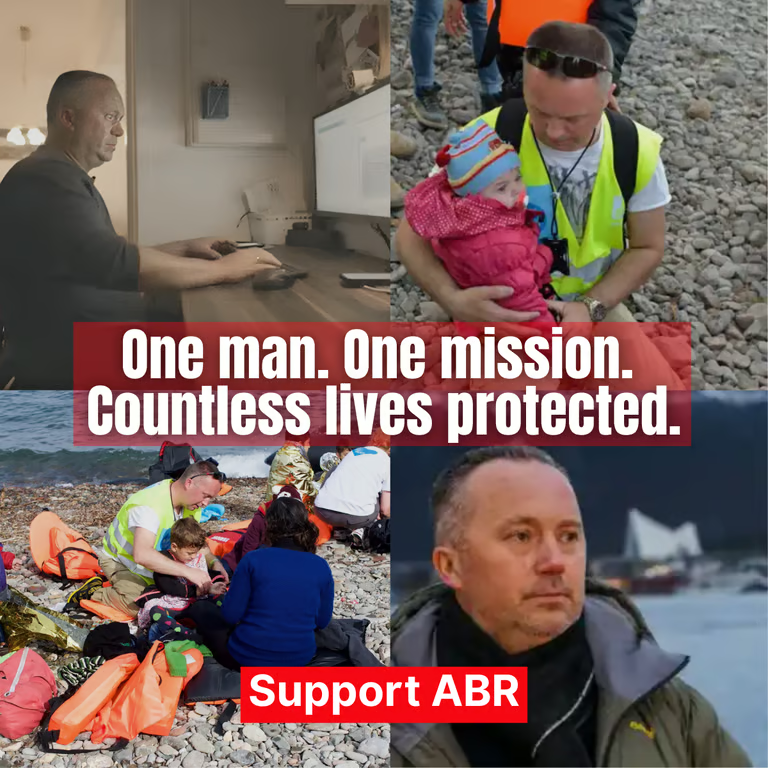
Every contribution helps us continue this work.
Thank you for your continued support and solidarity ❤️