
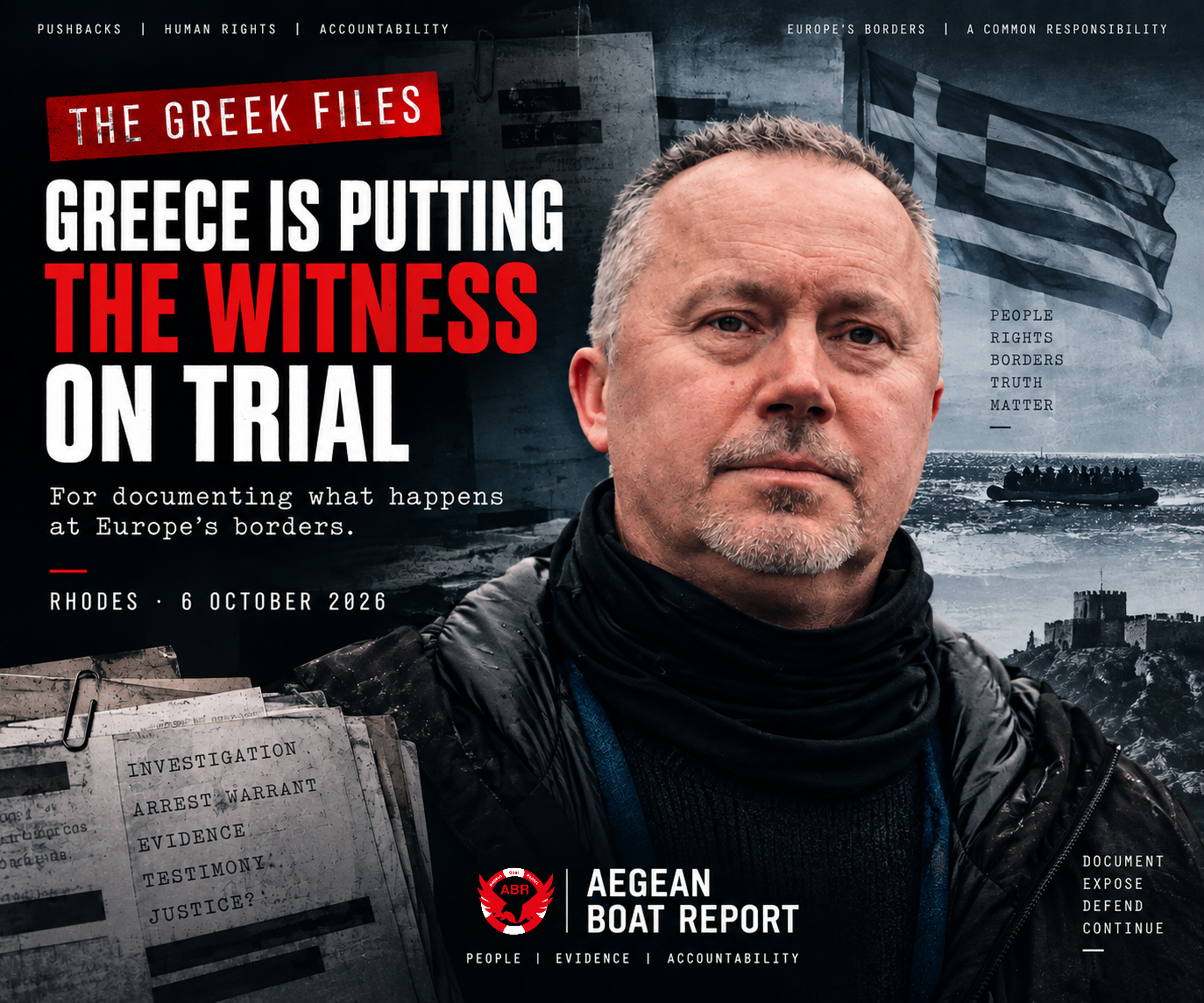
For documenting what happens at Europe’s borders.
On 6 October, I am due to face criminal proceedings on the Greek island of Rhodes.
I face three charges:
• Establishing and participating in a criminal organisation.
• Facilitating the unlawful entry into Greek territory of third-country nationals without the legally required border checks, jointly, in respect of multiple persons, for profit and on a professional basis.
• Facilitating the unlawful stay of third-country nationals in Greek territory, in respect of multiple persons and for profit.
I deny the charges.
For almost nine years, my work through Aegean Boat Report has been to document what happens to people at Europe’s borders.
We have documented arrivals, people in distress at sea, disappearances, pushbacks and human-rights violations. We have tried to ensure that people do not simply disappear at a border where independent documentation and accountability matter.
That work has repeatedly challenged official accounts of what happens at Greece’s borders.
Now I am the person facing prosecution.
The witness on trial
The headline of this campaign is deliberate: “Greece is putting the witness on trial.”
When I use “Greece” in this context, I am referring to the Greek state authorities responsible for bringing and pursuing this prosecution. I am not referring to the Greek people, civil society, journalists, independent institutions or the court that will hear the case.
The court did not initiate this prosecution. Its responsibility is to examine the case and determine the outcome according to law, and I respect that independent role.
I use these words because for years I have witnessed and documented pushbacks and human-rights violations at Greece’s borders. Now I am the person facing criminal prosecution.
Arrested in Norway
The case did not remain inside Greece.
A European Arrest Warrant was issued against me. On 16 March 2026, Norwegian police arrested me at my home in Tromsø.
Greece asked Norway to surrender me.
On 15 May 2026, the Hålogaland Court of Appeal refused.
That decision did not acquit me of the Greek charges, terminate the Greek proceedings or determine what the Greek court must decide. But it is a central part of this story.
Amnesty International reported that the Norwegian court confirmed that the actions for which I am prosecuted in Greece are not punishable under Norwegian law and that the charges represent “a real risk of violation of his freedom of expression.”
The Greek prosecution nevertheless remains in place.
International concern
The concerns surrounding this case are not mine alone.
The UN Special Rapporteur on the situation of human rights defenders, Mary Lawlor, expressed deep concern about my arrest. Human Rights Watch reported that on 19 March she said the charges appear to be “in direct retaliation” for my work and form part of a “long-standing and well-documented repression” of human-rights defenders in Greece. On 25 March, a joint communication by five UN Special Procedures mandates to the Greek Government specifically identified me as a human-rights defender and founder of Aegean Boat Report, and raised concerns about increased restrictions on civic space and the environment for defending the rights of refugees, migrants and asylum seekers in Greece.
Amnesty International has said that the charges are not backed by evidence and stem from Greece’s misuse of anti-smuggling legislation. Human Rights Watch has criticised the prosecution and, after the Norwegian ruling, called on Greece to revoke the warrant and drop the charges.
The Observatory for the Protection of Human Rights Defenders, a partnership of OMCT and FIDH, has addressed the case under the headings of arbitrary detention, judicial harassment and transnational repression.
Fair Trials has raised concerns about the use and proportionality of the European Arrest Warrant in my case and has placed it within a wider pattern of criminalisation of human-rights defenders.
These are the independent assessments and concerns of the UN experts and organisations cited above. They are not findings of the Greek court.
Why I am speaking now
I will not use this campaign to publish evidence from the Greek criminal file or to argue individual pieces of evidence on social media before the trial. That belongs in the legal process.
But the existence of that process does not mean the wider questions should disappear.
The history and nature of this case raise serious concerns that the prosecution is connected to Aegean Boat Report’s documentation of pushbacks.
I believe this prosecution is politically motivated. That is my assessment, not a finding I attribute to the Norwegian court or to the Greek court.
The issue is larger than one person or one organisation. It concerns the space available in Europe for people who document what states do at their borders.
What happens when the person documenting human-rights violations becomes the accused?
On 6 October, the Greek court is due to consider the case.
Until then, THE GREEK FILES will explain the history of the prosecution, the significance of the Norwegian judgment and the wider concerns surrounding the criminalisation of human-rights work.
The court will decide the case. The public should be able to understand how we arrived here.
Tommy Olsen
Founder, Aegean Boat Report
Media enquiries and further information:
contact@aegeanboatreport.com
aegeanboatreport.com