

The EU’s official ‘border agency’ Frontex has once again been proven to have taken part in illegal pushbacks in Greece.
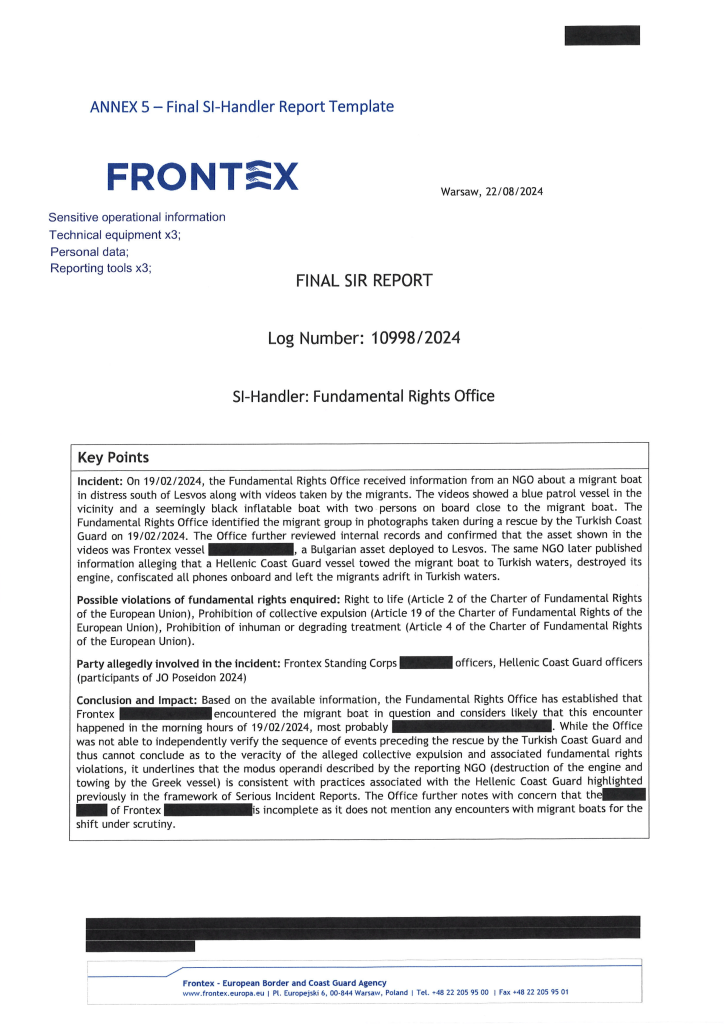
A newly released Serious Incident Report (SIR) by Frontex’ own Fundamental Rights Office, details a pushback performed in February by the Greek coast guard, assisted by Bulgarian Frontex, outside Lesvos.


In previous cases where Frontex vessels have been investigated by the Fundamental Rights Office, their crew have at least admitted being on location, stopping boats carrying refugees inside Greek territorial waters, and handing them over to the Greek coast guard before leaving the scene.


But in this case, the captain of the Bulgarian Frontex vessel ‘Balchik’ straight out lied when questioned in the Fundamental Rights Office’s Serious Incident Report investigation.
At first light on 19 February this year, a boat carrying 37 people, 13 of them small children, ended up in distress in Greek waters south east of Plomari, Lesvos south.

The first vessel on scene the Bulgarian coast guard’s ‘Balchik’, funded by the EU Internal Security Fund to be stationed on Lesvos as part of the European Border and Coast Guard Agency Frontex’s Operation Poseidon.
Despite this, and despite his vessel being caught on video taking part in the pushback, the boat’s captain denied it was there, and denied that they had any encounter with migrant boats during their 19 February shift.
He did admit that the blue vessel shown in the video was the ‘Balchik’ – he had little choice – but he claimed, falsely, that the video was taken at an earlier time, during another operation in the area. He also claimed that the rigid hulled inflatable boat (RHIB) in the video looked similar to the one carried by the ‘Balchik’, but was not theirs.

This was an extraordinary claim, not least because the RHIB in the video was carrying the Bulgarian coast guard’s Ensign. It’s very clear that the Bulgarian coast guard is lying to cover up a crime committed in cooperation with its Greek equivalent.

As is always the case, the Greek coast guard itself denied everything. It claims that: ‘The allegations are not confirmed,‘ (they are). ‘Moreover, the alleged practice does not correspond to the operational procedures of the Hellenic Coast Guard,’ (anyone who pays even the slightest shred of attention to the Hellenic Coast Guard knows very well that it corresponds to its operational procedures very closely). ‘Nor does it reflect the procedures followed for the management of incidents involving third country nationals in the area of its jurisdiction.’ (ditto).
We had expected nothing less than a total denial of this kind, as this is what the Greek Coast Guard does in all cases, even when the evidence against them is – as in this case – absolutely overwhelming.
We investigated this case, and found that there was absolutely no question who was involved or who was responsible, we published our findings on 19 May this year.

This case was also featured in the documentaries, “Dead Calm, Killing in The Med”, and “Das Frontex-Dilemma”.


One reason we knew what was happening in this case was that Aegean Boat Report was in direct contact with the refugees on board the rubber boat on that morning, 19 February. We informed and provided all necessary documents to Frontex’ Fundamental Rights Office on the same day.


On 8 March, the Office launched a Serious Incident Report (SIR 10998/24) investigation, to “clarify the circumstances and the potential role of the Frontex assets and crew in the incident.”
Their findings and conclusion were crystal clear: the group of 32 people was illegally and violently pushed back from Greek territory waters, and it’s proven without any doubt that the Bulgarian Frontex vessel ‘Balchik’ was involved.
The investigation found that ‘Balchik”s captain falsified his mission report on return to shore, leaving out the encounter with the boat carrying refugees deep inside Greek waters, to cover up their involvement, and the crime committed by their Greek counterparts.
The Office’s report states: “Correct and complete operational reporting is essential to the proper functioning of Frontex joint operations to ensure accountability and enable follow-up, particularly in a context where reports of alleged fundamental rights violations are frequent.
“Against this backdrop, the Fundamental Rights Office notes with concern that the mission report from the captain of the Bulgarian Frontex vessel ‘Balchik’ is incomplete, as it does not mention any encounters with migrant boats in the shift under scrutiny.
“Officers of the ‘Balchik’ repeatedly stated they have no recollection of such encounter despite having confirmed earlier that the vessel shown in the footage is theirs.”
We do not know Bulgarian law, but we would be surprised if falsifying official documents is legal in Bulgaria. It certainly is not elsewhere in the EU, and we cannot help but wonder whether ‘Balchik”s captain will be charged for his crime, even as we fear he will instead be more likely to receive recommendations and a medal for a ‘job well done’.
The simple reality, confirmed by the Frontex Fundamental Rights Office, is that the refugees’ boat was in Greek waters. They were intercepted, their lives were put at risk by the Greek coast guard, they were subjected to a prohibited collective expulsion, and both Frontex and the Greek coast guard deliberately covered up their crime by filing incorrect and incomplete information in their mission reports.
These Frontex reports are not publicly available, but it is of utmost importance that what they contain – proof and clear statements of lawbreaking by publicly funded uniformed services – is seen by the world. They are in the public interest, and we have again decided to publish the entire report.
This report proves again that Greek authorities, supported by Frontex, are involved in and responsible for human rights violations in the Aegean Sea.
We must ask: will Frontex’ head Hans Leijtens finally take responsibility? He promised when he took office, replacing the disgraced Fabrice Leggeri, now somehow a member of the European Parliament despite having been forced to resign in shame having broken international law as head of Frontex, to govern the agency’s work with three principles: accountability, respect for fundamental rights, and transparency. He has failed, miserably.

We wonder if Leijtens will, since he said he was responsible for the agency’s activities, actually, take responsibility for its illegal acts, performed by its officers under Operation Poseidon. Will he resign from his well-paid post as head of Frontex?
At the absolute best, Leijtens has made no significant changes at Frontex, and created zero meaningful improvements. In the most flattering of all possible lights, he is nothing more than a puppet doing the EU Commission’s bidding. He is a bad reflection of Leggeri; perhaps in new wrapping, but containing the same poison Fabrice always had.
Leijtens is far from the only person of whom questions must be asked, however.
It is clear that the Greek government is insufficiently honest to admit its serial law-breaking, but we must also ask when the European Commission will take seriously its responsibility for the rule of law and fundamental rights in Europe?


We demand the Commission immediately launches infringement proceedings against the Greek government for systematic and widespread human rights violations, and we demand the cessation of all Frontex operations in Greece, in accordance with article 46 of the Frontex regulation.
We must also note that this case – and the few others like it – are only the tip of the iceberg. It is only when organisations can present solid data on pushbacks that the Fundamental Rights Office will even investigate incidents, let alone declaring guilt.
But the cases where evidence has been presented have resulted in a series of confirmations of Frontex involvement in illegal pushbacks from Greece: it is extremely clear that Frontex is deeply involved in human rights violations.
The case also highlights another worrying reality.
There are very few organisations – perhaps only one – which takes the time to document these cases properly, and share its findings in detail with the publick.
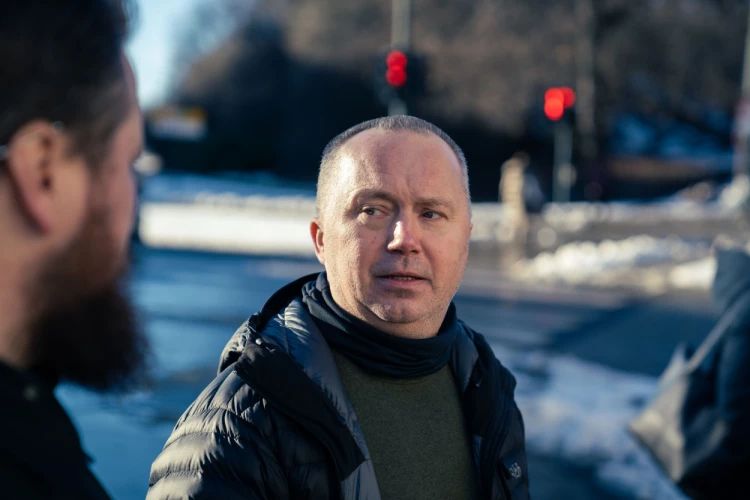
It’s actually dangerous, as the founder of Aegean Boat Report has discovered. Those who seek and dare to report the truth are targeted by Greek authorities, who go to extreme lengths in their efforts to try to silence their critics.
If Aegean Boat Report hadn’t brought this, and many previous, cases to the attention of the FRO, they would never have been investigated.
If this organization hadn’t for years documented and pushed these cases to journalists, the attention paid to these crimes would have been far less.
But Aegean Boat Report, which has worked tirelessly and systematically, contributing an exceptional amount of the light shed on the Greek government’s astonishing human rights violations in the Aegean Sea, is regarded an outcast in the humanitarian community, without any official support from organisations working on the ground.
Due to systematic targeting by Greek authorities, we are now also without financial support, and in imminent danger of being forced to close down.
Who will pick up the ball if we close down?
Most likely nobody.
Who would benefit most?
Definitely not the people on the move.
This is where we are heading.
Aegean Boat Report is currently running on fumes. We cannot continue to do our work without your help.
To support our work and help us continue saving lives in the Aegean, please donate through PayPal by clicking on the link below 👇

Thank You for Your Support.