
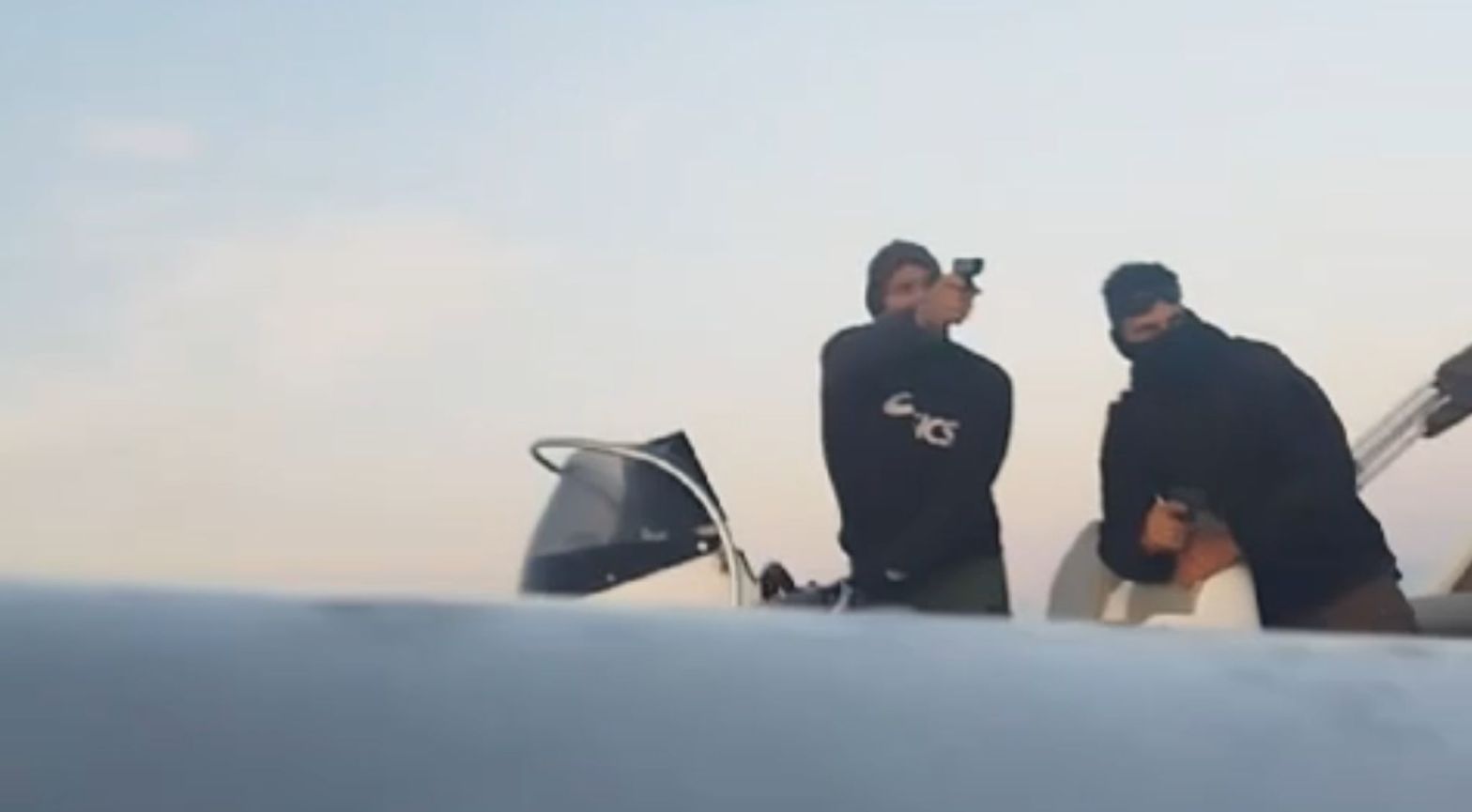
This summer, the Greek Coastguard has escalated its illegal and vicious violence against people travelling to seek safety, by opening fire on boats carrying men, women and children, including shooting one man dead.
How much more has to happen, and for how long, before the EU pays attention, and takes action against this horrifying practice?
For many years, people of different nationalities and from all walks of life, have tried to reach safety in Europe by crossing from Turkey to Greece’s Aegean Islands, in flimsy rubber boats.


The trip might appear easy: the distance from Turkey to the islands is in some places only a few kilometres. But there are many hidden dangers lurking, and most of them are not due to the often treacherous sea.


In the last five years, countries who have experienced huge increases in arrivals of refugees, including Spain, Malta, Italy and Greece, have tried different methods – some legal, most absolutely illegal – to reduce arrivals to their shores. In many cases, this has resulted in more people dying in the attempt to reach Europe.
On land, countries wishing to break the law believe fences and walls can be efficient, despite the clear failures of ‘the wall’ former US president Donald Trump claimed he would build. At sea, they aren’t even an option.

The solution hit upon by governments of coastal countries when they wish to break the law, is to turn boats carrying people seeking protection in Europe, around at sea, towing boats out of their waters, removing people after they have arrived on land, placing them in life rafts at sea, refusing to rescue boats carrying refugees in distress in their SAR Zones, taking legal action against rescue boats and banning them from operating, and providing dictatorships and even failed or failing states like Libya with funding and equipment to stop people from leaving the country.
There are deals the European Union has made to prevent people moving, including funding the so-called Libyan coast guard (in practice, as the EU is well aware, nothing but a sea-militia armed and equipped by the EU), the EU-Turkey deal, and numerous deals with African countries.


The simple fact is that people’s right to leave their country if they are in or believe they may soon face danger is not considered important. What the EU believes is important is that those people must be prevented – including by breaking the law – from arriving on EU soil.
Article 13.2 of the Universal Declaration of Human Rights states: “Everyone has the right to leave any country, including his own, and to return to his country… in accordance with UN human rights practices”.

Its Article 14 states: “Everyone has the right to seek and to enjoy in other countries asylum from persecution.”
The 1951 Refugee Convention, of which every EU rule related to people movement opens by claiming not to be in any way in contravention, defines refugees as: “(any person who) owing to well-founded fear of being persecuted for reasons of race, religion, nationality, membership of a particular social group or political opinion, is outside the country of his nationality and is unable or, owing to such fear, is unwilling to avail himself of the protection of that country; or who, not having a nationality and being outside the country of his former habitual residence as a result of such events, is unable or, owing to such fear, is unwilling to return to it.”

And in its address to the United Kingdom government regarding the right to asylum under the law (UNHCR: UNHCR Observations on the New Plan for Immigration policy
statement of the Government of the United Kingdom, May 2021), UNHCR, the world authority on refugee rights and the law relating to people seeking safety, noted: “The right to seek and enjoy asylum does not depend on the (means by which) an asylum-seeker arrives to a country. In reality, asylum-seekers are often forced to arrive at or enter a territory without prior authorisation.
“In order to meet their obligations under the 1951 Convention, States are required to grant individuals seeking asylum access to their territory and to fair and efficient procedures, before taking action to effect their removal.”
These are laws signed up to by every EU member state – indeed, by almost every state in the world.
Nowhere in these laws is there a provision that allows government-employees or anyone else to beat, rob from, sexually assault, torture, or forcibly push back people attempting to reach safety: these are illegal acts, which the Greek Coastguard has been carrying out for more than four years.
And certainly, these laws do not contain a provision allowing the firing on boats carrying men, women and children trying to reach safe places to live.
Yet that is precisely what the Greek Coastguard has been doing for the last three months: starting in May this year, it has four times opened fire on boats carrying men, women and children who have broken no law and are exercising their legal right to travel to seek safety.
The EU and its member states have, in the last decade, made a grave out of the Mediterranean – the sea the Romans once called ‘Mare Nostrum’ – ‘our sea’.
IOM’s Missing Migrants projects lists at least 28,000 people as having drowned in the Mediterranean trying to reach Europe since 2014. At least some, and arguably a very large proportion, of these deaths are directly linked to national authorities failing to carry out search and rescue efforts, and carrying out illegal pushbacks.
There are simply – and shamefully – far tragedies involving people on the move in ‘Our Sea’ to list here.
But some of the major ones include:
- In March 2009, more than 200 African people drowned after their boat sank off the coast of Libya
- In October 2013, 366 people, mostly Eritrean, died when their boat caught fire and sank near Lampedusa
- In August 2014, around 170 people were feared dead after another boat sank off Libya
- In September 2014, more than 500 people died after their boat sank off the Malta coast
- In June 2023, more than 650 people died off the coast of Pylos, Greece, after the Greek authorities tried to tow an overcrowded fishing vessel into the Italian SAR Zone

These large shipwrecks get huge coverage by the international press, but this attention does not last: most are never properly investigated, and are soon forgotten. They and those killed within them become just another number in the statistics, in the list of the dead in Our Sea.
And those are the large disasters.
Most shipwrecks are small, and are never investigated, nor mentioned by the press. It is an inescapable fact that they have become ‘normal’, just another shipwreck, killing just another group of people the EU and its members states do not want, and do not want us even to think of as people.


And in the last three months, specifically at the hands of the Greek Coastguard, violence towards people seeking protection in Europe has escalated even further.
It’s no longer enough, it seems, for the Coastguard (seldom has a title been so poorly-deserved) to push them back and leave them helplessly drifting at sea, now it seems to be ok to open fire on men, women and children.
In the last three months, there have been at least four shootings by the Greek coast guard against boats carrying refugees, sending several people to hospital, and killing one.


These incidents were:
- On May 30, the Greek Coastguard fired against a boat carrying 25 refugees outside Chios, claiming the boat was manoeuvring dangerously. One person ended up in hospital with gunshot injuries. No official information was provided by the coast guard
- On July 5, the Greek Coastguard opened fire on a boat carrying 24 people outside Chios, claiming that the boat refused to stop, and was manoeuvring dangerously. In this case, the smuggler onboard returned fire, before heading back towards Turkey.
- On July 20, the Greek Coastguard opened fire on a boat carrying 15 people outside Chios, claiming that the boat refused to stop, and was manoeuvring dangerously. One person was transported to hospital with a bullet wound. The Greek Coastguard issued a press release in which it left out the shooting altogether
- On August 23, the Greek Coastguard opened fire against a boat carrying refugees outside Simi, claiming the boat refused to stop, and was manoeuvring dangerously. The Coastguard’s shooting killed one man, who was shot in the head by the armed officers
As you will have noted, in every one of these cases, case the Greek Coastguard has claimed the boats carrying refugees have “manoeuvred dangerously”, putting their (the Coastguard) vessel “at risk”.

It is unfortunate that the Greek Coastguard has earned itself such a reputation for, let us say “misleading people about events in which it has been involved”, because it appears the agency is now demanding that we simply take its word as truth on each of these shootings.
Because although the Greek Coastguard has a legal responsibility to get everything on video, so that what it does is documented in case something goes wrong, in every incident of the Coastguard shooting at boats carrying refugees, and the men, women and children inside them, all its video equipment seems to have been malfunctioning.
This is very unfortunate.
The Greek Coastguard has not provided one single piece of evidence that boats carrying refugees, which the Coastguard has opened fire on, have been “manoeuvring dangerously”.
In fact, the videos that do exist, and Frontex investigations, show that it’s the Greek Coastguard vessels which are manoeuvring dangerously, putting the lives of refugees at risk.
And sadly, the Greek media has been seemingly happy to back the Coastguard in its misreporting of these events.
In the August 23 incident, in which the Coastguard shot a man in the head and killed him, it claimed – entirely without evidence – that “a smuggler” tried to sink their vessel, and so they were acting “in self-defence”.
The Coastguard did not explain how a rubber boat could possibly sink a coast guard vessel, which seems… difficult, to say the least.
In its broadcast regarding the killing, Greek national media, including Star News, used background footage not of the incident in which the man was killed, but footage from the July 5 incident off Chios, in which a people-smuggler returned fire at the Coastguard. Star never once mentioned that the video was from a totally different case, instead leaving the viewer to consider that perhaps the killing of the man at Simi – or at least the Coastguard’s claim of ‘self-defence’ – was somehow justified.
To back the Greek Coastguard, the news media deliberately misled their viewers: less ‘informing’ and more ‘misinforming’ the Greek public.
In most of the four incidents, the Coastguard claimed it was only firing warning shots in safe sectors, or shooting to disable the engine, as a last resort in self-defence.
But as we already noted: what kind of danger could a rubber boat carrying men, women and children possibly pose to a Coastguard vessel?
And to try to hit a small engine from a distance without hitting people sitting next to it would take an excellent marksman, using a sniper rifle. But the Coastguard is using handguns and assault rifles, ‘aiming at’ a very small target on a moving rubber boat, while the shooter is standing also on a moving vessel. It’s basically impossible to safely make such a shot. Yet, they are ‘attempting’ it.
To open fire on a boat filled with men, women and children, just because they refuse to stop, or there is a smuggler suspected to be onboard, shows a total lack of respect for human lives: extreme, illegal, violent and murderous measures by Greek authorities in the name of ‘border protection’.
And of course, it’s a new and dangerous escalation: if one side is using firearms, the other side, in this case a real smuggler, will potentially bring a gun to be able to fire back.
Law enforcement should be attempting to de-escalate potentially violent situations, to protect the lives of innocent people.
The problem is that Greek authorities have repeatedly shown, and Greek politicians repeatedly stated, that they do not see refugees as innocent. They wrongly claim – in fact pretend – that they are criminals, and openly state that they are not wanted, and can and should be stopped by all means possible.
This now appears to include cold-blooded killing.
We should also point out that on the vast majority of boats crossing from Turkey towards Greece, there are no smugglers onboard, only refugees.
In these cases, one or more refugees are ordered to drive the boat: when they arrive in Greece, they are arrested and charged with human trafficking, facing long prison sentences.
The Greek government gives every indication it believes that lying about people’s actions and identities to break the law by denying people their right to enter the asylum system, is a small price to pay for – in fact, an added bonus in – preventing people from outside Greece from entering the country.
More than 2,000 refugees are locked up in Greek prisons, because they steered a boat bringing people to safety.
Meanwhile, the Greek Coastguard has been investigated numerous times by the EU border agency Frontex for human rights violations. Greek authorities categorically deny any involvement, but the investigations have consistently found that in fact, the Greek Coastguard has consistently violated the rights of men, women and children attempting to reach Greece by sea.


These systematic crimes by the Greek authorities have been documented by EU bodies, journalists and organizations for years. Still, there has been no reaction from the European Commission: it’s as if it is still pretending these things are not happening.


In only one previous case – when the government of Victor Orban had been violently and illegally victimising and harming refugees entering Hungary – has Frontex acted on its duty to halt funding or operations or cancel a planned operation because of serious and persistent violations of fundamental rights related to its activities.
Even this came only after years of warnings and an EU court ruling.
The illegal, barbaric, behaviour of the Greek government and its employees towards people traveling to seek safety has now been ongoing for four years.
In this period, Frontex’ Fundamental Rights Officer (FRO), Jonas Grimheden, has repeatedly called for the agency to suspend operations in Greece due to systematic violations of fundamental rights. His calls have so far not been acted upon.


And in fact, nothing whatsoever has been done.
The EU Commission behaves as if it knows nothing, while the EU Parliament’s EPP group, to which Greece’s governing Nea Dimokratia party belongs, pretends there is nothing to know.
This summer, the Greek Coastguard added to its record of killing people by illegally pushing them away from Greece, or illegally pulling them into another country’s Search and Rescue Zone, the killing of people seeking safety by shooting them.
There is no justification for the EU sitting back and doing nothing about this. But if it needs a justification to act to end this disgusting practice – other than the obvious, that human life is sacred and must be our prime priority – it should consider this: if gunfire is normalised against people fleeing for their lives, how soon will it be normalised for those people to respond in kind?
The Greek government, and the Coastguard it uses as an attack-force against civilians exercising their legal rights, is creating a fire-fight on the Mediterranean. It is a chapter we – the EU Commission included – must prevent being opened in Our Sea.