When people documenting what states do at Europe’s borders face criminal investigation and prosecution, the consequences extend far beyond the individual defendant.
My case is not only about what happens inside one courtroom on Rhodes.
It raises a wider question about the space available for human-rights defenders, journalists, lawyers, volunteers and organisations documenting what states do at Europe’s borders.
For years, Aegean Boat Report has documented pushbacks and human-rights violations in the Aegean.
That work has included documenting people who arrive on Greek islands, people in distress at sea, people who disappear after reaching Greek territory, and people who are later found back in Turkey or at sea.
It has also meant challenging official accounts and providing documentation to journalists, lawyers and human-rights organisations.
A wider concern
The concerns surrounding this case did not begin with my arrest in Norway, and they are not mine alone.
For years, international human-rights bodies and organisations have raised concerns about the treatment and criminalisation of people working on migration and human rights in Greece.
The UN Special Rapporteur on the situation of human rights defenders, Mary Lawlor, reported after visiting Greece that human-rights lawyers, humanitarian workers, volunteers and journalists working on migration had faced smear campaigns, threats, attacks and misuse of criminal law.
More recently, a joint communication by five UN Special Procedures mandates specifically identified my case while raising concerns about restrictions on civic space and the environment for those defending the rights of refugees, migrants and asylum seekers in Greece.
Human Rights Watch has described the case against Panayote Dimitras and me as part of a wider pattern of prosecutions affecting people working with refugees and migrants.
The Observatory for the Protection of Human Rights Defenders, a partnership of OMCT and FIDH, has addressed my case under arbitrary detention, judicial harassment and transnational repression.
Fair Trials has also raised concerns about the European Arrest Warrant issued against me and about a wider pattern affecting human-rights defenders documenting violations at Europe’s borders.
And yesterday, Amnesty International issued perhaps its clearest assessment of the case so far.
Amnesty said the criminal charges against Panayote Dimitras and me are a “gross misuse of anti-smuggling legislation” and “are not backed by evidence.” It said we are being targeted for our work documenting serious human-rights violations against refugees and people on the move.
Amnesty went further.
It said that, for the first time, human-rights workers in Greece are being referred to trial for helping people access asylum procedures, and described construing such activity as “smuggling” as a distortion of international and domestic law.
Based on the information available to it, Amnesty said there is no indication that our work went beyond legitimate activities assisting people in exercising their human rights and documenting what was happening.
Amnesty International’s full statement can be read here:
Greece: Human rights defenders Tommy Olsen and Panayote Dimitras on trial for their work supporting refugees and migrants


These are independent organisations’ assessments. They are not findings of the Greek court.
The Greek prosecution maintains that the conduct amounts to serious criminal offences. The Greek court has not yet determined the charges.
My assessment
I believe this prosecution is politically motivated.
I also believe the history and nature of the case raise serious concerns that the prosecution is connected to Aegean Boat Report’s documentation of pushbacks.
Those are my assessments. I do not attribute them to the Norwegian court, and I do not present them as findings of the Greek court.
But there is now a much bigger question than what I personally believe about my prosecution.
What happens when documenting what states do at their borders carries the possibility of years of criminal investigation, arrest warrants, restrictions and ultimately a criminal trial?
The consequences do not stop with the people who are prosecuted.
Other people see what happens.
Other organisations calculate the risk.
Other witnesses decide whether speaking publicly is worth it.
And that is precisely why the wider context matters.
6 October
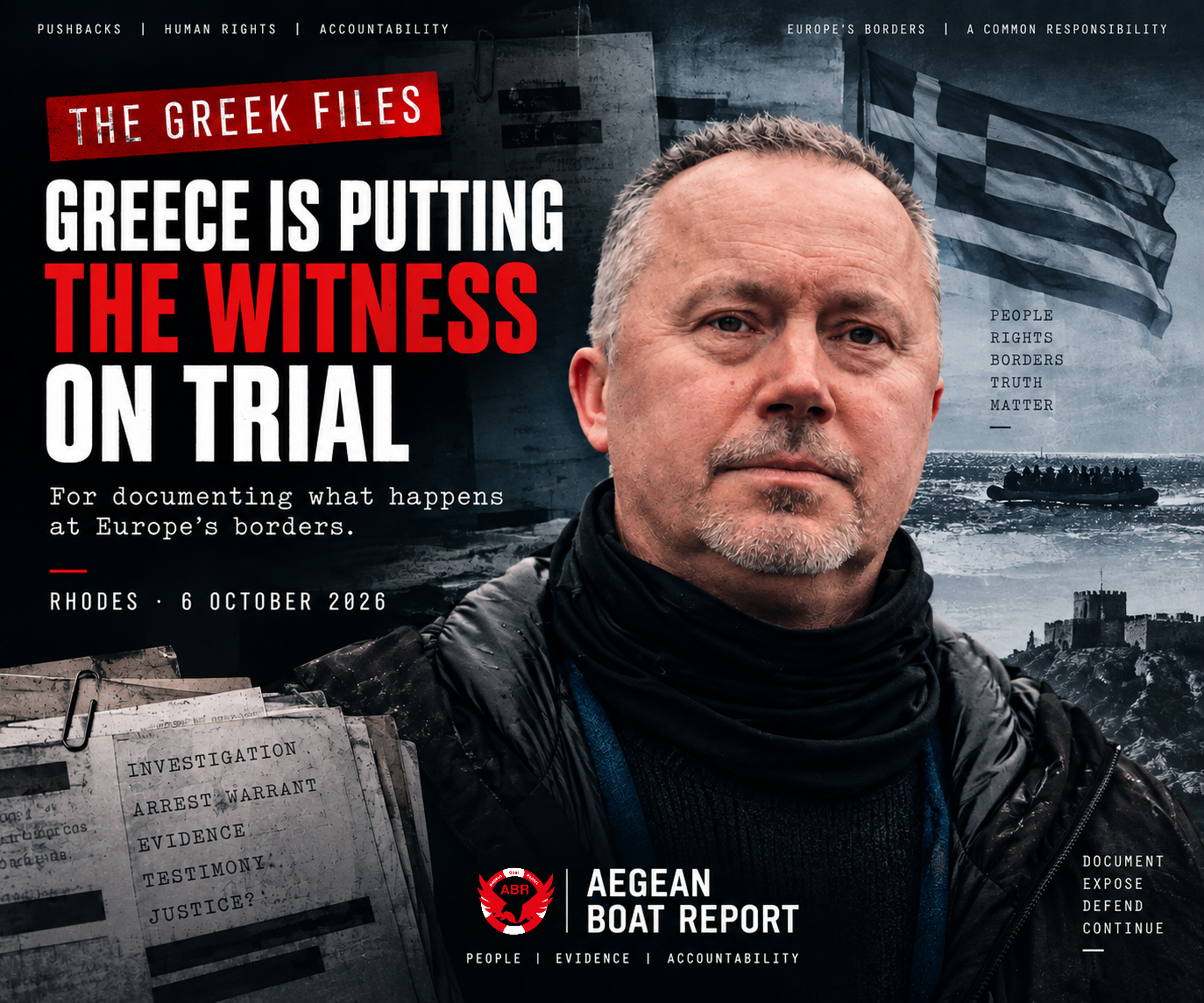
On 6 October, Panayote Dimitras and I are due to stand trial on Rhodes.
According to Amnesty International, if convicted, we face up to 20 years in prison.
I respect the role of the Greek court. It did not initiate this prosecution, and it is for that court to consider the case. I will not attempt to litigate the evidence here.
But whatever happens inside that courtroom, the question raised by this prosecution will remain:
How much space does Europe leave for those who document what happens at its borders?
THE GREEK FILES exists to ensure that question is not lost.
🔗 Defending myself in Greece costs money. If you want to help, you can support my legal defense here: