

While much of the world’s attention is focused elsewhere, Greek authorities continue their inhumane and illegal treatment of people seeking protection from war and persecution in the Aegean Sea.
Over the past six years, Greek authorities have pushed back more than 100,000 people. Some were intercepted at sea inside Greek territorial waters, others had already reached one of the Greek islands. Men, women and children who had escaped war and persecution were violently denied their fundamental right to seek asylum.


During the same period, Greek authorities have been responsible for kidnapping more than 30,000 people from the Greek islands, taking them back out to sea, forcing them into inflatable life rafts and leaving them helplessly drifting. There have been no genuinely independent investigations, no infringement procedures, no sanctions and no accountability.
Everyone knows this has been happening. It has been documented for years by journalists, NGOs, lawyers, international organisations and even official institutions. Yet Europe continues to look away.
Over the last six years, 1,750 life rafts have been found drifting in the Aegean Sea carrying men, women and children—not because of shipwrecks, but because they had been abandoned there following illegal pushbacks by Greek authorities.
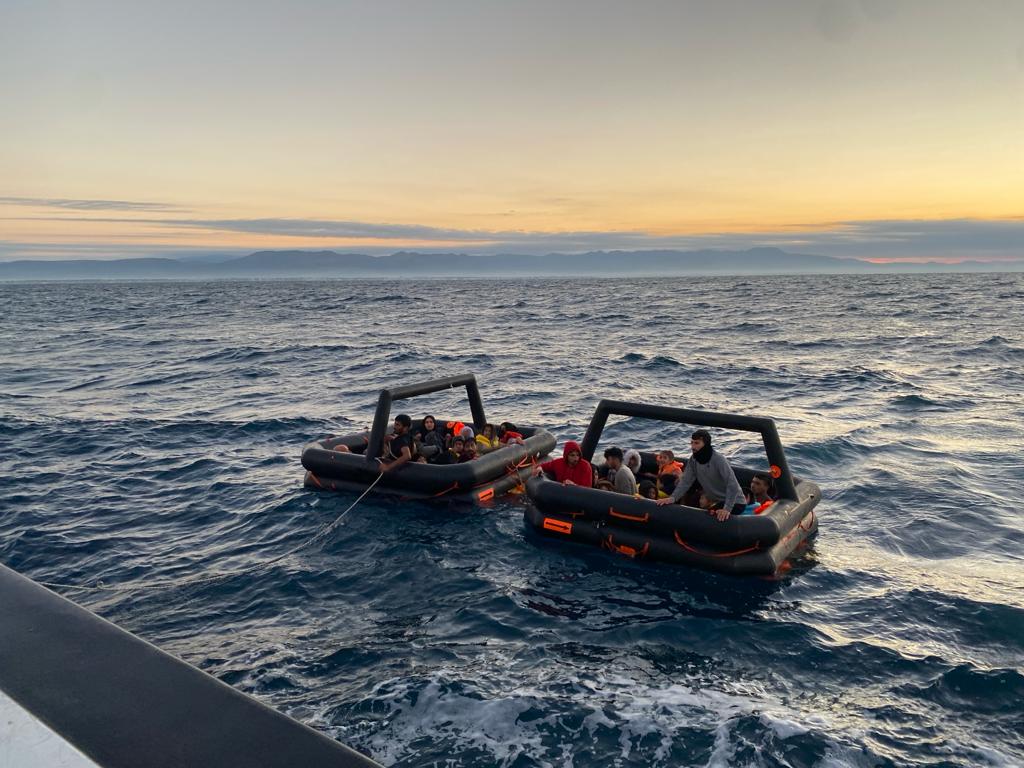
On the evening of 2 August, another 36 people became the latest victims.
⸻
At 17:00, a group reported to consist of 36 people—18 men, 10 women and 8 children—contacted Aegean Boat Report after arriving on the Greek island of Giali.


The group immediately provided pictures, videos and live location data proving beyond any doubt that they had reached Greek territory. Giali is a very distinctive volcanic island whose unique landscape makes it impossible to mistake for anywhere else.


Giali lies between Kos and Nisyros. Apart from workers connected to the island’s pumice mining operation, almost nobody lives there.
There is no accommodation, no organised reception facilities and virtually no permanent population. The only lawful course of action when people arrive on Giali is for the authorities to transport them to the Closed Controlled Access Centre in Makrygianni on Kos, where they can register their asylum claims in accordance with Greek, European and international law.
We advised the group to walk towards the island’s small port and make their presence known if they encountered anyone. On an island like Giali there are very few alternatives.
After some discussion the group agreed.
At around 20:00, they met two men who gave them water and contacted the authorities. At that point everything appeared to be unfolding exactly as it should.
About an hour later, a vessel identified as Greek Coast Guard LS-1133 arrived at the port.
The group found it unusual that the five men on board were not wearing official uniforms, but instead civilian clothing consisting of T-shirts and shorts.

At 20:59, we received the final message from the group.
“They are taking our phones. What should we do?”
Seconds later, every phone we had been communicating with went offline.


⸻
Had the authorities followed the law, the group would have been transported to Kos and registered at the Closed Controlled Access Centre in Makrygianni.
That never happened.
According to the official arrival figures published by the Greek authorities the following day, 3 August, arrivals were recorded only on Lesvos and Ikaria. No arrivals were registered on Kos or any other nearby island.

We know the group was on Giali. That is thoroughly documented.
We know Greek Coast Guard vessel LS-1133 arrived on the island. The refugees documented its arrival with photographs and video.
We know the group’s phones went offline immediately after they reported that officers were confiscating them.
And we know what happened next.
Shortly before midnight, the Turkish Coast Guard rescued two life rafts carrying all 36 people drifting off the coast of Datça, Turkey.

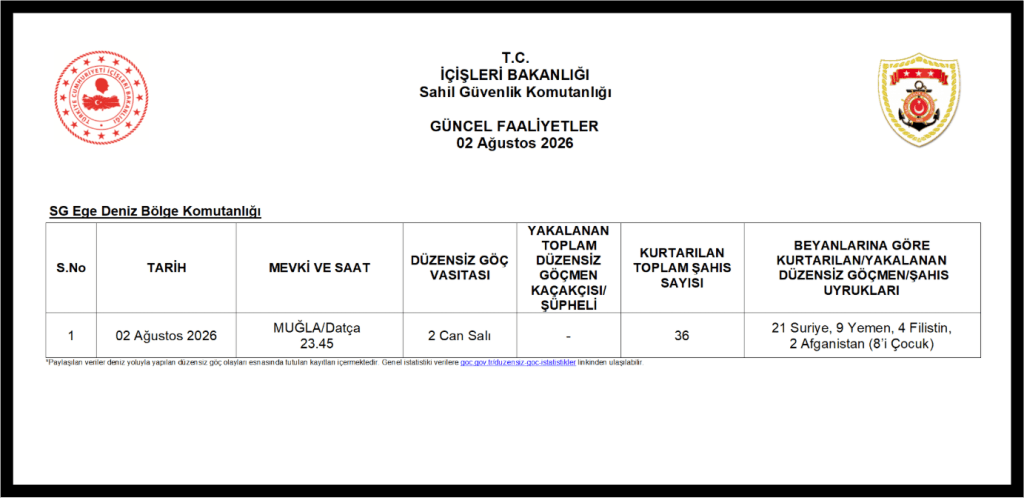
The pictures and videos released by the Turkish Coast Guard leave no room for doubt.

They are the exact same men, women and children who had safely reached Giali only hours earlier.
⸻
So how did 36 people disappear from a Greek island and end up drifting in two life rafts in Turkish waters only a few hours later?
Perhaps there is an innocent explanation.
Perhaps 36 exhausted people—including eight small children—voluntarily abandoned the safety of Greek territory, climbed into two orange inflatable life rafts in the middle of the night, carefully switched off every phone at exactly the same moment, and somehow drifted across the Aegean before being rescued by the Turkish Coast Guard.

That explanation would require considerably more imagination than simply accepting the evidence already before us.
The obvious question is not whether these people disappeared.
The obvious question is:
Who removed them from Greek territory, who placed them into life rafts, and under what legal authority?
International refugee law, the European Convention on Human Rights and the Charter of Fundamental Rights of the European Union are all clear. People who reach Greek territory have the right to seek asylum and to have their claims examined individually. Collective expulsions are prohibited, and people cannot lawfully be removed without due process.
If Greek authorities believe their actions on Giali were lawful, they should have no hesitation in welcoming a genuinely independent investigation, preserving and disclosing all operational records, vessel logs, AIS data, communications and any available video recordings.
If they cannot explain how 36 people disappeared from a Greek island only to reappear hours later drifting in life rafts in Turkish waters, then the evidence points towards only one conclusion.
Another illegal pushback.
Another 36 people denied their fundamental rights.
Another case added to the long list that Europe continues to ignore.
History will eventually judge what happened in the Aegean Sea.
The question is whether Europe intends to uphold the rule of law before history delivers its verdict.
In this report, the faces of the adults have not been obscured because their identities form part of the evidence documenting that the same group who arrived on Giali were later recovered by the Turkish Coast Guard after being found drifting in life rafts. We have carefully considered the privacy implications before publishing this material.